
Triggered: Why Your Reaction Doesn’t Match The Moment
Are you doing the Yap Challenge? Have you prepared for your Netflix documentary yet? Perhaps you’ve been too busy compiling a list of things that are worth every penny, deciding whether to get a bob or informing Instagram that something is kinda chic.
Or perhaps you’ve watched some of these things appear on your feed for the 847th time and felt an entirely disproportionate urge to throw your phone into the sea.
Triggered.
Except… probably not.
Annoyed? Yes. Irritated? Quite possibly. Experiencing second hand embarrassment so intense you’ve had to look away from the screen? Absolutely. But triggered?
We’ve become very fond of that word. Someone disagrees with us and we’re triggered. A trend gets on our nerves and we’re triggered. Something makes us cringe and we’re triggered. But being triggered isn’t the same as being annoyed, offended, uncomfortable or simply having had quite enough of Instagram for one day.
Sometimes your nervous system isn’t revealing a deeply buried wound. Sometimes you’ve just had enough of the Yap Challenge.
So What Does Being Triggered Actually Mean?
A trigger is something happening now that activates an emotional response learned then. And the trigger itself can seem ridiculously small.
The particular rhythm of somebody's keys in the door and knowing already what kind of evening this is going to be.
A door that closes too quietly. Not slammed. Quietly.
"Can I have a quick word?"
Someone standing slightly too close behind you while you're at the sink.
A raised voice two gardens away that has nothing to do with you at all.
The silence of somebody deciding not to say something.
Being shown unexpected kindness.
A smell you couldn't name, although your stomach identified it instantly.
You might even be thinking, why on earth am I reacting like this? Because consciously, you know you're okay. Your body apparently has other ideas.
What Just Happened in My Brain?
Your brain seems to work by constantly using previous experience to predict what might happen next.
If something was frightening, painful, humiliating or overwhelming, your brain learns from it. It appears to record not just what happened, but everything that was around it at the time.
So when something in the present resembles an old danger, your threat system can react before you've had time to establish whether you're actually in danger now. Your heart races. Your stomach drops. Your chest tightens. You feel hot, shaky, sick, panicky, angry or desperate to get away. Then the rational part of you arrives saying, This is ridiculous. I KNOW I’m safe. And that’s one of the most frustrating things about genuine triggers. You can know you’re safe without feeling safe.
This is also why triggers don’t always make sense from the outside. A physical sensation isn’t necessarily dangerous but if you’ve previously experienced a frightening panic attack, that first flutter in your chest can be enough for your brain to go, Oh no. Here we go again.
The Present Never Quite Gets a Fair Hearing
Here's the part that costs the most and often the most overlooked.
Your partner asks where you've been and gets an answer pitched at somebody else entirely. Someone who asked that question years ago and meant something very different by it. Your partner can feel the size of the response. He just can't work out what he's done.
Your manager says she needs a quick word and you spend the whole walk to her office preparing your defence. She wants to talk to you about the parking.
Your daughter knocks a glass over and you hear a tone come out of your mouth that you had promised yourself, specifically and repeatedly, would never come out of your mouth.
None of these people were there. They are being assessed on evidence gathered long before they met you. And they have no idea they're being assessed at all.
That's the real cost, not the moment itself. The slow accumulation of a life where the present keeps getting checked against the past, and cleared for danger, before you get to experience any of it.
If You're Constantly Triggered
If it feels like you're constantly being triggered, that's worth paying attention to. Not because you're "too sensitive" but because a nervous system that's repeatedly sounding the alarm doesn't get much opportunity to stand down.
You might find yourself constantly scanning people's faces, tone of voice, messages or behaviour. Replaying conversations. Needing reassurance. Overthinking what might happen next or feeling permanently braced for something you can't quite name.
And eventually, the fear of being triggered can become as limiting as the trigger itself. That's when anticipatory anxiety creeps in.
What if it happens again?
What if I panic?
What if I can't cope?
What if they leave?
What if I lose control?
So you start avoiding. And every time avoidance brings relief, your brain gets another little piece of evidence that avoiding the situation kept you safe. Before long, you aren't simply responding to triggers. You're organising your life around preventing them. That's when I'd recommend getting professional help.
Particularly if your reactions are affecting your relationships, work, sleep, confidence or social life. If you're avoiding things you used to do. If you're relying increasingly on reassurance or other safety behaviours. Or if you understand perfectly well that you're safe but your body simply doesn't believe you. You don't need to wait until your world has become tiny before asking for help.
Why Can't I Just Talk Myself Out of It?
Because the problem isn't necessarily a lack of understanding. Most people I work with are actually incredibly good at understanding themselves. They'll tell me ‘I know where this comes from’.
I know my partner isn't my ex.
I know I'm not in danger.
I know this doesn't make sense
And yet the feeling is still there. But knowing why you react doesn't automatically change the emotional response underneath it.
Changing the Response, Not Just Coping With It
This is why my work doesn't stop at teaching you how to calm yourself down when you're triggered.
IEMT is useful when a memory, feeling or emotional state still carries a strong charge. Rather than endlessly retelling the story, we're interested in how that experience is being represented internally now, and in changing the emotional intensity attached to it.
Hypnotherapy gives us another route. When conscious reasoning keeps saying I'm fine while another part of you is screaming absolutely not, we can work with the automatic associations and expectations operating outside that everyday analytical thinking.
And then there's identity-level work. Because sometimes a trigger has become connected to something deeper than ‘that frightened me’. It has become:
I'm not safe.
I’m not good enough.
People leave me.
I can't cope.
I'm weak.
Those aren't simply thoughts. They can become part of the way you experience yourself. Which is why the most important question usually isn't: How do I cope better when I'm triggered? It's why does my system still believe it needs to react this way? And what would happen if we changed that?
What Changes
Most people don’t notice it changing. They notice afterwards. Something happens that would have flattened you a month ago, and its only later, driving home or halfway through making the dinner, that you realise it didn’t.
Somebody asks for a quick word and it's just a quick word. Your partner asks a question and gets an answer that belongs to them. The tone you swore you'd never use stays where it is. Not because you've got better at overriding it.
Because it stopped firing.
Triggered?
So yes, sometimes we're triggered. Sometimes we're annoyed. Sometimes we're offended, uncomfortable or experiencing industrial strength second hand embarrassment. And sometimes we've just been on Instagram too long.
But if your reaction feels bigger than the moment, if you know logically you're safe but your body doesn't seem to agree or you're beginning to organise your life around avoiding that feeling, don't dismiss it as you being ridiculous or overly sensitive. Get curious about it. Because your reaction may make much more sense than you think.
And once we understand what your brain is still trying to protect you from, we can begin teaching it that then isn't now.
So, If you're tired of anticipating and avoiding, book a free consultation at Still Mind Therapies. Let's work on what's keeping the alarm going, so you can get back to living your life rather than organising it around what might set you off.
5 Myths Therapists Believe About Themselves
There are some things we know as therapists. We know people struggle, emotions are messy and nobody has it all figured out. We know asking for help is a strength, perfectionism is exhausting and boundaries matter. We know all of this. And yet, somehow, we can be very good at making exceptions for ourselves.
There can be an unspoken expectation that because we are therapists, we should somehow be better at being human: more self-aware, more emotionally regulated, better at boundaries, more confident, and definitely better at dealing with our own stuff. But being a therapist doesn’t make you immune to being human. So let’s look at five myths therapists can believe about themselves.
1. “ I shouldn’t have issues of my own.”
This is probably the big one. There can be a strange expectation that once you’ve trained, done your own therapy and spent years learning about people, you should be fairly sorted, as though your qualification comes with a certificate saying, "Congratulations. You are now officially healed."
Sadly, it doesn’t. You can understand anxiety and still experience it, know all about boundaries and still struggle with your own and understand attachment and still get triggered in your relationships. You can be incredibly self-aware and still repeat an old pattern or have done years of personal work and still have things that hurt. That doesn’t mean the therapy didn’t work; it means you’re human. Life doesn’t stop happening because you became a therapist. You will still have relationships, losses, disappointments, difficult days and insecurities. Your own struggles don’t make you a bad therapist. They make you a person who has your own stuff too.
2. “I should be able to work this out myself.”
We’re very good at helping other people work things out. We sit with uncertainty, help people untangle complicated thoughts and feelings, ask useful questions, offer perspective, and help people see things differently. But when it’s our own stuff, suddenly we can become very committed to figuring it out alone. We think about it, think about it some more, read a book, listen to a podcast, do some journaling, analyse our childhood, analyse our analysis of our childhood, and then, obviously, decide we probably need another training course because surely, as therapists, we should be able to sort ourselves out.
But you don’t have to. You can be self-aware and still need support. You can have supervision and still need somewhere to be the person rather than the practitioner. You can understand exactly what’s happening and still need someone to help you work through it. Sometimes you don’t need another insight. You need someone to support you to resolve the issues that you are experiencing.
3. “If I’m struggling, maybe I’m not a good enough therapist.”
This one can really get under the skin because when you’re a therapist, it’s very easy to turn your own struggles into evidence that something is wrong with you. Shouldn’t I know how to deal with this? Shouldn’t I be more regulated? What does it say about me if I’m anxious, or if I’m not coping as well as I should? Underneath it all can be the fear that maybe I’m not actually a very good therapist and just an imposter.
But your personal struggles are not a professional competency assessment. Having a difficult time doesn’t mean you’re incompetent, feeling overwhelmed doesn’t mean you can’t support your clients, and having self-doubt doesn’t mean you don’t know what you’re doing. As therapists, I think we put ourselves under a ridiculous amount of pressure to be the one group of people who never need or ask for help. We don’t expect doctors never to get ill, so why do therapists sometimes expect themselves to be permanently sorted? You can be a good therapist and still struggle as a human being.
4. “I need to know more before I can feel confident.”
This one can be particularly sneaky. You feel uncertain about something in your practice, so you think that you probably need another course. You do the course and feel better for a little while, but then something else comes along, and you think that actually, you probably need to learn about that too. Before you know it, you have enough certificates to wallpaper the spare room, but you’re still waiting to feel like a proper therapist.
Sometimes the problem isn’t that you don’t know enough; sometimes you just don’t trust yourself enough. There will always be something else to learn: another modality, another book, another training, another therapist who seems to know something you don’t. But confidence doesn’t necessarily come from knowing more. Sometimes it comes from trusting what you already know, from doing the work, making decisions, getting things wrong, learning, trying again, and gradually realising that actually, you know what you’re doing. You don’t need to know everything to be a good therapist. You never will. At some point, you have to stop collecting evidence that you’re qualified and start trusting that you are.
5. “I have to hold it together all the time.”
Being able to hold it together professionally doesn’t mean you have to be endlessly capable personally. You can be calm and grounded with your clients and then go home and realise you’ve got absolutely nothing left in the tank. You can do a perfectly good day’s work and still be struggling with something in your own life, or support someone through an incredibly difficult experience and then need support yourself afterwards. That’s not hypocrisy. That’s not incompetence. That’s being a human being doing emotionally demanding work. You can be the person who holds it together for your clients and still need somewhere to work through your own stuff.
You don’t need to have everything figured out just because you spend your working life helping other people figure things out. I work with therapists who are struggling with their own stuff. Maybe it’s confidence, perfectionism, boundaries, or feeling overwhelmed. Maybe you’re questioning yourself, maybe something from your own life is getting stirred up, or maybe you just know you’re not feeling quite like yourself.
It’s the quiet relief when you stop carrying it all in isolation and finally take off the professional armour. Give yourself the care that you so freely hand to others and let us take that first step together.
Book a free consultation and let’s start there.
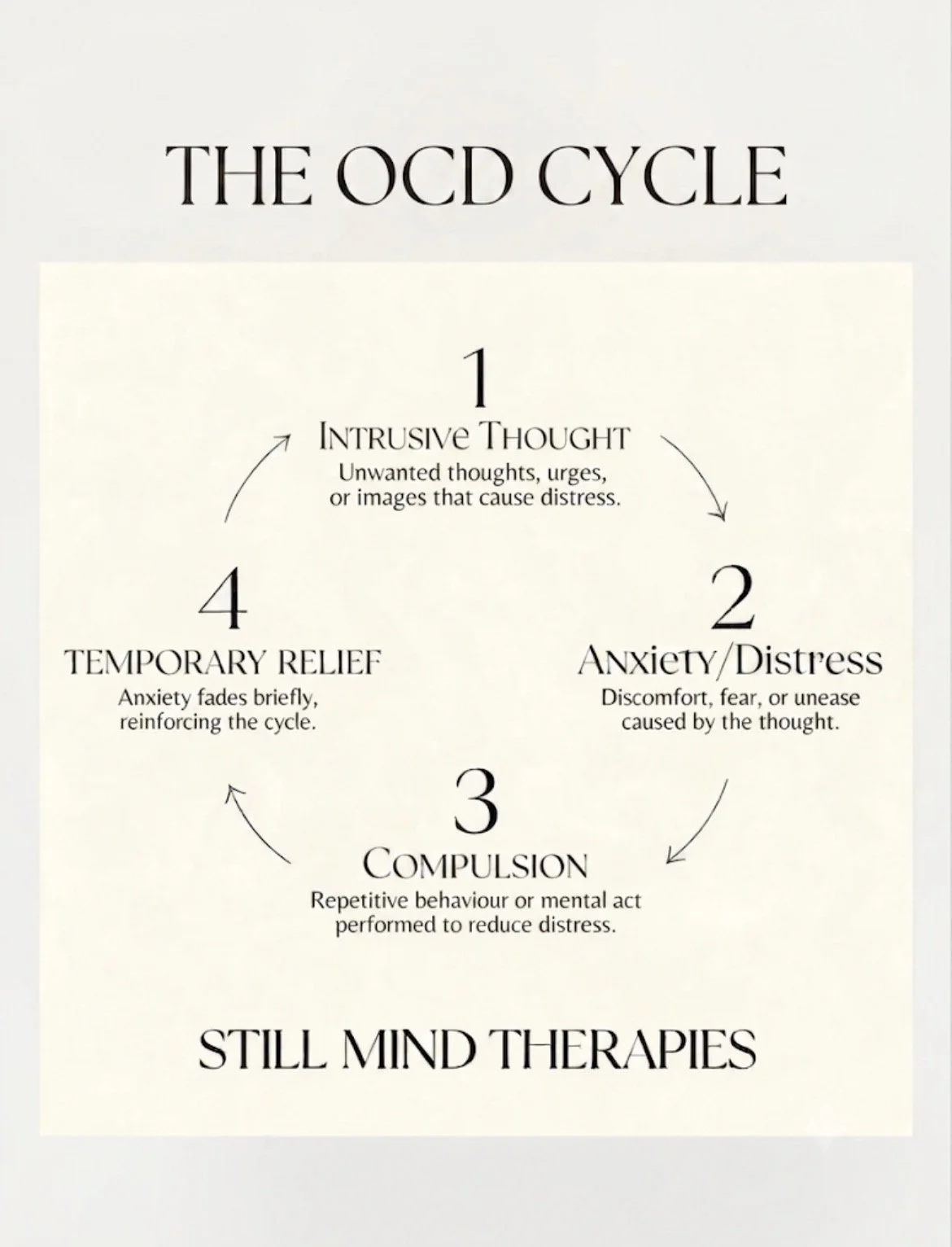
Understanding the OCD Cycle
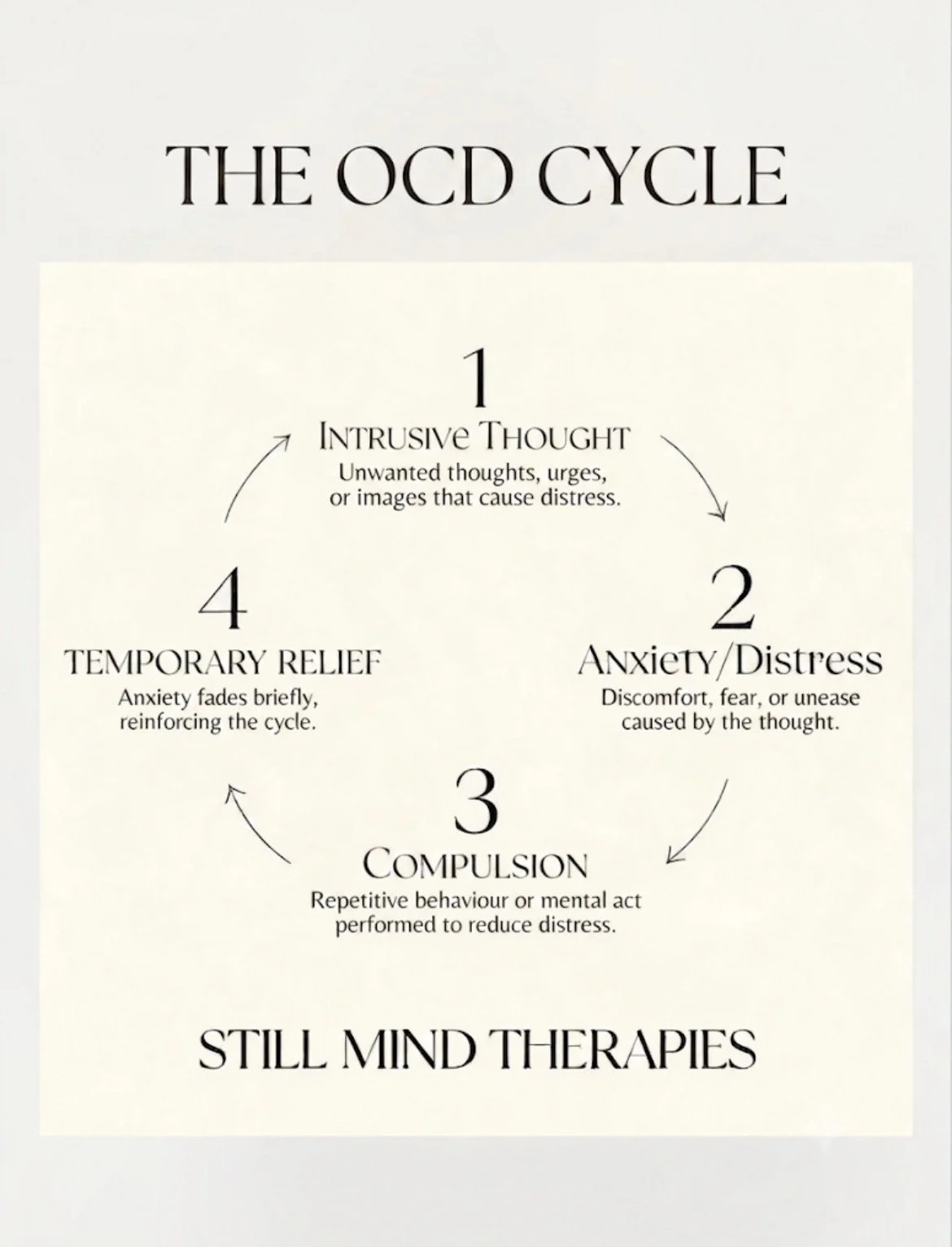
A thought arrives and it won't leave.
Maybe it's physical. That trolley, that door handle, that hand I just shook. What if it makes me ill?
Maybe it's quieter and entirely in your head. What if I meant that? What if I'm not who I think I am? What if I'm a bad person?
Most people would let a thought like that drift past. But if you live with OCD, it doesn't drift. It sticks.
Your anxiety climbs. Your mind starts hunting for certainty. So you do something to make it stop. You wash. You check. You replay it. You search, again, for reassurance.
The anxiety settles. You feel better.
For a little while.
Then the doubt returns. And the whole thing starts again.
If you live with OCD, you don't need me to describe this. You've lived it a thousand times. What you might not have been told is why it's so hard to stop, and why stopping has almost nothing to do with the thoughts themselves.
It's a loop and your brain is learning it
Think of OCD as a learning loop.
A thought appears. The thought triggers anxiety and uncertainty. To reduce the anxiety, you do something. A check. A wash. A search for reassurance. The anxiety drops and that drop feels like relief.
Here's the trap.
Your brain makes a connection. It decides the ritual was what kept you safe, even when there was never any real danger. So the next time a similar thought turns up, the urge to perform the ritual is stronger. And the time after that, stronger still.
Without realising it, you've been teaching your brain to fear the thought. Every ritual is another rep.
The content barely matters. Contamination, your health, your relationship, harming someone, intrusive sexual thoughts, whether you locked the door. The fear changes. The loop stays the same.
One pattern, many disguises
Take contamination as an example, because it's easy to picture.
You touch a shopping trolley. What if someone ill touched this? Your anxiety rises. You wash your hands and it settles. Your brain files it away: washing kept me safe. Next time, the anxiety comes faster and the urge to wash is stronger, even though there was never any real danger.
Now swap the trolley for a thought about whether you love your partner. Or whether you're a good person. Or whether you left the hob on. The trigger changes and the ritual changes, but the machinery is identical. Anxiety, ritual, relief, reinforcement.
Same loop. Different disguise.
It was never about the thought
The thoughts aren't the problem. Everyone has strange, random, unwanted thoughts. They drift in, they drift out, and most people barely notice. The difference with OCD is that your brain snags on them. The thought suddenly feels important. Dangerous. Urgent. Something you have to solve right now.
It's not the thought that keeps you stuck. It's the emotional response to it.
Compulsions you can't see
When people hear "compulsion", they picture hand washing or checking the door. Sometimes that's exactly it.
But a lot of OCD happens silently, inside your head.
Replaying a conversation to check you didn't say the wrong thing. Reviewing a memory for evidence. Analysing what a thought means about you. Reassuring yourself, again, that you're a good person.
Nobody sees these. But they work the same way. A moment of relief, and another lesson to your brain that the thought was dangerous.
If your OCD lives almost entirely in your head, this is where it hides. And it counts. It's every bit as real as the visible kind.
What you're actually fighting
One of the biggest shifts I see in therapy is the moment someone realises they're not fighting the thoughts at all.
They're fighting uncertainty.
OCD makes a promise. Check one more time, think it through a little longer, find one more piece of reassurance and then you'll feel certain. So you do. And the certainty never comes. It can't, because every ritual teaches your brain that not knowing is unbearable.
When people see this clearly, something changes. They stop blaming themselves. They realise they're not broken or obsessive or untrustworthy. They're caught in a pattern.
And patterns can be changed.
How I work
Most people I see already understand their OCD. They know the fear doesn't quite add up. And yet their body reacts as though the danger is real. That's the heart of it. Insight isn't enough, because the emotional response has become automatic.
The approach with the strongest evidence behind it is ERP, exposure and response prevention. You gradually face what triggers the anxiety, and you don’t perform the ritual. No washing. No checking. No silent replaying. The anxiety climbs. Then, because you haven’t fed it, it falls on its own. And your brain learns the lesson the compulsion kept blocking. The danger wasn’t real. You could sit with not knowing after all. It’s hard work, which is why so much of what I do is aimed at making it possible, turning down the fear enough that you can actually face it.
So that's what I work with directly. The fear attached to the thought, rather than the thought itself. Hypnotherapy helps turn down the intensity of that automatic anxiety, so there's room to respond differently. IEMT works with the emotional charge sitting under old memories and triggers, the imprints that keep your nervous system braced for danger that isn't there. As that charge softens, the thoughts tend to lose their grip.
And we work at the level of identity, because OCD has a way of rewriting how you see yourself. I'm obsessive. I'm an anxious person. I can't trust myself anymore. Over time it stops feeling like something you're going through and starts feeling like who you are.
It isn't. It's something you're experiencing. And that distinction is where change begins.
Where it starts
When you understand the cycle, you stop seeing OCD as the truth about who you are and start seeing it for what it is. A pattern. The thoughts may still turn up. They just don't get to run the show.
That understanding is where the loop begins to loosen. And it's where the work begins.
If any of this feels familiar, you don't have to work it out alone. I offer a free, no pressure conversation where we can talk through what you're experiencing and whether we'd be a good fit to work together. Get in touch whenever you're ready.

Why Therapists Find It Hard To Ask For Support

Last week, a therapist told me her nervous system felt like it had been in a blender for months. Running the business, seeing clients, overthinking every decision, second guessing herself at every turn.
And I recognised it instantly. Not just because I hear it a lot but because it’s the answer most of us would give, if we ever gave the honest one. Instead, when someone asks how we are, we say “oh, you know, busy.” So why do we do that?
Partly it's the role. We spend all day being the one person people can say anything to. Listening, supporting and helping people through the hardest moments of their lives.
Partly it's the voice. I should be able to handle this. I’m a therapist, shouldn't I already know what to do?
And partly, perhaps mostly, it's because asking for support feels like exposure. Our whole professional identity is built on being the steady one in the room. Saying "actually, I need some help with this" doesn't just feel vulnerable. It feels like it threatens the very thing we are.
And underneath all of that, there's often something much older. For many therapists, this didn't begin with the profession. It began long before we ever trained. We became the one who read the room. The one who noticed other people's moods and worked out that life went more smoothly when we paid attention to everyone else first. That's where much of our attunement comes from, and it's part of what makes us good at this work. But it often came with an unspoken rule: I look after. I don't get looked after.
So we don't ask. We get productive instead.
We enrol on another course. We learn another modality. We read another book. We tell ourselves that if we just know a little more, we'll finally feel confident enough. We tweak the website. We rethink the niche. We build things with real care and then never put them in front of anyone. Every one of those things feels productive. It even looks productive. But none of it touches the thing that's actually driving it.
As therapists, we have a socially acceptable hiding place. Nobody questions someone in this field doing more training. It looks like dedication. It even feels like dedication. Which makes it the perfect hiding place for anxiety, self-doubt and the fear that somehow we're not enough.
"But I have supervision."
So do I. Supervision matters. But supervision supports the therapist you are. Your work, your ethics, your development.
Personal support supports the person who is the therapist. The one starting another course. The one editing the website at 11pm. The one doing another rebrand. The one having a crisis of confidence.
None of this means we are bad therapists. It means the patterns we help clients with every week don't politely exempt us. They just seem different somehow, usually because they arrive with a certificate at the end.
Recognising the pattern is the beginning. But recognising it rarely changes it. Understanding why we do something isn't the same as changing what we do.
That's why I created RESOLVE™. A programme for therapists and helping professionals who want to work on the things that quietly get in their own way, so they can show up with greater confidence, authority and ease both in their work and in themselves.
So for now, just try this. The next time someone asks how you are, notice the version you give them.
We're human too. And letting ourselves be supported isn't separate from being good at this work.
It's part of it.

Why So Many Skilled Practitioners Aren’t Having the Impact They Are Capable Of

If you’re a therapist, coach or wellness practitioner, can I ask you something?
Have you ever had that quiet feeling that you’re capable of so much more than you’re currently expressing? Not because you’re not good enough. Not because you need another qualification. Not because you don’t care enough. But because you know, deep down, that there is something more within you.
You didn’t choose this profession because you wanted to collect certificates. You chose it because you wanted to make a difference. You felt called to support people, create change and help others move towards a better version of themselves.
So you learned. You trained. You invested in yourself. You gathered knowledge, techniques and qualifications because you genuinely cared about becoming the best practitioner you could be.
And it worked. Your clients get better. They recommend you to others. They tell you how much your work has helped them. Yet despite all of that, many skilled practitioners are left with a quiet sense of untapped potential.
Not because they lack knowledge. But because they struggle to fully express the depth of what they know.
Years of working with people gives you something no course ever can. You begin to recognise patterns. You develop intuition. You instinctively know the questions to ask, when to challenge and when to simply hold space. You develop an understanding of people that goes beyond any textbook.
The irony is that this wisdom becomes so familiar that you stop recognising it as expertise. It becomes part of who you are, so you underestimate its value. You assume everyone sees what you see.
They don’t.
I used to think impact came from learning more. Another course. Another model. Another way of working. And learning is valuable. Growth matters. Every training, experience and conversation shapes us as practitioners. But somewhere along the way, I realised that the biggest shift wasn’t about adding more. It was about making sense of everything I already knew.
It was about bringing together years of psychology, lived experience and clinical practice into something that felt clear, coherent and unmistakably my own.
That’s where RESOLVE™ came from.
I began to see that what holds many skilled practitioners back isn’t a lack of knowledge or ability. It is often the self-doubt, limiting beliefs, old stories and internal barriers that quietly influence how we show up in our work.
RESOLVE™ is about helping practitioners identify and resolve what is getting in the way of their own potential, so they can reconnect with their confidence, trust their own wisdom and express the depth of who they already are.
When that happens, they don’t become a different practitioner. They become more fully themselves. When you stop trying to become someone else’s version of a great practitioner, something changes.
Your message becomes clearer. Your work becomes deeper. Your confidence grows quietly, without needing to prove itself.
And your impact naturally expands.
Perhaps that’s what so many of us have been searching for all along.
Not another qualification.
Not another technique.
But the confidence to trust the practitioner we’ve already become.
Sometimes the greatest transformation doesn’t come from learning something new. It comes from finally recognising the value of what has been within us all along.
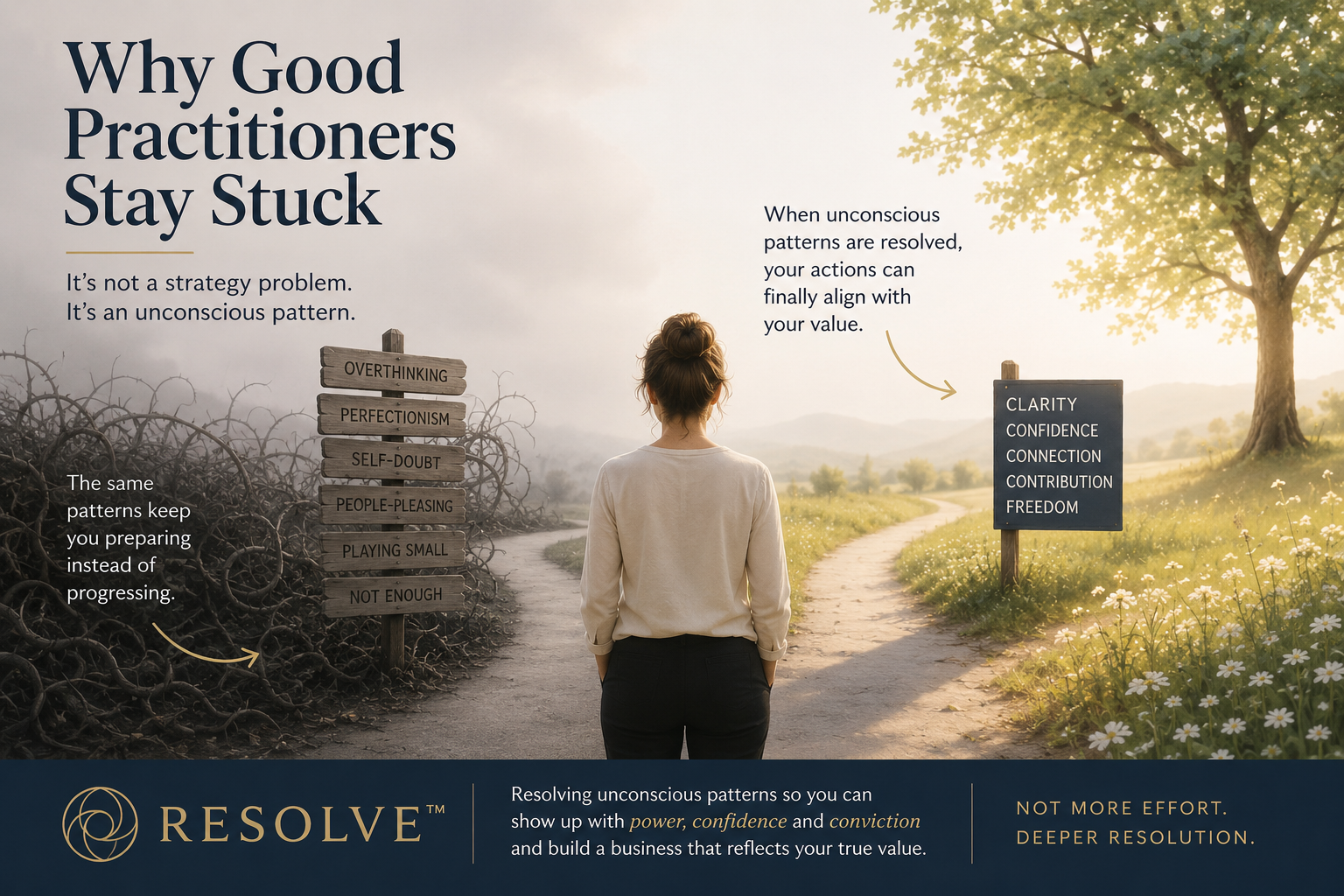
Why Good Practitioners Stay Stuck
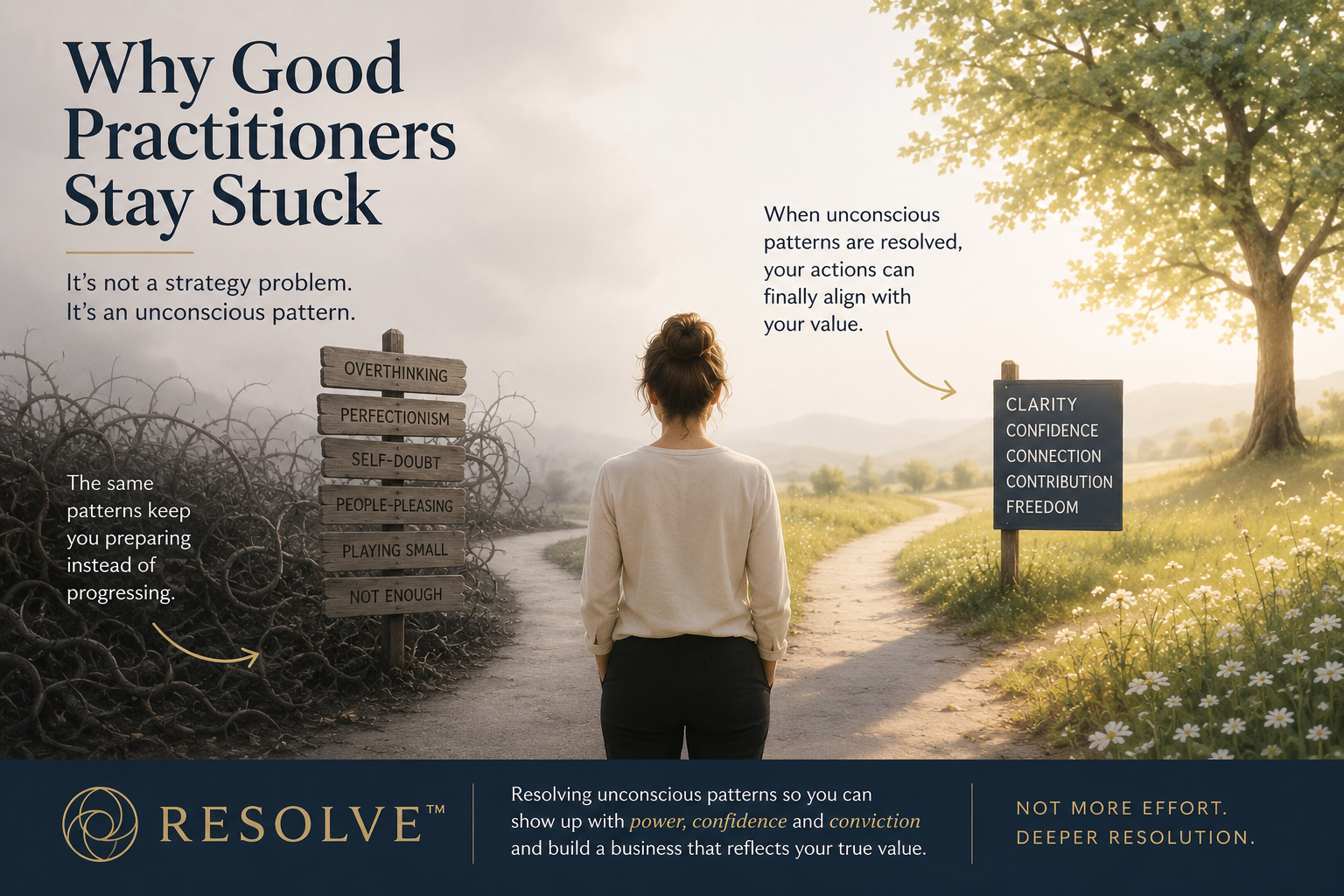
A skilled practitioner said to me recently, “I know what I need to do, so why can’t I do it?”
It’s a question I hear often. And I think it points to something many practitioners experience. Because you do know what to do. You understand your work. You care deeply about your clients. You’ve invested in your training, built your skills and worked hard to become good at what you do.
Yet something still feels stuck.
You mean to post on social media, but the caption sits in your drafts because it’s not quite perfect yet.
You think about increasing your fees, then decide to leave them as they are.
You tell yourself you’ll start networking next month.
You buy another course or create another offer instead of promoting the one you already have.
You decide to give your website “just a few more tweaks” before you really put yourself out there.
You say no to the interview, podcast or speaking event
From the outside, it looks like you’re being thoughtful, professional and committed. But sometimes what looks like professionalism is actually self-protection.
The Behaviours Aren’t The Problem
Most practitioners assume they have a motivation problem. Or a confidence problem. Or a marketing problem. In my experience, that’s rarely what’s happening.
The behaviours you’re frustrated by; overthinking, procrastinating, over-delivering, undercharging, perfectionism, avoiding visibility, are usually expressions of something deeper.
They’re often being organised by unconscious protective patterns. These patterns develop for good reasons. At some point in your life they helped you stay emotionally safe. But they don’t disappear simply because you’ve become more experienced or more qualified.
Instead, they quietly continue influencing your decisions without you even realising it. That’s why you can genuinely want to grow your business while repeatedly doing things that keep it small.
What Unconscious Patterns Can Look Like
Rewriting the same post over and over.
Editing out your real voice because it feels too direct.
Changing your wording so nobody could possibly disagree with you.
Delaying a price increase because it feels uncomfortable.
Signing up for another training instead of selling the expertise you already have.
Creating something new because marketing your existing offer feels too exposing.
Telling yourself you just need to refine things a little more.
Hiding behind preparation instead of showing up.
On the surface, every decision feels reasonable.
Together, they create a business that’s constantly preparing but rarely fully stepping forward.
Why Knowing Isn’t Enough
This is why advice alone doesn’t create lasting change. You already know what to do. Knowledge isn’t the missing piece.
If an unconscious pattern associates visibility with criticism, or charging more with rejection, your mind will keep finding ways to protect you. Until that pattern changes, the behaviour returns, no matter how much strategy you learn.
That’s why it feels so frustrating. You can be “productive” all day and still not move the needle on what actually matters. First it’s tension. Then annoyance. Then resentment. Then exhaustion.
You start to feel like you’re carrying the business rather than leading it. And then the question comes: “Why does this feel so hard when I know I’m capable?”
Because this was never about effort. It’s about the patterns keeping your actions organised around fear.
What Changes When The Pattern Is Resolved
When those unconscious patterns begin to resolve, something shifts.
You stop hiding behind preparation and start taking action.
You stop treating visibility like a test and start seeing it as part of the work.
You speak more clearly. You show up more consistently. You price with more confidence.
You stop abandoning your ideas halfway through.
You trust yourself more quickly.
You grow a business that reflects your actual value.
This Is The Work I Do
This is exactly what I help practitioners do through RESOLVE™. This 8-session 1-1 programme is designed to help you identify and resolve the unconscious patterns limiting your confidence, visibility, income and impact.
If your business looks strong on the outside but still feels blocked on the inside, this is the work.
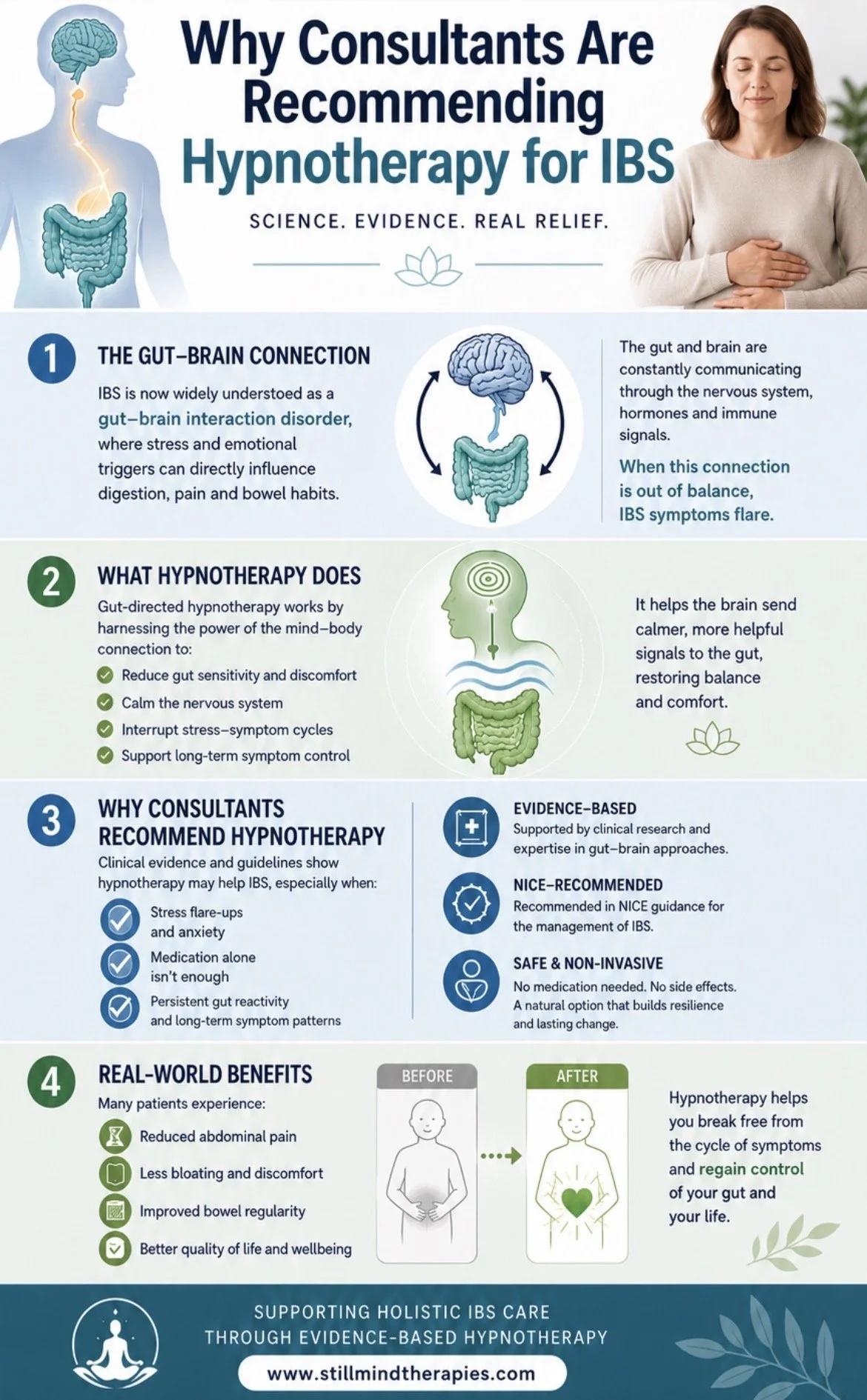
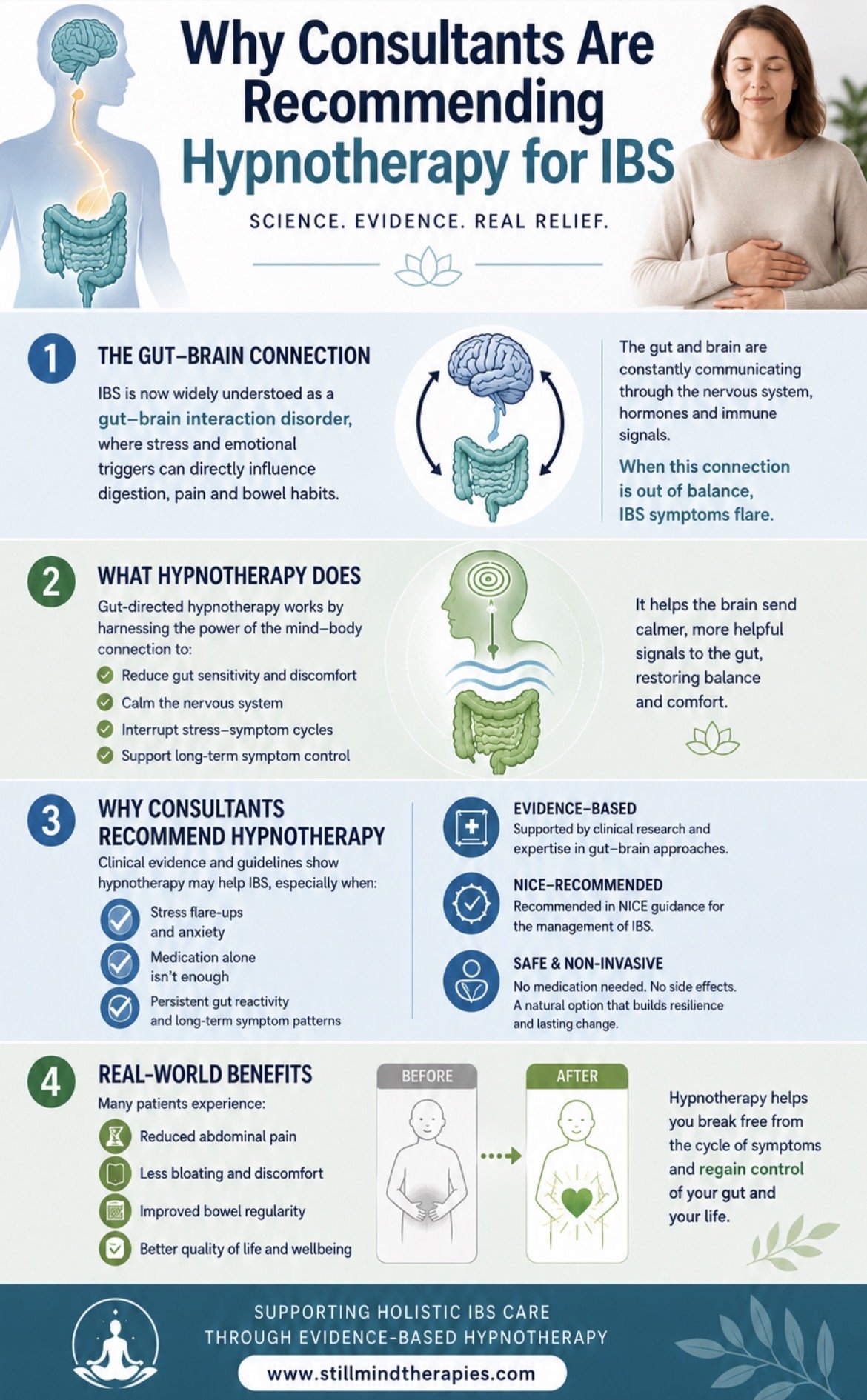
Why Consultants Are Recommending Hypnotherapy for IBS
A client contacted me recently after her gastroenterologist recommended hypnotherapy. She’d been through every test, had the all-clear on anything structural and was still living with symptoms that were running her life. Her consultant didn’t suggest it as a last resort. He told her it was genuinely one of the better evidenced options available to her.
She’s not alone in that, and her consultant isn’t alone in recommending it either. More and more, gastroenterologists are referring patients for hypnotherapy, not as a last resort, but because the evidence behind it is genuinely strong. So I wanted to explain why.
Before you leave the house, you've already worked out where the toilets are.
Not because you're paranoid. Because you've learned the hard way. So now it's automatic and the mental map runs in the background everywhere you go, whether you want it to or not.
You've turned down restaurant invitations you wanted to say yes to because you couldn't face explaining, again, why you might need to leave suddenly. Sometimes it's easier to just say you're busy.
Other times you go anyway and you eat half of what you actually want because you don't trust your gut to behave if you eat the whole thing.
Or you're in a meeting, doing a kind of internal triage. Is that cramping or is that nothing? Can I get through the next hour? Where's the nearest bathroom?
You check in with your stomach constantly. Automatically. It’s exhausting.
And here's the cruel bit, the more you brace for it, the more likely it is to happen. You feel a flicker of something in your gut, your brain immediately goes on alert, your body responds to that alert as if it's a genuine threat, and suddenly the very thing you were trying to avoid is happening. You weren't imagining it. You were anticipating it into existence. This is a real, recognised pattern and it's exactly why consultants and gastroenterologists are increasingly recommending hypnotherapy.
What's Actually Happening In Your Body
IBS is now understood as a disorder of gut-brain interaction. The gut isn't structurally broken, the communication between gut and brain has become dysregulated.
Your gut has its own extensive nervous system, sometimes called the second brain and in IBS this system becomes hypersensitive. Normal digestive sensations get amplified. Your brain interprets them as threats, which triggers the stress response, which makes the gut more reactive. That's the loop.
But here's the part that explains the constant checking, the planning around toilets, the quiet dread before you've even left the house — anticipatory anxiety. Once your nervous system has been caught out enough times, it stops waiting for symptoms to start. It starts predicting them. Scanning for them. Trying to get ahead of them.
That hypervigilance feels like protection. It feels like you're managing the risk. But it's actually maintaining the cycle because a nervous system that's constantly scanning for threat is a nervous system that stays in a heightened, reactive state, which keeps the gut sensitive, which gives you more to scan for. You end up fighting a fire you're also quietly feeding.
This is why treating the gut alone often doesn't give lasting relief if the nervous system underneath is still living in a state of threat.
Why Consultants Are Recommending Hypnotherapy
Hypnotherapy is being recommended because it works directly on this gut-brain pathway and specifically on the anxiety that keeps the whole cycle running.
In a gut-directed hypnotherapy session, the mind becomes calm and focused, which makes it possible to introduce suggestions that help the gut feel smoother, less reactive, less like something to be feared. Just as importantly, the work addresses the hypervigilance itself, gradually teaching your nervous system that it doesn't need to scan, predict, and brace the way it has been. That checking-in becomes less automatic. The background hum quietens.
The Research
The first controlled trial, published by Whorwell, Prior and Faragher in The Lancet in 1984, found dramatic improvement in patients with severe IBS who hadn't responded to anything else, improvement that held up at follow-up, with no relapses recorded. This work led to the development of the Manchester Protocol, now one of the most widely studied psychological approaches to IBS in the world. A later audit of over a thousand patients treated using this approach, published in Frontline Gastroenterology in 2020, reported a response rate of 76%, with benefits maintained long term. More recent research from the same group, published in 2024, found that people carrying both physical and psychological symptoms, including anxiety, were among those most likely to benefit. Which makes sense. If anxiety is driving the cycle, addressing it directly gets results.
Because this work treats the gut symptoms and the anxiety driving them at the same time, the results tend to be more durable than approaches that treat mind and body as separate problems.
What This Means For You
If you've been through every investigation, had the all-clear on anything structural, and are still living with IBS that isn't fully responding to diet changes or medication; especially if anticipation, checking, or anxiety are part of your picture , you're exactly who this work is for.
What actually shifts is the anxiety. The constant scanning quietens. You stop running the toilet-location check before you've even decided to go somewhere. A flicker of sensation in your gut stops being an automatic five-alarm event. It can just be a flicker, and pass, the way it does for everyone else. Your nervous system learns it doesn't need to stay on guard, so it stops sending the signals that kept the cycle going.
That's not the same as never having a bad day. It's your baseline changing, from braced to settled. And when that baseline changes, everything built on top of it changes too.
These are the changes people report after hypnotherapy sessions.
You order what you actually want, not what feels "safest." You say yes to the dinner, the trip, the last-minute plan, without running a risk assessment first. You sit in the meeting, the cinema, the long car journey, and realise twenty minutes have gone by without a single thought about your gut. You go back to the things IBS quietly took from you; the job, the gym, the sport, the hobby, the spontaneity, because your body finally feels like something you can trust again, not something you have to manage.
This is the part people don't expect: it's not just about the gut. It's about getting yourself back. The version of you who isn't constantly negotiating with your own body just to get through the day.
Book your free consultation and let's explore whether gut-directed hypnotherapy could be the missing piece for your IBS.

An Emotion Lasts 90 Seconds. So What Are We Actually Running From?

Ninety seconds.
That's how long an emotion lasts if you actually let it move through you without interference. Ninety seconds of pure, uninterrupted feeling and then physiologically, chemically, in your actual body and it's done.
I'll give you a moment with that.
Because if you're anything like most of the people I work with, your first reaction is either "that's complete nonsense" or "then why does mine feel like it's been going since 2009."
Both are valid responses. And both tell you something important.
First. What actually is an emotion?
Not in a textbook way. In a real, happening-in-your-body way.
An emotion is a chemical event. Something happens, real or imagined, present or remembered and your brain releases a cocktail of chemicals into your bloodstream. Those chemicals create a physical sensation. The tightening in your chest. The heat in your face. The hollow feeling in your stomach that you've been calling anxiety for so long you've forgotten it has a name.
That's it. That's the emotion. Chemicals, sensation, body.
And here's the thing about chemicals. They move through the bloodstream and they clear.
The neuroscientist Jill Bolte Taylor wrote about this in her book My Stroke of Insight after having a stroke and observing her own brain from the inside in real time. She discovered that the physiological chemical response of an emotion , the actual wave moving through the body, runs its course in approximately 90 seconds if you don't interfere with it. After that, any continuation of the feeling isn't the original wave. It's you retriggering it with thought, story or resistance.
Which is an extreme way to learn things but here we are.
So why does yours feel permanent?
Because you're not actually feeling it.
Here's what we do instead of feeling feelings.
We suppress them. We think about them. We analyse them. We judge them. We judge ourselves for having them. We google them. We text our friends about them. We eat something. We scroll. We plan how to make the feeling stop. We worry that the feeling means something terrible about us or our lives or our futures.
We do everything except actually feel the feeling.
And every single one of those responses; the analysing, the avoiding, the distracting , resets the ninety seconds. The chemical wave can't complete its journey because we keep pulling it back to the beginning.
So the feeling doesn't last ninety seconds. It lasts days. Weeks. Sometimes years. Not because the emotion itself is permanent but because we've become very, very good at keeping it alive without realising that's what we're doing.
Why do we do this?
Probably because nobody taught us not to.
We learned, somewhere along the way, that certain feelings were too uncomfortable. Too inconvenient. Too messy. Too scary. We learned to manage them, suppress them, power through them, or perform our way around them.
Some of us learned this from families where emotions weren't discussed. Some of us learned it from environments where being visibly affected by something felt dangerous. Some of us just absorbed it from a culture that prizes productivity and composure and has very little language for sitting with discomfort.
And some of us feel things so intensely that we decided early on that the feeling itself must be the problem. That if we could just stop feeling so much everything would be fine.
It was never the feeling that was the problem.
It was never having been taught that feelings are survivable.
The brain's role in all of this
Your brain is genuinely, enthusiastically trying to protect you from discomfort. That's its job and it takes it very seriously.
It notices that feeling that thing was uncomfortable last time. So it helpfully suggests some alternatives. Have you considered scrolling? Or having an argument with someone in your head? Or running seventeen worst case scenarios? Or just generally avoiding the entire situation that might produce that feeling again?
The brain calls this protection. Therapists call it avoidance. The result either way is that the feeling never gets to complete its ninety seconds and you never get to discover that you could actually hold it.
The irony is that the avoiding is so much more exhausting than the feeling would have been.
So how do you actually feel a feeling?
I like the RAIN approach from psychologist and meditation teacher Tara Brach. It's simple enough to actually use when you're in the middle of something difficult which is the only time it matters.
Recognise what's happening. Name it. Not "I'm a mess" but "this is shame" or "this is fear" or "this is grief." Naming creates just enough distance between you and the feeling to remember that you are not the feeling. You are the person having it.
Allow it to be there. Without immediately trying to fix it or explain it away or make it more comfortable. Just let it exist for a moment. This is the part that feels impossible and isn't.
Investigate where you feel it in your body. Not what you think about it. Where is it? Your chest? Your throat? Your stomach? Get curious rather than analytical. The body is where the feeling actually lives and the body is where it needs to be met.
Nurture yourself the way you would a friend who was feeling this. With some basic human kindness rather than the running commentary of criticism most of us subject ourselves to when we're struggling.
That's it. Recognise, Allow, Investigate, Nurture.
Ninety seconds. Sometimes a bit more. But not years.
What prolongs it
Since we're being honest.
Resistance prolongs it. The fighting, the pushing away, the insisting that you shouldn't be feeling this or that you don't have time for this right now.
Rumination prolongs it. The thinking about the feeling rather than feeling the feeling. Going over it again and again looking for a resolution that thinking was never going to provide.
Suppression prolongs it. Feelings that don't get felt don't disappear. They go underground and come back later wearing different clothes. Usually as anxiety, or physical tension, or a sudden disproportionate reaction to something small that is absolutely not actually about the small thing.
And story prolongs it. The narrative we build around the feeling. Not just "I feel sad" but "I feel sad and this means I'm fundamentally broken and I'll always feel this way and nobody else feels this and what is wrong with me." The feeling is ninety seconds. The story can run indefinitely.
The feeling itself is almost never the problem.
What this means in practice
You don't need to become someone who processes every emotion in real time with perfect mindfulness and a journal. That's not a real person.
You just need to get a little less afraid of what happens when you stop running.
Because here's what I've watched happen with people who start actually feeling their feelings instead of managing them. The anxiety reduces. Not because the feelings stop coming but because the nervous system learns something it may never have been taught before. That feelings arrive and feelings pass. That they are survivable. That you are bigger than any feeling that moves through you.
You are the sky. The feelings are the weather.
They were always going to pass.
You just needed someone to tell you it was safe to let them.
Where I come in
A lot of what brings people to therapy isn't just the feeling itself. It's the years of accumulated effort it took to not feel it.
The exhaustion of the management. The anxiety that built up around the avoidance. The identity that formed around being someone who holds it together.
When we go back to where the avoiding started, when we update what the nervous system learned about whether feelings were safe, the feelings stop being so terrifying. They become information rather than emergency. Weather rather than catastrophe.
Ninety seconds.
You were always going to be okay.
Nobody just told you that soon enough.
If you want to go deeper on the science behind this, Jill Bolte Taylor's TED talk My Stroke of Insight is 18 minutes that will genuinely change how you think about your brain. Worth every second.
What's Your Relationship Like With Uncertainty?
If you've ever stood at a Scottish bus stop in July wearing both sunscreen and a cagoule, you already understand something important about uncertainty. You just haven't applied it to the rest of your life yet.
I was discussing this with a client the other day.
How our relationship with uncertainty can feel genuinely excruciating. Not just uncomfortable, not just a bit anxiety-inducing, but the kind of feeling that has you dissecting a two sentence text message for forty five minutes trying to work out the tone or asking the same question for the third time to a friend who is starting to look slightly tired of it.
You know the ones.
Replaying a conversation you had weeks ago trying to work out if you said something wrong and knowing, somewhere underneath it all, that you will probably never get a definitive answer either way.
Sending the message and then watching to see if they've read it. They have. They haven't replied. What does that mean?
Rehearsing a difficult conversation so thoroughly that you've essentially had it forty times before it happens and yet still feel unprepared.
Asking someone you trust if you think you handled something badly. They say no. You feel better for eleven minutes. Then you ask again.
We are exhausting ourselves trying to get certainty from a world that was never going to give it to us.
And the really uncomfortable truth is that we know this.
We know somewhere underneath all the checking and the planning and the needing to know, that we can't actually control how things turn out.
We just can't stop trying.
A Different Question
We talk a lot about how uncertainty makes us feel. Anxious. Out of control. Like something bad is probably coming and we just haven't identified it yet.
But here is the more interesting question.
What kind of relationship have you built with uncertainty over the years?
Because here's the thing. Two people can be facing the exact same unknown situation with the same complete lack of certainty about how it's going to turn out and have completely different experiences of it.
One person is in bits. The other is curious.
And the difference isn't personality. It isn't strength. It isn't that one of them has fewer problems or a more predictable life.
It's the relationship.
How the Relationship Gets Built
Your relationship with uncertainty didn't start last week when you were waiting for that email.
It started much earlier. In a house. With particular people. In a specific emotional climate.
If you grew up somewhere predictable and safe, where you knew roughly what was coming, where the adults around you modelled a kind of steady okay-ness in the face of the unknown, you probably built an early sense that uncertainty was manageable.
Or, if you grew up somewhere less predictable, where uncertainty meant something bad was probably coming, where the adults around you were anxious or unpredictable or struggling, your nervous system learned something different.
It learned that not knowing is something to be afraid of.
And that lesson didn't stay in childhood. It came with you. It's in the room right now, running quietly in the background, turning every unanswered question into a low-level emergency.
That's not a character flaw. That's an adaptation that made complete sense at the time.
It just hasn't been updated yet.
When certainty feels out of reach we tend to reach for control instead. We over-prepare, over-plan, over-research, over-reassure ourselves. The Overs. They give us the feeling of doing something useful about the uncertainty even when the uncertainty itself is completely unchanged. They work just long enough to keep us doing them.
The Moment Things Start to Shift
It's the moment you realise that uncertainty isn't actually the problem.
Your relationship with it is.
Because the uncertainty itself is neutral. It's just not-knowing-yet. It doesn't mean something bad is coming. It doesn't mean you've missed something or done something wrong or that the worst case scenario is quietly loading in the background.
It just means you don't know yet.
And somewhere along the way you learned to treat those two things as the same. Uncertainty equals threat. Not-knowing equals danger. And your nervous system has been responding accordingly ever since.
The Metaphor I Keep Coming Back To
Let me give you a metaphor because I like metaphors.
The sky.
The sky doesn't brace against the weather. It doesn't try to stop the clouds forming or resolve the storm before it arrives. It just holds the space for whatever is passing through and stays exactly what it is throughout. Vast. Permanent. Unchanged by all of it.
The uncertainty, the negative thoughts, the what ifs, they're the weather. They form, they move through, and if you stop trying to anchor them in place by fighting them or fixing them or seeking certainty about them, they pass.
Because that's what weather does when the sky stops treating it like an emergency.
You are not the weather.
You are the sky.
The question isn't how to make the uncertainty go away. It never goes away. The question is whether you've got a big enough sky to hold it from?
So How Do You Actually Build It?
Firstly, notice the urge before you act on it. Before you check the phone, send the follow up message, ask the question again; just pause and notice that the urge is there. You don't have to fight it. Just see it for what it is. Your nervous system asking for certainty it isn't going to get.
Let the feeling be present without resolving it. The discomfort of uncertainty has a natural lifespan. It rises, it intensifies, it peaks and then, if you don't feed it by seeking reassurance or running the scenarios again, it starts to subside. It's uncomfortable. But it's survivable. And every time you let it pass without acting on it you teach your nervous system something it may never have learned before. That you can hold this.
Now ask yourself honestly. Is there anything I can actually do about this right now? Sometimes there is. Do that thing. But a lot of the time the answer is no, not yet, or not ever and that's the moment to put the thought down rather than carry it around looking for a resolution that doesn't exist.
Interrupt the loop with something physical. Not as a distraction but as a genuine pattern interrupt. Move your body. Get outside. The nervous system lives in the body and sometimes the fastest way to shift a thought spiral is to change what the body is doing. A walk works. The gym works. Anything that brings you back into the physical present rather than the imagined future.
Also name what's actually happening. Not "I'm anxious" but "I'm sitting with uncertainty about X and my nervous system is treating it like a threat." That small act of naming creates a tiny bit of distance between you and the feeling. Enough to remember that you are the sky. Not the weather.
That's how the sky gets bigger. One uncomfortable moment held, one urge not acted on, one loop interrupted. Not dramatically. Just steadily.
The Real Work
Building a different relationship with uncertainty is about going back to where the relationship was first formed and updating what you learned there.
That's what I work with. Not the symptoms. The source.
Most of the checking and the catastrophising and the need to know isn't actually about the present situation. It's an old pattern running on new material. Your nervous system doing in 2026 what it learned to do in 1995 or 1985 because nobody told it things had changed.
Because when the source shifts, the relationship changes. Not all at once. But steadily, genuinely, in a way that actually lasts.
And you get to find out what it feels like to stand in the gap between what you know and what you don't and actually be okay there.
Just like standing at a Scottish bus stop in July.
Cagoule in one hand. Sunscreen in the other.
Absolutely fine either way.

What It’s Like to Start Therapy When You’ve Spent Your Life Coping On Your Own

You don’t do falling apart. You never really have.
When things got hard, you found a way through. You kept going. You held it together for yourself, for other people, for the version of you that everyone else needed you to be. Maybe you cried in the shower sometimes, when nobody could see. Maybe you lay awake at night with your thoughts circling the same ground, exhausted but unable to switch off. But by morning you were up. Dressed. Functioning. Fine. “Fine” has carried you a long way.
And that’s exactly why starting therapy can feel like so much.
Because it means sitting in front of someone and saying, out loud, that you’re not fine. That underneath all the holding it together, there’s pain. That you’re tired in a way you don’t quite have words for.
The Cost of Coping
The coping isn't the problem. Somewhere along the way, probably when you were quite young, you learned that handling things yourself was safer. More reliable than hoping someone else would show up for you. Maybe the adults around you were overwhelmed, or absent, or just not equipped. Maybe needing things felt like too much of a risk. Maybe you just learned, slowly and without anyone spelling it out, that being okay was your job. And so you got good at it. Really good. You became the person who manages. The one who holds things together. The strong one, the capable one, the one who doesn't make a fuss. And from the outside, it works. You look like someone who has it together.
But being the one who copes is often quietly lonely. Not in an obvious way. Just in the sense that no one really checks. No one sees past the “fine,” because you’ve never given them reason to. And somewhere underneath that, there’s a kind of exhaustion that doesn’t quite lift.
Why Starting Therapy Can Feel Hard
Therapy asks you to do the exact thing you learned not to do. To let someone see you. To say things out loud that you’ve carried on your own for a long time. That’s not a small thing. It makes complete sense if it feels uncomfortable. Which is why the relationship matters. You’re not just bringing a problem. You’re bringing parts of yourself you don’t usually show anyone. That requires real safety. Not just professionalism but warmth, steadiness, and the sense that you won’t be judged or overwhelmed. That’s the foundation of the work.
What the First Session Is Actually Like
You’ll probably come prepared. You'll have thought about what to say, maybe rehearsed it a little on the way there. You'll arrive with a tidy version of events ready to go, the edited highlights, the parts that make sense and don't make you look too messy. And then something happens that you didn't quite plan for. You get asked about yourself, not the headline version, but the real one. What it's actually been like. How you've actually been feeling.
There’s no rush. No interruption. No one trying to fix it or move you on.
Just space. For many people, that’s the moment something shifts. Not dramatically, just a quiet loosening of something that’s been held tightly for a long time. It can feel unfamiliar. Even exposing. But it’s also where things begin.
“Other People Have It Worse”
There’s usually a voice that shows up too:
“Other people have it worse.”
“I’m basically fine.”
“I don’t even know why I’m here.”
It sounds like perspective. It isn’t. It’s the same protective part of you that learned to keep going no matter what, still trying to minimise, still trying to manage. But your experience doesn’t have to be the worst to matter. If something is affecting how you feel, how you live and how you relate to yourself, it counts.
When Things Start to Shift
It’s also worth knowing that it can feel harder before it feels easier.
When you’ve spent years holding things up or suppressing things down, therapy means some of that starts to move. Feelings come up. Patterns you haven’t had space for begin to surface.
That’s not things going wrong. That’s things finally being processed properly, with support, at a pace that’s manageable. And it doesn’t stay intense. What tends to change is quieter than people expect. A calmer mind at night. Less overthinking. More presence. A sense of steadiness that doesn’t need to be performed. Often, what shifts most is how you feel about yourself.
You might go in to work on one specific thing and discover it has roots going back further than you realised, roots that suddenly explain a lot. What I hear most from people who do this work isn't "I feel better." It's "I feel like myself ." Sometimes for the first time in years. Sometimes, honestly, for the first time they can remember. And that's not a small thing. And then, almost always, quietly, with a kind of wonder at it: "I don't know why I waited so long."
How I Work
I work with people who are used to coping, the ones who look fine on the outside, but know something isn’t right underneath. Together, we look at what’s been driving that pattern and gently change the way it’s held in place so you’re not just managing anymore.
You’re actually living.
Ready When You Are
If this feels familiar, you don’t have to keep doing it on your own.
You can find out more or book a session here:

The Overthinker's Guide to Thinking About Thinking
Most people think they have "a mind." If you're an overthinker, you know better. You have a Committee. Let's meet the regulars…

The house is silent.
The world is asleep.
But inside your head? It's T in the Park circa 2007. A 24 hour festival of What Ifs, WTFs and Why Did I Say That.
You're lying in bed arguing with someone who isn't there about something that hasn't happened.
And somehow?
You're still losing.
To yourself.
You think about thinking.
Then you think about the fact you're thinking.
Then you start wondering if thinking about thinking about thinking is a sign you should be gently supervised.
Welcome to Your Brain's Internal Committee
Most people think they have "a mind." If you're an overthinker, you know better. You have a Committee. Let's meet the regulars:
The Analyst
Will create a 14 point pros and cons list about switching washing powder. Wants evidence. Wants data. Wants you to wait three weeks before committing to Fairy Non-Bio.
The Historian
Keeps a 4K Ultra HD archive of every awkward moment since Primary 3. Appears at the most inconvenient times.
"Remember when you waved back at someone who wasn't waving at you”
The Catastrophist
Is convinced that being "left on read" is a clear sign you should probably move to a new country and change your name.
The Illusion of Productivity
Here's the thing though, overthinking makes you feel like you're doing something productive.
You're not just sitting there passively worrying. You're analysing! You're problem solving! You're being thorough! Except, let's be honest, you're not actually solving anything.
You're just turning the same thoughts over and over like a rotisserie chicken, hoping that the 47th rotation will suddenly reveal some juicy bit of clarity the first 46 didn't.
This is the overthinker's trap. The thinking feels like progress. It feels like if you just think about it a bit more, you'll finally be safe.
You won't.
The "Safety" Trap
Your brain thinks it's being helpful.
Your nervous system is basically an overzealous steward at Hampden Park. He's just doing his job, but he's obsessed with rules you didn't know existed. He's the voice in your head shouting:
"No standing there. No sitting there. No enjoying yourself until it’s 100% secure'."
He means well. He's trying to keep you safe. But he's treating a perfectly normal Tuesday like the security threat level is severe.
The Three Flavours of "The Spin"
To stop the cycle, you have to recognise which brand of overthinking your brain is currently obsessed with:
1. The Time Traveller
You're stuck in the past (rumination) or sprinting into the future (anxiety). You're everywhere except right here, where your tea is getting cold.
2. The Scriptwriter
You are writing dialogue for people who aren't in the room.
"If she says X, I'll say Y, then she'll realise Z..."
However, she will say Q and your entire script goes in the bin.
3. The Autopsy
Taking a perfectly normal social interaction and dissecting it until it's unrecognisable.
"Did I say 'hi' to the Barista too loudly? They nodded slowly…. do they think I'm a loud weirdo who can’t order coffee right?"
Why Thinking Won't Solve Thinking
We think that by understanding our anxiety, it will go away. We try to "reason" with a panic attack. But you can't use logic to talk down a nervous system that's already decided the building is on fire.
Your logical brain is trying to write a polite letter to your subconscious, while your subconscious is in the basement screaming, "ABORT MISSION! EVERYONE HATES US!"
Calm down Gollum. It’s just a late reply.
This issue is they are not speaking the same language.
What Helps
You can't think your way out of a overthinking problem. I know. The irony is almost painful.
Your brain has learned that thinking = safety. That if you can just analyse it thoroughly enough, consider every angle, plan for every outcome, anticipate what could go wrong, you'll finally feel okay.
But that's like trying to put out a fire with petrol. You're using the exact thing that's causing the problem to try and solve it.
The overthinking isn't happening because you haven't thought about it enough. It's happening because your nervous system genuinely believes that uncertainty is dangerous and thinking is the only way to stay safe.
That belief doesn't live in your logical mind where you can reason with it. It lives in your automatic responses. The ones that kick in before you've even registered what's happening.
We're updating the pattern at the level where it actually runs, in your subconscious and nervous system.
We're teaching your overzealous Hampden steward that he can clock off occasionally. That you're allowed to not know something without it being a threat. That uncertainty is just... life.
The Goal Isn't To Stop Thinking
The goal isn't to turn you into someone who doesn't think carefully about things.
You're intelligent. You're analytical. Those are strengths. The thinking itself isn't the problem.
The problem is the compulsive, repetitive, exhausting thinking that doesn't actually help you make better decisions or feel better or move forward. The analysis paralysis. The mental arguments with people who aren't there. The 47 rotations of the same thought hoping for different results.
The goal is to keep the helpful thinking and lose the anxious spinning. To be able to consider something thoughtfully without getting stuck in loops. To think something through once, properly and then move forward.
The Bottom Line
You are not your thoughts. You are the person hearing the thoughts.
The next time your brain throws an all night festival you didn't buy tickets for, just remember the band isn't even that good and its the same set list that’s been playing on repeat for years.
Let's get you some peace and quiet instead.
Craving More Calm In Your Life?
The Still Mind Toolkit for Instant Calm
Download a free toolkit with five simple techniques you can use immediately to restore a sense of calm when life feels overwhelming.
If any of this resonated, you don’t have to keep doing this alone.

The Definitive Guide To High Functioning Anxiety

You have a life that looks, from the outside, like it's working.
Good job. Reliable. Together. The person everyone calls when they need something done properly.
And privately, quietly, in the gap between who everyone thinks you are and how you actually feel most of the time, there is a version of you that is absolutely exhausted.
Not the tired that sleep fixes. The tired that comes from running a constant internal surveillance system. From monitoring every interaction for signs of disapproval. From preparing obsessively for things that probably won't go wrong and then preparing for the possibility that your preparation wasn't enough. From achieving things that were supposed to make you feel better and discovering, when you get there, that the hollow feeling of not-quite-enough came with you.
That is high functioning anxiety. And if you've been wondering whether what you're experiencing has a name, it does.
This guide covers what high functioning anxiety actually is, how it gets formed, what keeps it going, why so many conventional approaches don't fully reach it, and what actually works.
It's long because this topic deserves more than a listicle. Get a coffee and settle in.
What is High Functioning Anxiety?
High functioning anxiety isn't a formal clinical diagnosis. You won't find it in the DSM. But it describes something extraordinarily real and remarkably common, particularly in women.
It refers to the experience of living with significant, chronic anxiety while continuing to function at a high level, often at an impressively high level. The anxiety doesn't stop you. In many ways, it drives you. It shows up not as avoidance but as over-engagement. Not as paralysis but as hyperproductivity. Not as falling apart, but as holding everything together so relentlessly and so well that nobody, including sometimes yourself, notices that anything is wrong.
High functioning anxiety is anxiety wearing the costume of competence. And it is exceptionally good at its disguise.
Women are disproportionately affected. Research from the National Institute of Mental Health shows that women are more than twice as likely as men to experience anxiety disorders across their lifetime. The reasons are complex and layered, involving biology, socialisation, and the particular pressures that still fall disproportionately on women in both professional and domestic spheres. But one significant factor is this: the traits that high functioning anxiety produces, the reliability, the conscientiousness, the over-preparation, the people-pleasing, the emotional labour, are still broadly culturally rewarded in women. Which means the anxiety gets praised rather than questioned, and the person living with it often doesn't recognise it as a problem until the cost becomes impossible to ignore.
How It Presents: The Signs That Are Easy to Miss
Because high functioning anxiety wears the mask of competence so well, it often goes unrecognised for years. The person experiencing it rarely looks anxious to the outside world. What they look like is capable.
But here's what's happening on the inside.
The mind that never switches off.The replaying of conversations hours or days after they happened. The mental rehearsing of scenarios that probably won't occur but what if they did. The inner inventory of everything that could go wrong tomorrow, next week, eventually. The brain that treats rest as a waste of time and quiet as an invitation to generate new things to worry about.
The body that holds what the mind produces.Tight jaw. Shoulders that live somewhere around the ears. Chest that's always slightly compressed. The stomach that's been vaguely knotted for so long it's started to feel normal. Headaches. Fatigue that doesn't improve with sleep. Digestive issues that the GP has investigated and found nothing obvious. The physical toll of a nervous system that has been running on high alert for years is real, measurable, and frequently mistaken for something else.
The behaviours that manage the internal state.Over preparation as a way of controlling outcomes. Saying yes when every cell in your body wants to say no, because saying no feels scary. Seeking reassurance in ways so subtle they barely register as reassurance seeking. Procrastinating and then working in frantic, pressured bursts. Keeping so relentlessly busy that there's no space to feel what's underneath. Perfectionism in work, in relationships, in presentation, in everything.
The relationship patterns.The difficulty with true vulnerability because if people really knew what was happening inside, they might see that you're not actually as capable as you appear. The tendency to take on other people's emotional labour. The fear of conflict that means things simmer rather than get addressed. The overthinking of text messages, emails and interactions. The constant low level monitoring for signs that someone is disappointed, annoyed or pulling away.
The internal experience nobody else sees.Imposter syndrome that persists regardless of evidence to the contrary. Success that feels hollow because it was supposed to make the anxiety quiet and it didn't. A deep, persistent sense of not quite enough that achievement keeps briefly covering but never actually resolves. The feeling that you are performing a version of yourself rather than being one.
What High Functioning Anxiety Actually Costs
The most insidious thing about high functioning anxiety is that it's so easy to rationalise. You're still functioning. Still achieving. Still showing up. How bad can it really be?
Here's what it's actually costing you.
Burnout.Maintaining the performance of capability while managing significant internal anxiety is enormously energy-intensive. Most people with high functioning anxiety are operating at a significant energy deficit, drawing on reserves that aren't being replenished because rest never quite feels safe or deserved. The crash, when it comes, tends to be significant.
Your relationships.True intimacy requires vulnerability, and vulnerability feels genuinely dangerous when your entire coping strategy is built around appearing capable. Partners feel shut out. Friendships stay at a certain depth and don't go further. The loneliness that comes from being surrounded by people who think they know you but don't quite reach the real version is one of the quieter pains of high functioning anxiety.
Your health.Chronic nervous system activation has measurable physiological consequences. Sleep disruption, immune suppression, digestive issues, cardiovascular stress, chronic pain, shingles, migraines. The body keeps score of what the mind is carrying, and it is keeping a detailed ledger.
Your joy.The inability to actually rest. The inability to be fully present in a good moment because part of your brain is already anticipating the next thing that needs managing. The achievement that lands flat. The holiday that you spend half of catching up on work and the other half anxious about returning to it. High functioning anxiety has a particular talent for taking the things that should feel good and making them feel anxious too.
Your sense of self.Perhaps most significantly, the version of you that the world sees and the version of you that actually exists inside have been living at a distance from each other for a long time. That distance is exhausting to maintain. And the quiet question underneath everything, the one that high functioning anxiety generates and then prevents you from sitting with long enough to answer, is: who am I when I'm not performing?
How High Functioning Anxiety Gets Formed
High functioning anxiety doesn't appear out of nowhere. It has an origin story. And understanding that origin story is crucial to understanding why it's so persistent and why certain approaches to resolving it work while others don't.
The foundation is almost always laid early.
Perhaps there was a home environment where love, approval or safety felt conditional. Where being good, capable, helpful, compliant, or achieving was rewarded, and anything else, neediness, failure, big emotions, making mistakes, felt risky or unwelcome. The child in that environment learns, very quickly and very thoroughly, that performance equals safety. That being enough means doing enough. That the way to stay loved and secure is to be excellent.
This is adaptive. In that environment, it works. The problem is that the nervous system doesn't simply store this as a childhood strategy. It stores it as truth. As identity. As the fundamental operating system through which all subsequent experience gets processed.
Or perhaps the environment was unpredictable. A parent whose emotional state was volatile or unreliable. A home where the atmosphere could shift without warning and where vigilance, staying one step ahead, reading the room before entering it, became a survival skill. The nervous system that learns hypervigilance in childhood doesn't automatically unlearn it when the childhood ends.
Or perhaps nothing dramatic happened at all. Perhaps it was the accumulated weight of a culture that consistently communicates to girls and women that their value lies in their usefulness, their likability, their compliance, their appearance, their capability. That taking up space is acceptable only if you earn it. That rest is laziness unless you've done enough first. That emotions are inconvenient unless they're the right kind.
Most people with high functioning anxiety have some combination of all three.
What forms in response is a cluster of patterns that are so deeply interwoven they can be difficult to separate. But understanding them individually helps.
The Cluster: Perfectionism, Self-Criticism, Imposter Syndrome, People-Pleasing and Fear of Failure
These aren't separate issues that happen to coexist. They are different expressions of the same underlying system.
Perfectionismis not really about standards. It's about safety. At its root, perfectionism is the belief that if I do this perfectly, something bad won't happen. The bad thing varies. It might be criticism. Rejection. Exposure. Abandonment. The loss of approval. Perfectionism is anxiety's most successful productivity hack. It keeps you working hard, producing results, and never quite finishing because finishing means submitting and submitting means risking judgement.
Self-criticismis the internal enforcement mechanism. If perfectionism sets the standard, self-criticism is the voice that enforces it. It monitors constantly. It catalogues every mistake, every imperfect interaction, every moment of not-quite-enough. It is often ferociously harsh in ways that the person would never be to anyone else. And it masquerades as motivation. As high standards. As self-awareness. But genuine self-awareness isn't punishing. Self-criticism is punishment dressed up as self-improvement.
Imposter syndromeis what happens when the identity level says "I am not enough" but the external reality keeps producing evidence to the contrary. The brain, loyal to its internal model, discounts the external evidence. You're not actually competent. You've just got away with it so far. You've fooled everyone. It's only a matter of time before they find out. Imposter syndrome is so pervasive in high-achieving women that it's sometimes treated as a personality quirk rather than a symptom of something deeper. It isn't a quirk. It's a sign that the internal model of self hasn't caught up with reality because the internal model was formed a very long time ago and hasn't been updated.
People pleasingis the interpersonal expression of the same core fear. If my value depends on being liked, needed and approved of, then disapproval feels existentially threatening rather than just unpleasant. People pleasing isn't weakness. It was originally a very sophisticated social survival strategy. But when it becomes the default setting in every relationship, it is exhausting, self erasing and quietly devastating to authentic connection.
Fear of failureties it all together. Failure, in the high functioning anxiety model, doesn't just mean a project didn't go well. It means the entire carefully constructed performance of capability is at risk. It means exposure. Judgement. Loss of approval. Loss of the safety that performance has always provided. Which is why the stakes feel so extraordinarily high for things that rationally, consciously, you know are not that important.
What Keeps It Going
Understanding how high functioning anxiety formed is one thing. Understanding what keeps it running is another, and this is where it gets interesting.
High functioning anxiety is self-perpetuating in several clever ways.
The results reinforce the system.High functioning anxiety produces behaviours, over-preparation, perfectionism, relentless effort, that generate real results. Which teaches the nervous system that the system works. The anxiety is uncomfortable but it's also, in a narrow sense, functional. Which makes it very difficult to challenge.
The relief valve gets used before the pressure builds enough to force change.When anxiety builds, the over-preparing and over-doing releases the pressure just enough to stay functional. Which means the system never quite reaches the point of breaking down in a way that demands attention. It just maintains a chronic low-to-medium level of tension that becomes the baseline.
The identity protects itself.If who you believe yourself to be is fundamentally organised around being capable, reliable and high-achieving, then anything that threatens that identity, including allowing yourself to be imperfect, vulnerable, or less than excellent, will be resisted at a very deep level. Not consciously. Automatically.
Avoidance prevents disconfirmation.Fear of failure means avoiding situations where failure might occur. But avoidance prevents you from ever discovering that failure is survivable, that imperfection doesn't destroy relationships, that asking for help doesn't result in rejection. The feared outcome never gets tested, so it never gets disproved.
The Identity Layer: The Part That Everything Else Is Built On
Here is the piece that most discussions of high functioning anxiety either skip entirely or mention briefly without really sitting with it. And it is, in my clinical experience, the most important piece of all.
Underneath the perfectionism, the self-criticism, the imposter syndrome and the fear of failure, there is an identity. A set of deeply held, largely unconscious beliefs about who you are, what you are worth, and what is required of you to be safe, loved and acceptable.
These beliefs are not conclusions you reached consciously. They were formed through early experience, through the messages, explicit and implicit, that your environment communicated about who you were and what was required of you. They are stored not in your thinking mind but in your subconscious, in your nervous system, in your body. They are old, they are deeply embedded, and they feel less like beliefs and more like facts.
They sound something like this:
I am only valuable when I am achieving.
I am not allowed to take up space unless I have earned it.
My needs are less important than other people's.
I am not quite enough, and I must work very hard to conceal this.
If people really knew me, they would be disappointed.
Love and approval are things I have to earn, not things I deserve.
Resting is the same as failing.
Asking for help means I am weak.
None of these beliefs are true. But they are extraordinarily convincing when they've been operating below conscious awareness for twenty or thirty years. And they generate anxiety automatically, constantly, because the world keeps producing situations that threaten to expose them.
This is why high functioning anxiety is so much more than a thinking problem or a behaviour problem. It is an identity problem. And addressing it requires working at the level where the identity actually lives.
Why Talking Therapies Often Hit a Ceiling
This is the part that is often frustrating for people who have already tried therapy and found it helpful up to a point, but not all the way.
Cognitive approaches like CBT work at the level of conscious thought. They help you identify unhelpful thinking patterns, examine the evidence for and against them, and develop more balanced perspectives. This is genuinely useful. For many presentations of anxiety, it's enough.
But high functioning anxiety, particularly when it has deep identity roots, is not primarily a thinking problem. The beliefs driving it are not being generated by your conscious, rational mind. They are being generated by your subconscious, by your nervous system, by patterns that are automatic and pre-rational. By the time your thinking mind gets involved, the anxiety has already fired.
You can know, consciously and completely, that your fear of failure is disproportionate to the actual risk. And still feel it with full physiological intensity. You can have talked extensively about where your perfectionism comes from. And still be unable to submit something without checking it six times. You can understand your imposter syndrome perfectly. And still feel like a fraud sitting in a meeting.
Understanding is not the same as resolving. And approaches that work primarily at the level of understanding will consistently hit a ceiling with high functioning anxiety.
What's needed is something that works at the level where the patterns actually live. In the subconscious. In the nervous system. In the identity.
The Trifecta: IEMT, Hypnotherapy and Identity Work
At Still Mind Therapies, I utilise three specialist modalities used as standalone approaches, each targeting a different layer of what's maintaining the anxiety.
Integral Eye Movement Therapy (IEMT)targets the emotional charge on specific memories, feelings and identity-level beliefs. Using guided eye movements, IEMT works directly with how distressing experiences are encoded in the brain and reduces their emotional intensity, often significantly and quickly, without requiring detailed verbal disclosure. For high functioning anxiety, IEMT is particularly powerful for the automatic emotional responses that fire before conscious thought gets involved. The fear response in a meeting. The wave of shame when something goes wrong. The visceral discomfort when asked to be vulnerable. These responses are being generated by old imprints, conclusions the nervous system drew from past experience and has been applying ever since. IEMT goes to those imprints and reduces their grip. The memory or belief is still there, but it loses its power to activate the same overwhelming response. Clients often describe this as something becoming suddenly lighter, like a hand has been removed from their chest.
Clinical Hypnotherapyworks through a deeply relaxed state to access and update the subconscious patterns maintaining the anxiety. Where IEMT is precise and targeted, hypnotherapy is more expansive, working with the broader landscape of automatic beliefs, habitual responses and nervous system conditioning. For high functioning anxiety, hypnotherapy can work directly with perfectionism as a safety behaviour, with the inner critic and where it comes from, with the nervous system's tendency to run on chronic alert, with sleep disruption, with the identity-level belief that rest must be earned. In a hypnotic state, the critical, analytical mind steps back and the subconscious becomes more receptive to change. This is not about positive suggestion plastered over old beliefs. It is about working at the level where the beliefs actually live, and genuinely updating them.
Identity Workis the third layer and, in many ways, the most fundamental. Identity work addresses the core "I am..." statements that are generating everything else. When perfectionism, self-criticism, imposter syndrome and people-pleasing are all expressions of a deep belief that I am not quite enough and must work constantly to conceal this, then addressing each symptom individually will only go so far. What's needed is to go to the root of the identity and change the belief that's generating all of it. Identity work uses specific techniques to identify where key identity beliefs were formed, access the emotional experience attached to their formation, and create genuine shift at that level. Not by arguing the old belief out of existence, but by removing the emotional charge that has been holding it in place. When "I am not enough" loses its felt sense of truth, the perfectionism, the self-criticism and the imposter syndrome tend to quiet with it. Because the fuel source has changed.
These three approaches are not used together in a single session. They are each standalone modalities, selected and sequenced based on what each individual needs and what is most likely to create the most direct route to change. The goal is never comprehensive ongoing management. It is efficient, focused, genuine resolution.
Why This Works When Other Approaches Haven't
CBT and talking therapies are not ineffective. For many presentations of anxiety they are exactly the right tool. But high functioning anxiety, particularly when it has deep identity roots and a long history, is not primarily a conscious thinking problem. And tools that work primarily at the level of conscious thought will consistently produce partial results.
IEMT, hypnotherapy and identity work go where the anxiety actually lives. They work at the subconscious level, at the nervous system level, at the level where identity beliefs are stored and maintained. They don't ask you to think differently about your anxiety. They change the conditions in which the anxiety is being generated. That is a fundamentally different thing. And it produces fundamentally different results.
The Outcome: What Becomes Possible
This is not about becoming someone different. It's about becoming more fully yourself, without the anxiety running the show.
Here is what women consistently describe after doing this work.
The noise quiets.Not instantly, not all at once, but genuinely and progressively. The mental chatter, the replaying, the catastrophising, the 3am inventory, loses its compulsive quality. There is actual space in the mind. This is often the first thing people notice and it consistently surprises them because they had stopped believing it was possible.
Rest becomes available.Not earned, not scheduled, not justified by productivity. Just available. The ability to sit down without immediately generating a list of things that should be happening instead. The capacity to be on holiday and actually be on holiday. This sounds small. It is not small. It is transformative.
The inner critic gets significantly quieter.Not silent necessarily, but no longer running the show. The voice that catalogued every mistake, every imperfect moment, every interaction that could have gone better, stops having the same authority. Clients often describe this as like having turned down a constant background noise they had forgotten wasn't normal.
Success lands.The achievement connects to a felt sense of satisfaction rather than immediately being replaced by the next target. This doesn't mean ambition disappears. It means the ambition is no longer being powered exclusively by anxiety and fear of failure. That is a very different, much more sustainable, way to pursue things.
Relationships deepen.When the performance of capability is no longer the primary mode of engagement, there is space for genuine vulnerability, genuine connection, genuine intimacy. Partners stop feeling shut out. Friendships go deeper. The loneliness of being known only at the surface level begins to lift.
The body releases.The jaw unclenches. The shoulders drop. The stomach unknots. Sleep improves. The physical symptoms that were the body's record of years of nervous system activation begin to resolve as the nervous system finds a new baseline.
And perhaps most significantly, the gap between who you appear to be and who you feel yourself to be on the inside begins to close. The performed version and the real version start to become the same person. And that is, in my experience, one of the most profound shifts a person can make.
You are still driven. Still capable. Still you. But the drive comes from somewhere different now. Not from fear of what will happen if you stop. From genuine engagement with a life you're actually present for.
That is what becomes possible.
Working with Clients in Coatbridge, Glasgow and Online Internationally
Still Mind Therapies is based in Coatbridge, Glasgow and offers specialist work with high functioning anxiety in person locally and online via Zoom to clients across the UK, USA, Europe and internationally.
If any of this resonated and you would like to go deeper,let’s work together.
Frequently Asked Questions
Is high functioning anxiety a real diagnosis?It isn't a formal clinical diagnosis but it describes a very real and very common pattern of anxiety, particularly in women. The experience is taken seriously regardless of whether it appears in a diagnostic manual.
I'm still functioning. Is it bad enough to get help?This is one of the most common questions I hear. Functioning and thriving are not the same thing. If you recognise yourself in what you've read here, the cost to your energy, your relationships, your joy and your sense of self is real. You don't have to be falling apart to deserve support.
I've tried therapy before and it helped but didn't fully shift things. Why would this be different?Because this approach works at a different level. If previous therapy worked primarily through insight and conscious reframing, this works at the subconscious and nervous system level, where the anxiety is actually being generated. It is genuinely different in mechanism and typically produces different results.
Do you work online?Yes. Sessions via Zoom are available to clients across the UK, USA, Europe and internationally, and are equally as effective as in-person work.
How many sessions will I need?This varies. Some people notice significant shifts within a small number of sessions. Others prefer a longer programme, particularly when working at the identity level. I'll give you an honest, individual picture at your initial consultation.
Will I lose my drive or ambition?No. What tends to shift is the quality of the drive, from anxiety-fuelled performance to grounded, sustainable engagement. Most people find they are more effective after this work, not less.

Can Hypnotherapy Help ADHD? Why ADHD Minds Are Actually Built for Hypnosis.
"But I can't sit still for five minutes. How on earth could I be hypnotised?"

I've lost count of how many times I've heard this. Usually from someone who's been told their whole life that their brain is "too much." Too distractible, too restless, too all-over-the-place for anything requiring stillness or focus.
So let me just say this upfront:
People with ADHD are some of the best candidates for hypnotherapy I have ever worked with.
I know. I know. Bear with me.
What is Hypnotherapy for ADHD?
Hypnotherapy for ADHD is a therapeutic approach that works directly with the subconscious mind to address the patterns, beliefs and automatic responses that sit underneath ADHD symptoms. Rather than managing behaviour from the outside in, hypnotherapy works from the inside out, accessing the part of the mind where habits, emotional responses and identity-level beliefs actually live.
And before you ask, no, it has nothing to do with a man in a waistcoat swinging a pendulum. Clinical hypnotherapy is a focused, deeply relaxed state, one where the analytical, critical part of your mind steps back a little and the subconscious becomes more accessible. Think of it as getting underneath the noise to where the actual patterns and programmes live.
Here's the thing about that state. Your ADHD brain already goes there. Regularly. Possibly daily.
You know that thing that happens when you're doing something you love and suddenly three hours have evaporated? You weren't distracted. You weren't restless. You were completely, utterly absorbed.
That's called hyperfocus. And neurologically, it's remarkably close to a trance state.
Your brain already knows how to do this. We're just going to learn to direct it intentionally.
The ADHD Brain
ADHD isn't a deficit of attention. It's a difference in how attention is regulated. The ADHD brain doesn't struggle to focus. It struggles to focus on things it finds unstimulating. Meanwhile, it can achieve extraordinary depth of focus on things that genuinely engage it.
This is actually crucial to understanding why hypnotherapy for ADHD works so well. Because hypnotherapy is engaging. It's imaginative, it's sensory, it's experiential. It doesn't ask you to sit quietly filling in a thought diary. It works with the way your brain naturally operates, through imagery, metaphor, sensation and story.
Traditional approaches often try to squeeze the ADHD brain into a neurotypical box. Hypnotherapy works with the brain you actually have.
What's Actually Happening in Your Brain During Hypnosis
This is the part I love, because the neuroscience here is genuinely fascinating.
Recent brain imaging research has shown that during hypnosis, the brain demonstrates enhanced connectivity between the regions that regulate attention and emotional control, which are, not coincidentally, the exact same areas affected by ADHD.
In a 2016 study published in Cerebral Cortex, researchers at Stanford identified three key changes during hypnosis: reduced activity in the default mode network (the part responsible for mind-wandering and self-referential thought), increased connectivity between the prefrontal cortex and the insula, and a significant reduction in the kind of self-conscious monitoring that keeps people stuck in their heads.
For the ADHD brain, which often struggles with exactly these things, the constant mental noise, the difficulty regulating attention, the emotional reactivity, this isn't just interesting. It's significant.
Does Hypnotherapy for ADHD Actually Work? What the Research Says
Here's where it gets really compelling.
The Hiltunen study (2014, Nordic Journal of Psychiatry) was the first controlled trial to directly compare hypnotherapy with CBT for ADHD. And what it found was striking. While both approaches showed initial improvement, only the hypnotherapy group maintained significant gains at the six-month follow-up. Better psychological wellbeing, reduced anxiety and depression, and sustained improvement in ADHD symptoms.
Not just managed. Maintained.
A 2021 review in the American Journal of Clinical Hypnosis further supported hypnotherapy's role in improving attention regulation and impulse control in adults with ADHD, noting that the approach was particularly well suited to individuals who had found traditional cognitive approaches limited.
And a 2023 study published in Frontiers in Psychiatry highlighted the role of hypnotherapy in addressing the emotional dysregulation component of ADHD, something that often gets overlooked in standard ADHD treatment but which many ADHD adults find the most debilitating part of the whole experience.
The research is still growing. But the direction it's pointing is clear.
What Can Hypnotherapy for ADHD Specifically Help With?
Good question. Let's be specific, because "it helps with ADHD" isn't very useful when ADHD looks completely different from person to person.
Here's what the research and my own clinical experience consistently points to:
Sustained attention and focus. Research published in PLOS ONE found that hypnotic suggestions directly improved reaction times and performance in sustained attention tasks in adults with ADHD. Not a vague "felt more focused." Measurable, observable change in how the brain was performing. (Barker, 2021, PLOS ONE)
Impulsivity. This is one of the most consistently reported outcomes in hypnotherapy for ADHD. Hypnotherapy helps people become more aware of their impulse triggers and creates a pause between stimulus and response. That pause, tiny as it sounds, is genuinely life-changing when you've spent decades acting before thinking. (Hiltunen, 2014, Nordic Journal of Psychiatry)
ADHD emotional dysregulation. Here's the one that doesn't get talked about nearly enough. A 2023 systematic review confirmed that emotional dysregulation is now considered a core symptom of adult ADHD, not just a side effect. The sudden rage. The overwhelm from nowhere. The way rejection feels completely catastrophic. Hypnotherapy works directly with the subconscious patterns driving those responses, which is why clients often describe the emotional shifts as the most significant change they notice. (Beheshti et al., 2020, BMC Psychiatry; Lenzi et al., 2023, Frontiers in Psychiatry)
Anxiety and low mood. These were the areas where hypnotherapy specifically outperformed CBT at the six month follow up, which matters enormously because anxiety and depression are incredibly common in adults with ADHD and often make the core symptoms significantly worse. (Hiltunen, 2014, Nordic Journal of Psychiatry)
Sleep. Comes up repeatedly in the research and consistently in my therapy room. The ADHD brain that won't switch off at night responds really well to hypnotherapy, partly because the relaxation response itself is deeply regulating for a nervous system that's been running on high alert all day. (Lam et al., 2015, Australian Journal of Clinical and Experimental Hypnosis)
Self-esteem and ADHD identity. Not always listed in clinical outcome measures, but in my experience one of the most transformative shifts. When someone has spent decades believing they are lazy, unreliable or broken, and that belief starts to update at a subconscious level, everything changes. How they speak to themselves. The risks they're willing to take. The relationships they allow. The opportunities they go for. (Cawthorn and Mackereth, 2010, Integrative Hypnotherapy)
Hypnotherapy for ADHD won't eliminate ADHD. It's not a cure and I'd never suggest otherwise. But for many people it creates something that medication and talking therapies alone often can't quite reach: a genuine shift in how the brain regulates itself, and how the person relates to having ADHD in the first place.
And that, in practice, makes an enormous difference.
The Emotional Weight of ADHD
ADHD doesn't just affect focus and organisation. It carries an enormous emotional load.
Most adults with ADHD have spent decades being told, explicitly or implicitly, that they're lazy, inconsistent, difficult, too much, not enough. They've missed deadlines, forgotten things that mattered, let people down despite trying their absolute hardest. And over time, that experience doesn't just create frustration. It creates a story about who you are.
I'm someone who can't be relied on.I'm someone who always ruins things.I'm someone who has to work twice as hard just to keep up.
These identity-level beliefs often drive the symptoms as much as the neurology does. And this is where hypnotherapy for ADHD has an edge that goes beyond attention and focus.
Because in a hypnotic state, we can access and gently update those deep-seated beliefs. Not plaster something positive over the top of them. Actually go to where they live and shift them at the root.
"I'm lazy" becomes an understanding of a brain that was chronically under-stimulated. "I always mess things up" becomes recognition of someone who has been working with the wrong tools. "Something's wrong with me" becomes, finally, genuinely, "my brain works differently. And that's okay."
That shift isn't just therapeutic. For many of my ADHD clients, it's life-changing.
Can Adults with ADHD Actually Be Hypnotised?
Almost certainly yes, and probably more easily than you think.
Research consistently shows that hypnotic responsiveness is linked to the capacity for absorbed, imaginative thinking. Which, as we've established, is something the ADHD brain does rather well.
The restlessness you're worried about? It typically settles within minutes once the process begins. Because hypnotherapy for ADHD isn't asking your brain to go quiet. It's giving it something genuinely interesting to do.
Many of my ADHD clients are surprised to find themselves in the deepest state of relaxation they've experienced in years. Some describe it as the first time their brain has felt genuinely still. Not forced, not medicated into stillness, but naturally, willingly quiet.
Is Online Hypnotherapy for ADHD Effective?
Yes. Sessions at Still Mind Therapies are available in person in Coatbridge, Glasgow, and online via Zoom to clients across the UK, USA, Europe and internationally. Online hypnotherapy for ADHD is just as effective as face-to-face work. Many clients actually find the familiarity of their own environment makes it easier to relax and engage with the process.
Signs Hypnotherapy for ADHD Might Be Worth Exploring
You can lose hours in activities that genuinely engage you.
You have a vivid imagination and think in images, stories or associations rather than linear lists.
You've tried standard approaches and hit a ceiling. Things help but don't fully shift.
The emotional side of ADHD, the shame, the frustration, the exhaustion, feels as heavy as the practical side.
You're tired of managing your ADHD and actually want to change your relationship with it.
You want an approach that works with your brain, not against it.
One Last Thing
Your ADHD brain has been doing something quietly remarkable your whole life.
Every time you hyperfocused. Every time you got completely lost in something that lit you up. Every time you made an intuitive leap that left linear thinkers three steps behind. Every vivid daydream, every creative connection, every moment of "I don't know how I knew that, I just knew."
That wasn't a glitch. That was your brain doing what it does.
Hypnotherapy for ADHD doesn't fix your brain. It works with it, finally, properly, on its own terms.
And that changes everything.
Frequently Asked Questions: Hypnotherapy for ADHD
Can hypnotherapy replace ADHD medication? No. Hypnotherapy is not a replacement for medication and should never be presented as such. It can be a powerful complement to existing support, and many clients find that working at the subconscious level creates changes that other approaches haven't reached. Always speak to your GP or psychiatrist about your medication.
How many sessions of hypnotherapy would I need for ADHD? This varies depending on what you're working on. Some clients notice significant shifts within three to four sessions. Others prefer a longer programme, particularly when working on identity-level beliefs and emotional patterns alongside the core ADHD symptoms. Nicola will give you an honest picture at your initial consultation.
Is hypnotherapy for ADHD available online? Yes. Nicola works with ADHD clients online via Zoom across the UK, USA, Europe and internationally. Online hypnotherapy is equally as effective as in-person sessions.
Craving More Calm In Your Life?
The Still Mind Toolkit for Instant Calm
Download a free toolkit with five simple techniques you can use immediately to restore a sense of calm when life feels overwhelming.
If any of this resonated, you don’t have to keep doing this alone.

Why You're Still Stuck: The 5 IEMT Patterns of Chronicity Explained
Five ways the mind defends a problem against change

Have you ever done all the things? Therapy, journalling, self-help books, the podcast rabbit holes at 11pm... and still felt like the same old patterns were running the show? Like something inside you was quietly, stubbornly holding the problem in place?
If that sounds familiar, you're in good company. And there's actually a really elegant explanation for why this happens, one that comes from a therapy model called Integral Eye Movement Therapy (IEMT).
Rather than asking "what happened to you?" or endlessly measuring how bad the problem still feels, IEMT asks a different question entirely: what is stopping this from changing? That shift in focus is where something called the 5 Patterns of Chronicity comes in. These are five unconscious ways the mind defends a problem against change, not out of stubbornness, but because the mind is doing exactly what it was designed to do. And sometimes, change, even the good kind, can feel like a threat to who we believe we are.
Let's walk through them. And I'll warn you now: at least one of these is going to feel uncomfortably relatable.
1. The Three-Stage Overreaction
You know that moment in a session or a difficult conversation where someone gently suggests that things could look a bit different and suddenly the temperature in the room drops about fifteen degrees?
There's an escalation. Tears, or anger, or a very pointed silence that communicates, "I wouldn't go there if I were you."
This is the Three-Stage Overreaction. It's an emotional escalation pattern that functions, unconsciously, to stop change from happening. Not to manipulate anyone (well, not consciously), but to make the emotional cost of challenging things feel too high. The unspoken message is essentially: "You really don't want to push this."
And here's the thing, it works. The challenge gets backed off. The status quo is preserved. Nothing changes.
The nervous system has learned that this keeps things safe. And while it's doing a great job of that, it's also very quietly keeping the person stuck exactly where they are. It's like hiring an extremely enthusiastic bodyguard to protect a house that doesn't actually need protecting anymore.
2. The Great Big What-If Question
Oh, this one is clever. I genuinely respect its audacity.
You're making progress. Something is starting to shift. A new way of seeing things is taking shape. And then, right on cue, comes the hypothetical:
"Yes, but what if it happened like THIS? That's completely different, right? That would mean this whole approach doesn't apply to me."
The Great Big What-If uses one carefully constructed exception to dismantle any progress that threatens the existing belief system. It's the mental equivalent of building a solid wall and then watching someone produce a single obscure brick that supposedly means the whole wall doesn't count.
The exception is rarely a real exception. It's a thought experiment. Its job is to restore the comfort of the old way of thinking before the new one has a chance to take hold.
When I see this pattern, I know something important is being protected. And understanding what is being protected is where things get interesting.
3. The Maybe Man
"Well... I'm not entirely sure how I feel about it. It might be anxiety, or possibly it's stress, or it could be something else entirely. I think it probably bothers me, but I couldn't say for certain. Maybe. Possibly. Sort of."
The Maybe Man lives in a permanent, comfortable fog of uncertainty.
Now, if you're reading this thinking "but that IS how I feel, I genuinely can't tell," I hear you. And I'm not suggesting you're doing it on purpose. This is unconscious. But the function of this pattern is to keep everything at a safe distance by never committing to a specific experience.
If nothing is ever named, there's nothing to engage with. No clear target. No real progress. And more importantly, no risk of discovering something uncomfortable about who you are in relation to the problem.
The vagueness isn't laziness. It's protection. The fog is doing a job. And gently, precisely, lifting it is one of the more fascinating parts of IEMT work.
4. Testing for the Problem Instead of for Change
This one breaks my heart a little, if I'm honest.
Imagine someone who's been working hard. Their sleep is better. They're doing things they avoided before. Their relationships feel warmer. Objectively, measurably, things are changing.
And yet when you ask how they're doing, the answer is: "I still felt anxious on Tuesday, so it's clearly not working."
This pattern fixes attention entirely on what's still wrong, which means that genuine, real progress becomes invisible. The measuring stick only measures the remainder of the problem, not the 80% that's already shifted.
It's like going on a long journey, covering hundreds of miles, and declaring the trip a failure because you haven't arrived yet.
In IEMT, we work to redirect attention toward the rate of change, toward the growing gaps between difficult moments, the things that used to trigger you that now just... don't. Because if your measuring system only looks for proof the problem still exists, that's exactly what it will find. Every time.
5. Being at Effect Rather Than at Cause
Being "at effect" means experiencing yourself as entirely subject to what happens to you, as if the problem lives outside you and someone else holds the key to fixing it. "The therapist needs to make this better. The world needs to change first. There's nothing I can do."
Here's where I need to be very clear: some people have absolutely been subjected to things entirely beyond their control. Trauma, injustice, harm. Telling someone in that position to "just take responsibility" would be not only unhelpful but genuinely harmful. That is not what this pattern is about.
What IEMT is describing here is a generalised posture toward one's own experience, a habitual outsourcing of agency that makes internal change feel impossible before it's even tried. When someone is locked into this pattern, the door to genuine change isn't just closed. It's been bricked over from the inside.
And working with this pattern carefully, without blame, is where some of the most profound shifts can happen.
So What Does This Mean for You?
None of these patterns are character flaws. They are not signs you are difficult, or resistant, or secretly don't want to get better. They are deeply human, extraordinarily intelligent ways that the mind protects an identity that feels threatened by the prospect of change.
Even wonderful, wanted, long overdue change.
Understanding these patterns is what makes IEMT different. Instead of wondering why nothing is working, or adding yet another coping tool to the pile, we can look at the structure that's keeping the problem in place and work with it directly. Precisely. Often faster than people expect.
If you've been stuck for a long time, if you've done everything right and still can't shake it, there's a very good chance one of these patterns is quietly running the show in the background.
Recognising it is the beginning of something actually different.
Craving More Calm In Your Life?
The Still Mind Toolkit for Instant Calm
Download a free toolkit with five simple techniques you can use immediately to restore a sense of calm when life feels overwhelming.
If any of this resonated, you don’t have to keep doing this alone.

Change Your Identity, Change Your Life
Why Who You Think You Are Is Running The Show

Let me ask you something.
When was the last time you tried to change a habit, a pattern, or a behaviour and it actually stuck?
Not "I was good for three weeks and then life happened." I mean actually, genuinely, permanently gone.
For most people, the honest answer is: rarely. Maybe never.
And here's the thing, that's not a willpower problem. It's not a discipline problem. It's not even a "you haven't found the right strategy yet" problem.
It's an identity problem.
You Don't Rise to the Level of Your Goals. You Fall to the Level of Your Identity.
There's a reason that phrase has been shared approximately fourteen million times on LinkedIn. It's because it's true in a way that stops people in their tracks.
We spend enormous amounts of time and energy trying to change what we do; our habits, our reactions, our choices, while leaving completely untouched the thing that's actually driving all of it.
Who we believe we are.
Because here's what your brain is doing quietly in the background, every single day: it's running a programme. And that programme has a name. It's called your identity. The collection of "I am..." statements you carry around, most of which you've never consciously chosen and many of which were installed before you were old enough to question them.
I am shy
I am anxious
I am an intovery
I am someone who gets overwhelmed easily.
I am someone who can't trust people.
These aren't personality traits. They're beliefs that have been running the show so long they feel like facts.
They're not facts. They're just very well-rehearsed stories.
Where Did Your Identity Come From Anyway?
You didn't sit down one day with a list and consciously decide who you were going to be. Your identity was largely constructed for you by your early experiences, the conclusions you drew from them, the things people said and didn't say, and the patterns that repeated often enough to feel like truth.
A child who got laughed at when they put their hand up in class doesn't just feel embarrassed in that moment. Their brain files it under: speaking up isn't safe for people like me. Fast forward twenty years and that same person is sitting in meetings with brilliant ideas they never voice, wondering why they feel so stuck professionally and chalking it up to introversion.
It's not introversion. It's an identity.
A teenager who was told they were "too sensitive" doesn't just shrug it off. They learn to suppress emotion, to armour up, to stay in their head. Fast forward to adulthood and they're in therapy wondering why intimacy feels impossible and relationships keep going the same way.
It's not bad luck. It's an identity.
This is important: none of this is your fault. But at some point, and this is the part that actually matter, it becomes your responsibility. Not to blame yourself for the programme, but to decide whether you're going to keep running it.
Why Insight Alone Doesn't Change It
You can understand your patterns completely and still not be able to shift them.
You can know exactly where the anxiety came from, trace it back to a specific moment in childhood, understand the neuroscience, have read every self-help book on the shelf and still find yourself reacting the same way, choosing the same things, feeling the same feelings.
That's not a failure of intelligence. That's just how identity works.
Your identity doesn't live in your conscious, thinking mind. It lives at a deeper level; in the subconscious, in the nervous system, in the automatic responses that fire before rational thought even gets a look in. And that's exactly why approaches that work only at the level of conscious thought; talking about it, analysing it, reframing it, often hit a ceiling.
You can't think your way out of a belief that wasn't built through thinking.
Identity-Level Change: What It Actually Looks Like
So what does it look like to change at the identity level rather than just the behaviour level?
It looks like the client who came to me describing herself as "someone who has always been an anxious person" As if anxietywas as fundamental to her as her eye colour and who left several sessions later saying "I don't recognise that person anymore. She feels like someone I used to know."
It looks like the man who had spent decades believing he was "not the kind of person who deserves good things" and who, once that belief shifted at its root, found that his relationships, his choices, and his entire internal landscape changed without him having to consciously force anything.
It looks like watching someone's posture change in a single session. Not because I told them to sit differently. Because something shifted in how they were holding themselves from the inside.
That's identity-level change. And it is completely different from learning a new coping strategy.
The "I Am" Statements Worth Examining
Here are some of the most common identity beliefs I see in my work. Read through and notice which ones resonate:
"I am someone who worries."
"I am not good enough."
"I am someone who can't relax."
"I am broken."
"I am too much."
"I am not the kind of person who..."(fill in whatever you've been telling yourself you're not capable of)
Notice how they're stated as permanent facts. Not "I've been struggling with worry" but I am a worrier. Not "I've felt not good enough at times" but I am not good enough.
The language matters enormously. When something becomes an "I am" it stops being a problem to solve and becomes a self to protect.
And your brain will work incredibly hard to stay consistent with who it believes you are. Even when who it believes you are is making you miserable.
How Identity Work Actually Works
At Still Mind Therapies, Coatbridge Glasgow, identity-level change work is one of the most powerful things I do with clients. It's not about positive affirmations . It's not about willpower or mindset hacks.
It's about going to where the identity was formed and updating the belief at its root. We work directly with the subconscious, the part of the mind where these "I am" statements actually live. We're not plastering something new over the top of an old belief. We're addressing it at the foundation level and doing the actual work.
When the identity shifts, the behaviour follows naturally, without force. Because you're no longer fighting against who you believe yourself to be. You've simply become someone different.
A Few Signs You Might Be Living from an Outdated Identity
You know what you should do but consistently do something else instead
You make progress and then inexplicably self-sabotage
You find yourself having the same arguments, the same patterns, the same feelings in different relationships and different contexts
Change feels not just difficult but somehow wrong — like you're betraying something
You catch yourself saying "that's just who I am" about things you actually hate about yourself
That last one especially. "That's just who I am" is often the sound of an identity pulling up the drawbridge.
You Are Not the Sum of What Happened to You.
Your identity is not fixed. It is not your destiny. It is not carved into you at a cellular level.
It is a story. A very convincing, very well-rehearsed, deeply familiar story but a story nonetheless. And stories can be rewritten.
Not by pretending the old one didn't happen. Not by forcing yourself to "think positive." But by doing the real work at the level where the story actually lives.
When that shifts and it does shift, everything changes. Not because your life suddenly becomes perfect or your past disappears. But because the person navigating that life is fundamentally different.
And that changes everything.
Craving More Calm?
The Still Mind Toolkit for Instant Calm
Download a free toolkit with five simple techniques you can use immediately to restore a sense of calm when life feels overwhelming.
If any of this resonated, you don’t have to keep doing this alone.

Understanding PTSD and Emotional Triggers: How IEMT and Hypnotherapy Create Lasting Change

PTSD (Post-Traumatic Stress Disorder) and emotional triggers can feel overwhelming and exhausting but there is a way through. At Still Mind Therapies, both Integral Eye Movement Therapy (IEMT) and clinical hypnotherapy offer powerful, focused approaches to processing trauma and reducing the grip of emotional triggers, helping you move from surviving to genuinely living again.
What is PTSD?
PTSD is a psychological response to experiencing or witnessing a traumatic event or series of events that overwhelmed the nervous system's ability to process and integrate the experience. It is not a sign of weakness. It is a natural response to an abnormal level of stress, and it can affect anyone. Common presentations include intrusive memories or flashbacks, nightmares, hypervigilance, emotional numbness, avoidance behaviours, and a persistent sense of threat even in safe situations.
What Are Emotional Triggers?
Emotional triggers are stimuli; sounds, smells, places, phrases, tones of voice, or situations, that activate a strong, automatic emotional response that feels disproportionate to the present moment. They occur because the nervous system has learned to associate certain cues with danger or pain. The response bypasses rational thought entirely, which is why telling yourself to "calm down" rarely works. The trigger has already fired at a level beneath conscious control.
Why Standard Approaches Sometimes Fall Short
Traditional approaches like CBT can be helpful with trauma and triggers, particularly at the cognitive level. However, because trauma is stored somatically (in the body) and at a subconscious level, approaches that work primarily with conscious thought and verbal processing don't always reach deep enough. Clients can understand their patterns completely and still be ambushed by triggers. Understanding the pattern and resolving the pattern are different things.
How IEMT Works with Trauma
IEMT works directly with how traumatic memories are encoded in the brain. Through guided eye movements, IEMT interrupts the representation of the memory, reducing its emotional intensity without requiring detailed verbal disclosure. The memory doesn't disappear; rather, it loses its power to activate the same overwhelming response. Clients often describe it as "the memory is still there, but it feels like it belongs to someone else now, it seems neutral."
How Hypnotherapy Works with Trauma
Hypnotherapy approaches trauma from a different angle. Working with the subconscious mind, it addresses the broader patterns that can develop around traumatic experiences; the hypervigilance, the negative beliefs ("I am not safe," "I cannot trust"), the sleep disruption, and the gradual shrinking of life that happens as people avoid more and more. In a hypnotic state, the subconscious becomes more receptive to new patterns, allowing the nervous system to begin learning that safety is possible again.
Two Distinct Approaches, Each Powerful in Its Own Right
At Still Mind Therapies, IEMT and hypnotherapy are each used as standalone approaches, selected based on what best suits you and what you're working through. Nicola will discuss with you at your initial consultation which approach is most likely to get you the results you're looking for. Both are focused, efficient, and designed to create real and lasting change rather than indefinite management.
What Might You Notice?
Clients who work with Nicola on trauma and emotional triggers often report a reduction in flashback frequency and intensity, decreased emotional reactivity to triggers, improved sleep, a growing sense of inner safety, and the ability to engage with life again without constant threat-monitoring. Some describe it as finally being able to put the past in the past.
The National Institute for Health and Care Excellence (NICE) recognises trauma-focused therapy as the gold standard approach for supporting people with PTSD.
At Still Mind Therapies in Coatbridge, Glasgow I offer both Hypnotherapy and Integral Eye Movement Therapy (IEMT) as specialist standalone approaches to anxiety, trauma and stuck patterns, helping clients in Glasgow and online worldwide move from "white-knuckling" life to true emotional freedom.
Frequently Asked Questions
Do I need a formal PTSD diagnosis to work with you? No. You don't need a formal diagnosis. If you're experiencing trauma responses or emotional triggers that are affecting your quality of life, get in touch and we can discuss whether this work is right for you.
Will I have to talk about my trauma in detail? Not necessarily. IEMT in particular can work effectively without detailed disclosure. Nicola will always work at your pace and comfort level.
How many sessions might I need? This depends on the complexity and duration of what you've experienced. Nicola will give you an honest picture at your initial consultation, the goal is always to get you results as efficiently as possible.
Can I access this work online? Yes. Online sessions via Zoom are available to clients across the UK, USA, Canada, Europe and internationally. Both IEMT and hypnotherapy work effectively in an online setting.
Craving More Calm?
The Still Mind Toolkit for Instant Calm
Download a free toolkit with five simple techniques you can use immediately to restore a sense of calm when life feels overwhelming.
If any of this resonated, you don’t have to keep doing this alone.

How to Access Therapy Online: A Guide for Global Clients

You can access highly effective therapy online for anxiety or trauma, no matter where in the world you are. Still Mind Therapies offers online sessions via Zoom to clients across the UK, USA, Canada, Europe, and internationally, delivering the same results as in-person therapy from the comfort and privacy of your own space.
Is Online Therapy as Effective as In-Person?
This is the question most people ask first and the answer is yes. A growing body of research confirms that online therapy produces equivalent outcomes to face-to-face sessions across a wide range of presentations including anxiety, trauma, PTSD, and phobias. The therapeutic relationship, which is central to effective therapy, translates powerfully to video sessions. Many clients actually find it easier to open up from their own environment.
Research published in the Journal of Anxiety Disorders (Norwood et al., 2018) found internet-delivered therapy to be equally effective as face-to-face delivery for anxiety conditions, supporting the growing global shift toward online therapeutic services.
How Do Online Sessions Work?
Sessions take place via Zoom, a secure and easy-to-use video platform. You'll need a stable internet connection, a private space where you won't be interrupted, and a device with a camera and microphone — most laptops, tablets, and smartphones work perfectly. Sessions last 90 minutes and follow exactly the same format as in-person appointments.
Who Does Nicola Work with Online?
Nicola works with clients across the UK (including Scotland, England, Wales and Northern Ireland), the USA, Europe, Australia, and Canada. If you have a reliable internet connection and speak English, geography is no barrier to accessing specialist therapy in hypnotherapy and IEMT.
What Can Online Therapy Help With?
Online sessions at Still Mind Therapies, Coatbridge, Glasgow address the same presentations as in-person work. Online therapy sessions address trauma and PTSD, anxiety and panic, phobias, high functioning anxiety, identity and limiting beliefs, emotional triggers, and stress. Both hypnotherapy and IEMT translate extremely well to the online environment.
Is Online Hypnotherapy Effective?
Yes. Many people assume thathypnotherapyrequires physical presence to work, but this is not the case. Hypnosis is a naturally occurring mental state, one you can enter just as easily at home via Zoom as you can in a therapy office. Many clients find the familiarity of their own environment actually deepens the relaxation response.
Is Online Integral Eye Movement Therapy Effective?
Yes. Many clients find Integral Eye Movement Therapyeffective online because you are in your own environment. I can guide you just as easily from your screen as I can in person.
Practical Tips for Your First Online Session
To get the most from your online therapy session: choose a quiet, private room where you won't be disturbed; use headphones if possible for sound quality and privacy; ensure your device is fully charged or plugged in; test your Zoom connection beforehand; have a glass of water nearby; and if possible, arrange not to have any commitments for an hour after your session to allow yourself time to integrate.
Frequently Asked Questions
What countries do you work with? Nicola works with clients across the UK, USA, Canada, Europe, Australia and internationally. If you speak English and have a good internet connection, location is not a barrier.
Do I need to download any special software? You just need Zoom, which is free to download. A link will be sent to you before your session.
What time zones do you work across? Sessions can be arranged to accommodate different time zones where possible. This will be discussed at your free consultation.
How do I pay for online sessions? Payment details will be provided at the time of booking.
If any of this resonated, you don’t have to keep doing this alone.

What Is Integral Eye Movement Therapy (IEMT) and How Does It Resolve Trauma?

Integral Eye Movement Therapy (IEMT) is a powerful therapy for trauma recovery that uses guided eye movements to rapidly process distressing memories and emotions , without requiring you to relive them in detail. It is particularly effective for PTSD, emotional flashbacks, and stuck patterns of feeling, often producing noticeable shifts within just a few sessions.
What Exactly Is IEMT?
IEMT was developed by therapist Andrew T. Austin and draws on findings from neuroscience about how the brain stores and processes emotional memories. During a session, the therapist guides the client through a series of specific eye movements while focusing on a distressing memory, image, or feeling. This process interrupts the way the memory is encoded, reducing its emotional charge without requiring detailed discussion of what happened.
How Is IEMT Different from EMDR?
IEMT and EMDR (Eye Movement Desensitisation and Reprocessing) both use eye movements, but they differ significantly in approach. EMDR is a structured protocol that involves detailed processing of traumatic events over multiple sessions. IEMT is often faster, requires less verbal disclosure, and works not just on traumatic memories but on chronic emotional patterns and identity-level beliefs, making it versatile for a wide range of presentations.
How Does IEMT Help with Trauma?
Trauma memories are stored differently from ordinary memories. Rather than being filed away neutrally, they remain emotionally charged, meaning the brain treats them as still-present threats. This is why it can feel like the past is happening right now. IEMT works by changing how these memories are represented in the brain, reducing their emotional intensity so they can be filed away as past events rather than current dangers.
What Can IEMT Treat?
IEMT is particularly effective for: PTSD and complex trauma, emotional flashbacks, chronic negative emotions (shame, guilt, anger, grief), phobias and anxiety, identity-level patterns such as "I am not safe" or "I am not enough", and emotional triggers that feel disproportionate to the situation.
What Does a Session Look Like?
Sessions at Still Mind Therapies last 90 minutes. After an initial conversation to understand what you'd like to work on, Nicola will guide you through the IEMT process. You don't need to share details of traumatic events if you don't want to, the therapy works with the emotional experience rather than the narrative. Many clients describe the experience as surprisingly gentle given the depth of change that occurs.
How Quickly Does It Work?
Many clients report noticeable shifts after just one or two sessions. Unlike therapies that require months of weekly attendance, IEMT is designed to be efficient. That said, the number of sessions needed varies depending on the complexity of what you're working on.
Frequently Asked Questions
Do I have to talk about what happened to me? No. IEMT can work without you needing to disclose the details of traumatic events. The therapy works with your emotional experience.
Is IEMT available online? Yes. IEMT works effectively via Zoom. Nicola works with clients across the UK, USA, Europe and internationally.
Is IEMT evidence-based? IEMT draws on established neuroscience regarding memory reconsolidation and eye movement processing. It is an emerging therapy with a growing body of clinical evidence.
How is IEMT different from talking therapy? Talking therapy works primarily through insight and understanding. IEMT works directly with how memories and emotions are stored, creating change at a neurological level rather than just a cognitive one.
Craving More Calm?
The Still Mind Toolkit for Instant Calm
Download a free toolkit with five simple techniques you can use immediately to restore a sense of calm when life feels overwhelming.
If any of this resonated, you don’t have to keep doing this alone.

7 Ways Hypnotherapy Calms the Anxious Mind

Hypnotherapy is one of the most effective evidence based tools for managing anxiety and phobias. By working directly with the subconscious mind, where anxious patterns are stored, hypnotherapy can reduce the intensity of fear responses, dissolve phobias, and create lasting calm, often in fewer sessions than traditional talking therapies.
A 2024 review published in Frontiers in Psychology (Leo, Keller & Proietti, University of Liverpool) confirmed that hypnotherapy is effective in treating anxiety and reducing stress, with emerging evidence supporting its use alongside established therapeutic approaches.
1. It Addresses the Root, Not Just the Symptoms
Mostanxiety treatments focus on managing symptoms; breathing exercises, avoidance strategies, cognitive reframing. Hypnotherapy goes deeper. In a relaxed hypnotic state, the critical, analytical mind steps back, allowing us to access and gently update the subconscious patterns driving the anxiety in the first place. The result isn't better coping, it's genuine resolution.
2. It Rewires Your Automatic Fear Responses
Anxiety is largely an automatic response, your nervous system fires before your conscious mind has a chance to intervene. Hypnotherapy works with the part of the brain responsible for these automatic responses, gradually recalibrating them so that previously triggering situations no longer activate the same level of alarm.
3. It's Highly Effective for Specific Phobias
Whether it's a fear of flying, needles, spiders, social situations, or vomiting, phobias are often rooted in a single sensitising experience that the mind has generalised. Hypnotherapy can locate and neutralise this root event, often achieving significant reduction in phobia responses in just a handful of sessions.
4. It Reduces Physical Tension
Anxiety doesn't just live in the mind , it lives in the body. Tight chest, shallow breathing, nausea, racing heart. Hypnotherapy induces a deep state of physical relaxation, training your nervous system to find that calm baseline more easily over time. Many clients describe leaving sessions feeling physically lighter.
5. It Interrupts Anxious Thought Loops
The anxious mind tends to run the same worry loops on repeat. Hypnotherapy creates new mental pathways, interrupting these loops at a subconscious level. Over time, the mind learns to route away from catastrophic thinking automatically without you having to consciously intervene.
6. It Builds Genuine Confidence
Anxiety and low confidence are deeply intertwined. As anxiety reduces, clients consistently report a growing sense of inner steadiness and self-trust. Hypnotherapy can also be used proactively to install confidence and calm ahead of specific situations - presentations, medical procedures, social events, using a technique called future rehearsal.
7. It Works Well Alongside Other Approaches
At Still Mind Therapies, hypnotherapy is one of two specialist approaches available, the other being Integral Eye Movement Therapy (IEMT). Both are used as standalone therapies, selected based on what best suits you and what you're working through. Where relevant, Nicola may draw on both across separate sessions but the focus is always on using the right tool for the right job, rather than a one-size-fits-all approach. Both are focused, efficient, and designed to create real and lasting change rather than indefinite management.
Frequently Asked Questions
Is hypnotherapy safe for anxiety? Yes. Clinical hypnotherapy is a safe, gentle process. You remain aware and in control throughout. It is not the same as stage hypnosis.
How many sessions will I need? This varies, but many clients notice significant shifts within 3–6 sessions. Some phobias can resolve in even fewer.
Can hypnotherapy help with panic attacks? Yes. Hypnotherapy is particularly effective for reducing the frequency and intensity of panic attacks by recalibrating the automatic fear response.
Do you offer online hypnotherapy? Yes. Sessions are available online via Zoom to clients across the UK, USA, Europe and internationally. Online hypnotherapy is equally as effective as in-person.
Craving More Calm?
The Still Mind Toolkit for Instant Calm
Download a free toolkit with five simple techniques you can use immediately to restore a sense of calm when life feels overwhelming.
If any of this resonated, you don’t have to keep doing this alone.

What Is Integral Eye Movement Therapy and Why Does It Work So Fast?

When I tell people I use something called Integral Eye Movement Therapy, I get one of two reactions.
The first is a politely raised eyebrow and a "sorry , you do what with eyes exactly?" The second is someone nodding very seriously like they absolutely know what that is, while their eyes tell a completely different story.
Both are completely fair. IEMT is one of the most effective tools I use in my practice, and also one of the least explained, which is a genuine shame, because once you understand what it actually does and why it works, it makes complete sense. And for a lot of people, it's the thing that finally moves the needle after years of trying everything else.
What IEMT Actually Is
IEMT stands for Integral Eye Movement Therapy. It's a therapeutic approach developed by Andrew T. Austin and it works by using specific patterns of eye movement to help the brain process and release the emotional charge attached to distressing memories, beliefs, and patterns of feeling.
In simple terms, we use eye movements to access the parts of your memory and emotion processing that talk therapy simply can't reach. And then we update what's stored there. IEMT helps your brain let go of the emotional sting attached to painful memories and negative beliefs. Quickly, gently, and without requiring you to talk about everything in exhaustive detail.
It's often compared to EMDR, which you might have heard of. They share some similarities, both use eye movements, both work with trauma and distressing memories. But IEMT is distinct in its approach, particularly in how it works with identity level beliefs. More on that in a moment, because that's where it gets really interesting.
But... Why Eyes?
I know. It sounds like something a stage hypnotist would do. Look into my eyes and all that. I promise it's nothing like that.
Here's the science bit, kept mercifully brief.
Your eyes and your brain are deeply, intimately connected. Eye movements are directly linked to how your nervous system processes information including how it accesses, encodes and stores memories and emotions. This isn't fringe theory. It's neuroscience that researchers have understood for decades.
When you recall a distressing memory, your brain doesn't just retrieve the facts of what happened. It re-activates the emotional and sensory experience of it; the fear, the shame, the helplessness, almost as if it's happening again right now. That's why old memories can still feel completely raw years later. Your brain hasn't filed them away neatly under history. It's kept them on standby, ready to respond.
IEMT works because it interrupts that re-activation process while the memory is being accessed and in doing so, changes how it's stored. The memory stays. The sting goes.
That shift is the thing clients find most remarkable. Not that they forget what happened. But that they can think about it and feel ….nothing much. Neutral. Like a fact rather than a wound.
What Actually Happens in a Session
This is the part people are usually most curious about. And slightly nervous about, which is completely understandable.
You don't need to describe your trauma in detail. You don't need to relive it. In fact, one of the things I find most remarkable about IEMT is how much can shift with very little verbal processing at all. Your brain does most of the heavy lifting , we just create the right conditions for it to do so.
In a session, I'll ask you to hold a particular memory, feeling or belief in mind, just enough to activate it, not to dwell in it. Then I'll guide your eyes through specific movement patterns. As we do this, something interesting starts to happen. The emotional intensity around what you're holding begins to reduce. Sometimes gradually. Sometimes quite quickly.
Clients describe it as the memory becoming more distant. Like it's moved from the front of their mind to somewhere further back. Still accessible, still there but without the grip. Without the charge.
Before a session people often describe thinking about a particular memory and feeling an immediate wave of anxiety, shame or dread that feels almost physical. After, they describe the same memory feeling oddly flat. Neutral. Like something that happened rather than something that's still happening. That shift, which can happen in a single session, is something most people genuinely haven't experienced before. After years of trying to manage, suppress or think their way through something, the absence of the charge can feel almost disorienting. In the best possible way.
The Identity Piece
Here's what makes IEMT genuinely distinctive, and honestly the part I find most fascinating.
Alongside working with memories and emotions, IEMT also works with what are called identity imprints. These are the deeply held beliefs you have about who you fundamentally are. Not just “I feel anxious sometimes” but “I am an anxious person”. Not just “I made a mistake” but “I am someone who always gets things wrong”.
These identity-level beliefs are incredibly sticky. They form early, often in response to experiences that taught us something about our place in the world and they tend to resist change through insight alone. You can know, intellectually, that you're not fundamentally flawed or not good enough or too much. And still feel, in your bones, that you are. That gap between what you know and what you feel? That's where identity imprints live. And that's exactly where IEMT works.
“I am not good enough”- formed when praise was rare and criticism came easily.
“I am too much”- formed when your emotions were bigger than the room could hold.
“I am only safe when I'm in control”- formed when the world felt unpredictable and frightening.
“I am someone who doesn't deserve to rest”- formed when your value became entirely tied to your output.
IEMT helps update these imprints at the level where they're stored. Not by arguing with them or reasoning them away but by changing the felt sense that keeps them in place. The result isn't just feeling better. It's feeling fundamentally different about who you are. Clients often describe it as things just feeling lighter without being able to fully explain why. That's the identity shift happening.
So Why Does It Work So Fast?
This is the question I get most often, usually with a slightly suspicious edge, as though fast must mean superficial. It's a completely fair instinct. We've all been sold quick fixes that turned out to be anything but.
But here's the thing. IEMT isn't fast because it's doing something shallow. It's fast because it's working directly with the mechanism, the actual neurological process by which memories and emotions are stored and retrieved, rather than talking around it.
Traditional talk therapy is enormously valuable. I want to be clear about that. But talking about a painful memory activates the emotional response without necessarily changing how it's stored. You can spend years discussing something and still flinch every time it comes up. Not because you haven't done the work. But because the work happened at the wrong level.
IEMT works at the level where the pattern actually lives. And when you do that, when you address the root rather than the symptom, change doesn't have to take years.
You've probably spent a long time managing how something makes you feel. IEMT is about changing how it's stored, so there's nothing left to manage.
Who Is IEMT For?
In my practice I use IEMT with people working through anxiety, trauma, panic, high functioning anxiety, perfectionism and deep-seated beliefs about themselves that have resisted change despite their best efforts. It works beautifully alongside hypnotherapy , one working with the nervous system's response to the past, the other creating new possibilities for the future.
You might find IEMT particularly useful if you've talked about something extensively but the emotional charge simply hasn't shifted. If certain memories, situations or people trigger a response that feels completely out of proportion to what's happening. If you have a deeply held belief about yourself that you know isn't entirely rational but can't seem to shake no matter what. If you're ready to stop managing the symptoms and actually address what's underneath them.
It also works brilliantly for people who find traditional talking therapy difficult , whether that's because revisiting things in detail feels overwhelming, or simply because you're the kind of person who prefers doing over discussing. There are a lot of us.
Does It Actually Work Though?
Yes. Genuinely, measurably, sometimes remarkably- yes.
I see it in sessions regularly. The person who came in braced for a memory and left quietly astonished that it no longer had any weight. The client who'd described themselves as an anxious person their whole life and, after a few sessions, quietly stopped using that phrase. The perfectionist who easily submitted something without having to over-prepare for weeks beforehand.
I'm not going to promise it works for everyone in exactly the same way. Nothing does. But as a tool for getting to the root of what keeps people stuck, quickly, gently, without requiring years of talking about the same things in circles, it's one of the most powerful things I've encountered in my career.
And I tried a lot of things before I found it.
Which, for what it's worth, feels like a decent endorsement.
Craving More Calm?
The Still Mind Toolkit for Instant Calm
Download a free toolkit with five simple techniques you can use immediately to restore a sense of calm when life feels overwhelming.
If any of this resonated, you don’t have to keep doing this alone.