What's Your Relationship Like With Uncertainty?
If you've ever stood at a Scottish bus stop in July wearing both sunscreen and a cagoule, you already understand something important about uncertainty. You just haven't applied it to the rest of your life yet.
I was discussing this with a client the other day.
How our relationship with uncertainty can feel genuinely excruciating. Not just uncomfortable, not just a bit anxiety-inducing, but the kind of feeling that has you dissecting a two sentence text message for forty five minutes trying to work out the tone or asking the same question for the third time to a friend who is starting to look slightly tired of it.
You know the ones.
Replaying a conversation you had weeks ago trying to work out if you said something wrong and knowing, somewhere underneath it all, that you will probably never get a definitive answer either way.
Sending the message and then watching to see if they've read it. They have. They haven't replied. What does that mean?
Rehearsing a difficult conversation so thoroughly that you've essentially had it forty times before it happens and yet still feel unprepared.
Asking someone you trust if you think you handled something badly. They say no. You feel better for eleven minutes. Then you ask again.
We are exhausting ourselves trying to get certainty from a world that was never going to give it to us.
And the really uncomfortable truth is that we know this.
We know somewhere underneath all the checking and the planning and the needing to know, that we can't actually control how things turn out.
We just can't stop trying.
A Different Question
We talk a lot about how uncertainty makes us feel. Anxious. Out of control. Like something bad is probably coming and we just haven't identified it yet.
But here is the more interesting question.
What kind of relationship have you built with uncertainty over the years?
Because here's the thing. Two people can be facing the exact same unknown situation with the same complete lack of certainty about how it's going to turn out and have completely different experiences of it.
One person is in bits. The other is curious.
And the difference isn't personality. It isn't strength. It isn't that one of them has fewer problems or a more predictable life.
It's the relationship.
How the Relationship Gets Built
Your relationship with uncertainty didn't start last week when you were waiting for that email.
It started much earlier. In a house. With particular people. In a specific emotional climate.
If you grew up somewhere predictable and safe, where you knew roughly what was coming, where the adults around you modelled a kind of steady okay-ness in the face of the unknown, you probably built an early sense that uncertainty was manageable.
Or, if you grew up somewhere less predictable, where uncertainty meant something bad was probably coming, where the adults around you were anxious or unpredictable or struggling, your nervous system learned something different.
It learned that not knowing is something to be afraid of.
And that lesson didn't stay in childhood. It came with you. It's in the room right now, running quietly in the background, turning every unanswered question into a low-level emergency.
That's not a character flaw. That's an adaptation that made complete sense at the time.
It just hasn't been updated yet.
When certainty feels out of reach we tend to reach for control instead. We over-prepare, over-plan, over-research, over-reassure ourselves. The Overs. They give us the feeling of doing something useful about the uncertainty even when the uncertainty itself is completely unchanged. They work just long enough to keep us doing them.
The Moment Things Start to Shift
It's the moment you realise that uncertainty isn't actually the problem.
Your relationship with it is.
Because the uncertainty itself is neutral. It's just not-knowing-yet. It doesn't mean something bad is coming. It doesn't mean you've missed something or done something wrong or that the worst case scenario is quietly loading in the background.
It just means you don't know yet.
And somewhere along the way you learned to treat those two things as the same. Uncertainty equals threat. Not-knowing equals danger. And your nervous system has been responding accordingly ever since.
The Metaphor I Keep Coming Back To
Let me give you a metaphor because I like metaphors.
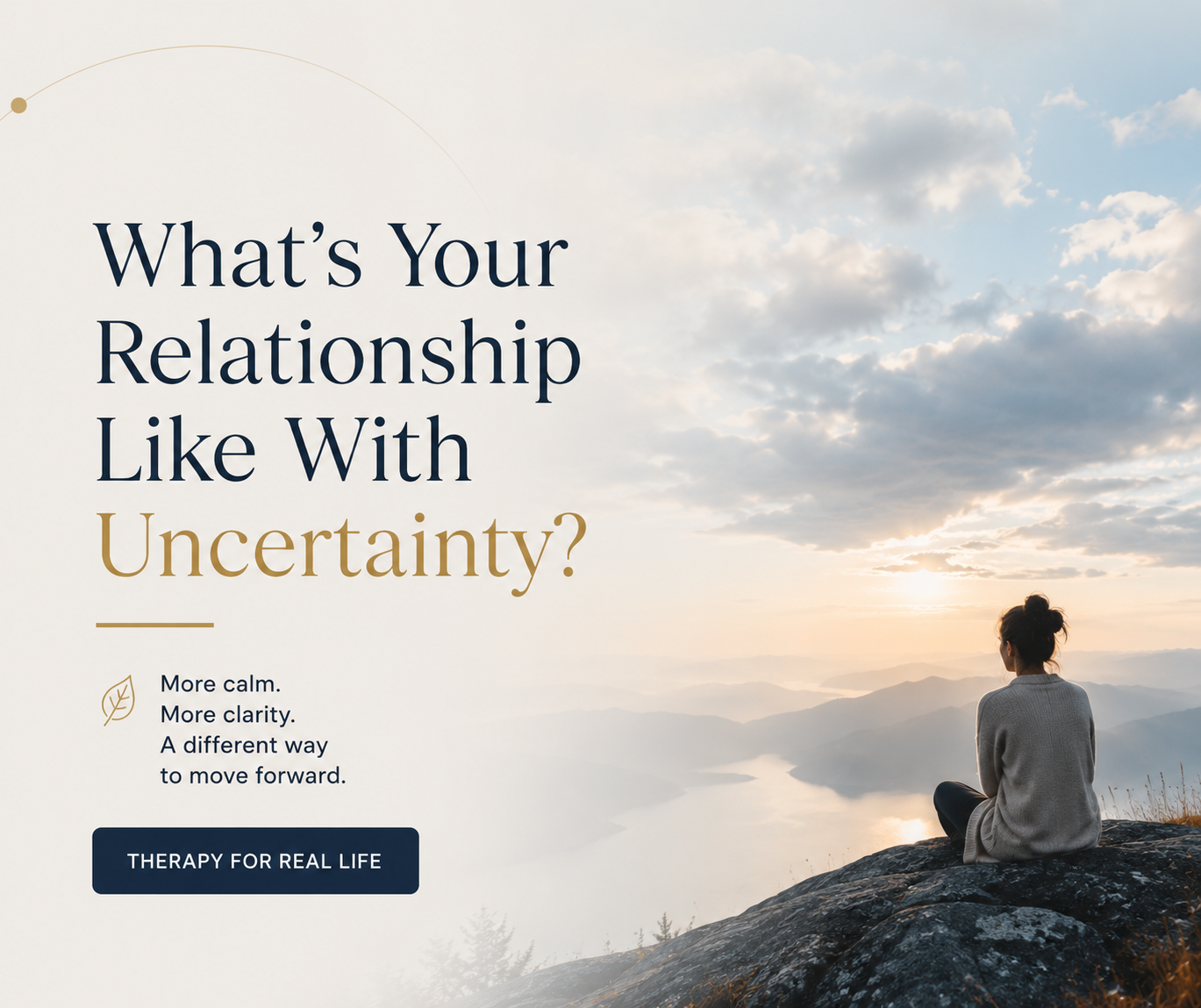
The sky.
The sky doesn't brace against the weather. It doesn't try to stop the clouds forming or resolve the storm before it arrives. It just holds the space for whatever is passing through and stays exactly what it is throughout. Vast. Permanent. Unchanged by all of it.
The uncertainty, the negative thoughts, the what ifs, they're the weather. They form, they move through, and if you stop trying to anchor them in place by fighting them or fixing them or seeking certainty about them, they pass.
Because that's what weather does when the sky stops treating it like an emergency.
You are not the weather.
You are the sky.
The question isn't how to make the uncertainty go away. It never goes away. The question is whether you've got a big enough sky to hold it from?
So How Do You Actually Build It?
Firstly, notice the urge before you act on it. Before you check the phone, send the follow up message, ask the question again; just pause and notice that the urge is there. You don't have to fight it. Just see it for what it is. Your nervous system asking for certainty it isn't going to get.
Let the feeling be present without resolving it. The discomfort of uncertainty has a natural lifespan. It rises, it intensifies, it peaks and then, if you don't feed it by seeking reassurance or running the scenarios again, it starts to subside. It's uncomfortable. But it's survivable. And every time you let it pass without acting on it you teach your nervous system something it may never have learned before. That you can hold this.
Now ask yourself honestly. Is there anything I can actually do about this right now? Sometimes there is. Do that thing. But a lot of the time the answer is no, not yet, or not ever and that's the moment to put the thought down rather than carry it around looking for a resolution that doesn't exist.
Interrupt the loop with something physical. Not as a distraction but as a genuine pattern interrupt. Move your body. Get outside. The nervous system lives in the body and sometimes the fastest way to shift a thought spiral is to change what the body is doing. A walk works. The gym works. Anything that brings you back into the physical present rather than the imagined future.
Also name what's actually happening. Not "I'm anxious" but "I'm sitting with uncertainty about X and my nervous system is treating it like a threat." That small act of naming creates a tiny bit of distance between you and the feeling. Enough to remember that you are the sky. Not the weather.
That's how the sky gets bigger. One uncomfortable moment held, one urge not acted on, one loop interrupted. Not dramatically. Just steadily.
The Real Work
Building a different relationship with uncertainty is about going back to where the relationship was first formed and updating what you learned there.
That's what I work with. Not the symptoms. The source.
Most of the checking and the catastrophising and the need to know isn't actually about the present situation. It's an old pattern running on new material. Your nervous system doing in 2026 what it learned to do in 1995 or 1985 because nobody told it things had changed.
Because when the source shifts, the relationship changes. Not all at once. But steadily, genuinely, in a way that actually lasts.
And you get to find out what it feels like to stand in the gap between what you know and what you don't and actually be okay there.
Just like standing at a Scottish bus stop in July.
Cagoule in one hand. Sunscreen in the other.
Absolutely fine either way.