An Emotion Lasts 90 Seconds. So What Are We Actually Running From?
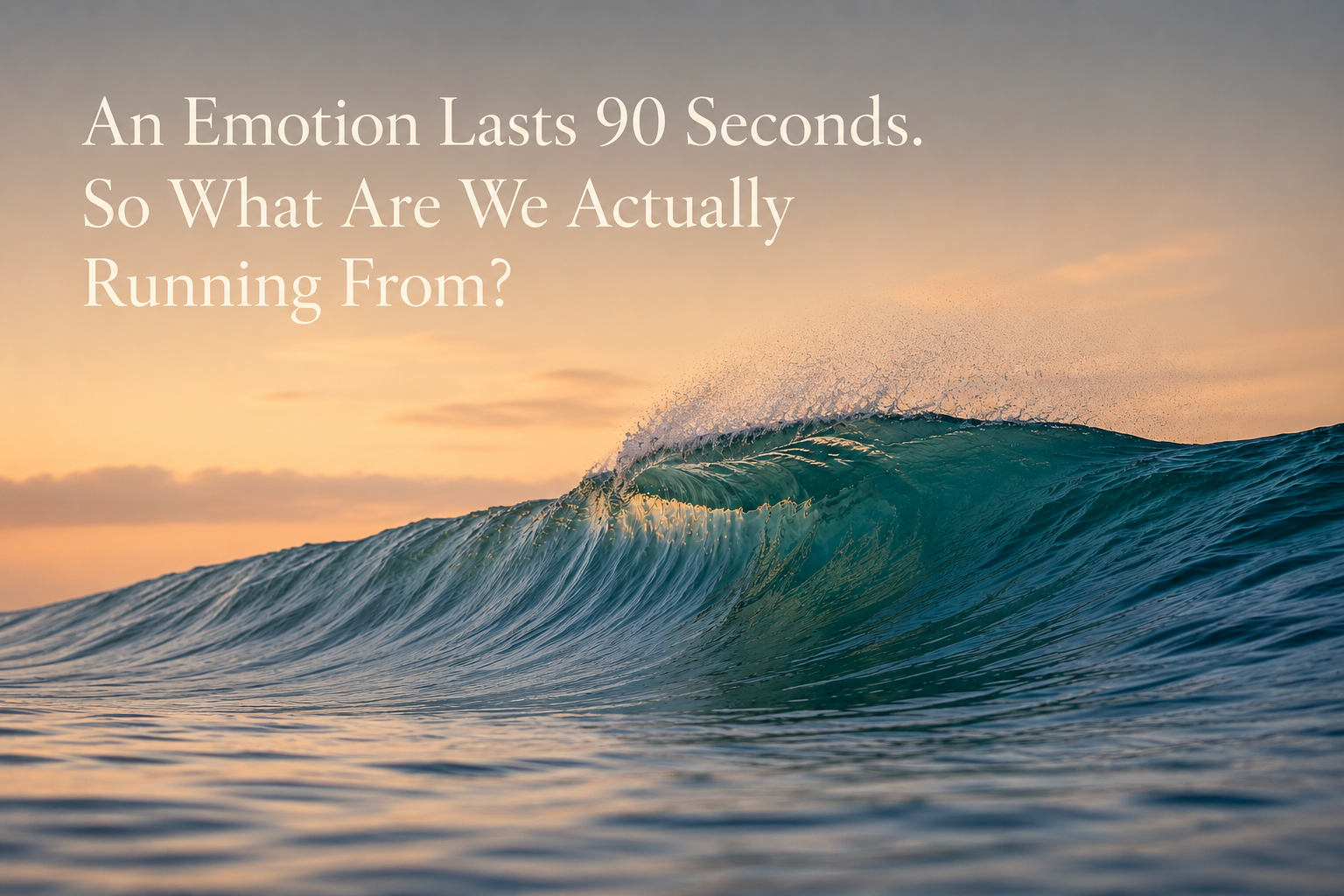
Ninety seconds.
That's how long an emotion lasts if you actually let it move through you without interference. Ninety seconds of pure, uninterrupted feeling and then physiologically, chemically, in your actual body and it's done.
I'll give you a moment with that.
Because if you're anything like most of the people I work with, your first reaction is either "that's complete nonsense" or "then why does mine feel like it's been going since 2009."
Both are valid responses. And both tell you something important.
First. What actually is an emotion?
Not in a textbook way. In a real, happening-in-your-body way.
An emotion is a chemical event. Something happens, real or imagined, present or remembered and your brain releases a cocktail of chemicals into your bloodstream. Those chemicals create a physical sensation. The tightening in your chest. The heat in your face. The hollow feeling in your stomach that you've been calling anxiety for so long you've forgotten it has a name.
That's it. That's the emotion. Chemicals, sensation, body.
And here's the thing about chemicals. They move through the bloodstream and they clear.
The neuroscientist Jill Bolte Taylor wrote about this in her book My Stroke of Insight after having a stroke and observing her own brain from the inside in real time. She discovered that the physiological chemical response of an emotion , the actual wave moving through the body, runs its course in approximately 90 seconds if you don't interfere with it. After that, any continuation of the feeling isn't the original wave. It's you retriggering it with thought, story or resistance.
Which is an extreme way to learn things but here we are.
So why does yours feel permanent?
Because you're not actually feeling it.
Here's what we do instead of feeling feelings.
We suppress them. We think about them. We analyse them. We judge them. We judge ourselves for having them. We google them. We text our friends about them. We eat something. We scroll. We plan how to make the feeling stop. We worry that the feeling means something terrible about us or our lives or our futures.
We do everything except actually feel the feeling.
And every single one of those responses; the analysing, the avoiding, the distracting , resets the ninety seconds. The chemical wave can't complete its journey because we keep pulling it back to the beginning.
So the feeling doesn't last ninety seconds. It lasts days. Weeks. Sometimes years. Not because the emotion itself is permanent but because we've become very, very good at keeping it alive without realising that's what we're doing.
Why do we do this?
Probably because nobody taught us not to.
We learned, somewhere along the way, that certain feelings were too uncomfortable. Too inconvenient. Too messy. Too scary. We learned to manage them, suppress them, power through them, or perform our way around them.
Some of us learned this from families where emotions weren't discussed. Some of us learned it from environments where being visibly affected by something felt dangerous. Some of us just absorbed it from a culture that prizes productivity and composure and has very little language for sitting with discomfort.
And some of us feel things so intensely that we decided early on that the feeling itself must be the problem. That if we could just stop feeling so much everything would be fine.
It was never the feeling that was the problem.
It was never having been taught that feelings are survivable.
The brain's role in all of this
Your brain is genuinely, enthusiastically trying to protect you from discomfort. That's its job and it takes it very seriously.
It notices that feeling that thing was uncomfortable last time. So it helpfully suggests some alternatives. Have you considered scrolling? Or having an argument with someone in your head? Or running seventeen worst case scenarios? Or just generally avoiding the entire situation that might produce that feeling again?
The brain calls this protection. Therapists call it avoidance. The result either way is that the feeling never gets to complete its ninety seconds and you never get to discover that you could actually hold it.
The irony is that the avoiding is so much more exhausting than the feeling would have been.
So how do you actually feel a feeling?
I like the RAIN approach from psychologist and meditation teacher Tara Brach. It's simple enough to actually use when you're in the middle of something difficult which is the only time it matters.
Recognise what's happening. Name it. Not "I'm a mess" but "this is shame" or "this is fear" or "this is grief." Naming creates just enough distance between you and the feeling to remember that you are not the feeling. You are the person having it.
Allow it to be there. Without immediately trying to fix it or explain it away or make it more comfortable. Just let it exist for a moment. This is the part that feels impossible and isn't.
Investigate where you feel it in your body. Not what you think about it. Where is it? Your chest? Your throat? Your stomach? Get curious rather than analytical. The body is where the feeling actually lives and the body is where it needs to be met.
Nurture yourself the way you would a friend who was feeling this. With some basic human kindness rather than the running commentary of criticism most of us subject ourselves to when we're struggling.
That's it. Recognise, Allow, Investigate, Nurture.
Ninety seconds. Sometimes a bit more. But not years.
What prolongs it
Since we're being honest.
Resistance prolongs it. The fighting, the pushing away, the insisting that you shouldn't be feeling this or that you don't have time for this right now.
Rumination prolongs it. The thinking about the feeling rather than feeling the feeling. Going over it again and again looking for a resolution that thinking was never going to provide.
Suppression prolongs it. Feelings that don't get felt don't disappear. They go underground and come back later wearing different clothes. Usually as anxiety, or physical tension, or a sudden disproportionate reaction to something small that is absolutely not actually about the small thing.
And story prolongs it. The narrative we build around the feeling. Not just "I feel sad" but "I feel sad and this means I'm fundamentally broken and I'll always feel this way and nobody else feels this and what is wrong with me." The feeling is ninety seconds. The story can run indefinitely.
The feeling itself is almost never the problem.
What this means in practice
You don't need to become someone who processes every emotion in real time with perfect mindfulness and a journal. That's not a real person.
You just need to get a little less afraid of what happens when you stop running.
Because here's what I've watched happen with people who start actually feeling their feelings instead of managing them. The anxiety reduces. Not because the feelings stop coming but because the nervous system learns something it may never have been taught before. That feelings arrive and feelings pass. That they are survivable. That you are bigger than any feeling that moves through you.
You are the sky. The feelings are the weather.
They were always going to pass.
You just needed someone to tell you it was safe to let them.
Where I come in
A lot of what brings people to therapy isn't just the feeling itself. It's the years of accumulated effort it took to not feel it.
The exhaustion of the management. The anxiety that built up around the avoidance. The identity that formed around being someone who holds it together.
When we go back to where the avoiding started, when we update what the nervous system learned about whether feelings were safe, the feelings stop being so terrifying. They become information rather than emergency. Weather rather than catastrophe.
Ninety seconds.
You were always going to be okay.
Nobody just told you that soon enough.
If you want to go deeper on the science behind this, Jill Bolte Taylor's TED talk My Stroke of Insight is 18 minutes that will genuinely change how you think about your brain. Worth every second.