


Obsessive -Compulsive Disorder Therapy Glasgow + Online
When your mind gets stuck in a cycle of fear, doubt + uncertainty
If you're living with OCD, you probably already know that it isn't about being tidy or liking things a certain way. It's about getting stuck in a cycle.
A thought appears. It feels frightening, disturbing or impossible to ignore. Anxiety builds and you feel driven to do something to reduce that discomfort. You might find yourself checking, researching, seeking reassurance, performing specific rituals, avoiding situations or repeatedly analysing thoughts in your mind. For a short time, these behaviours can bring relief. But then the doubt returns. And the cycle begins again.

OCD is not about the thoughts. It’s about the meaning attached to them.
One of the most distressing parts of OCD is experiencing intrusive thoughts. These are unwanted thoughts, images, urges or doubts that can feel frightening, disturbing or completely out of character.
A common misunderstanding is that having a thought means something about who you are. It doesn’t.
Everyone experiences unwanted thoughts. With OCD, the brain can attach a sense of threat or importance to these thoughts, creating an urgent need to get certainty or make the anxiety go away.
This is where the OCD cycle begins.
Understanding the OCD cycle
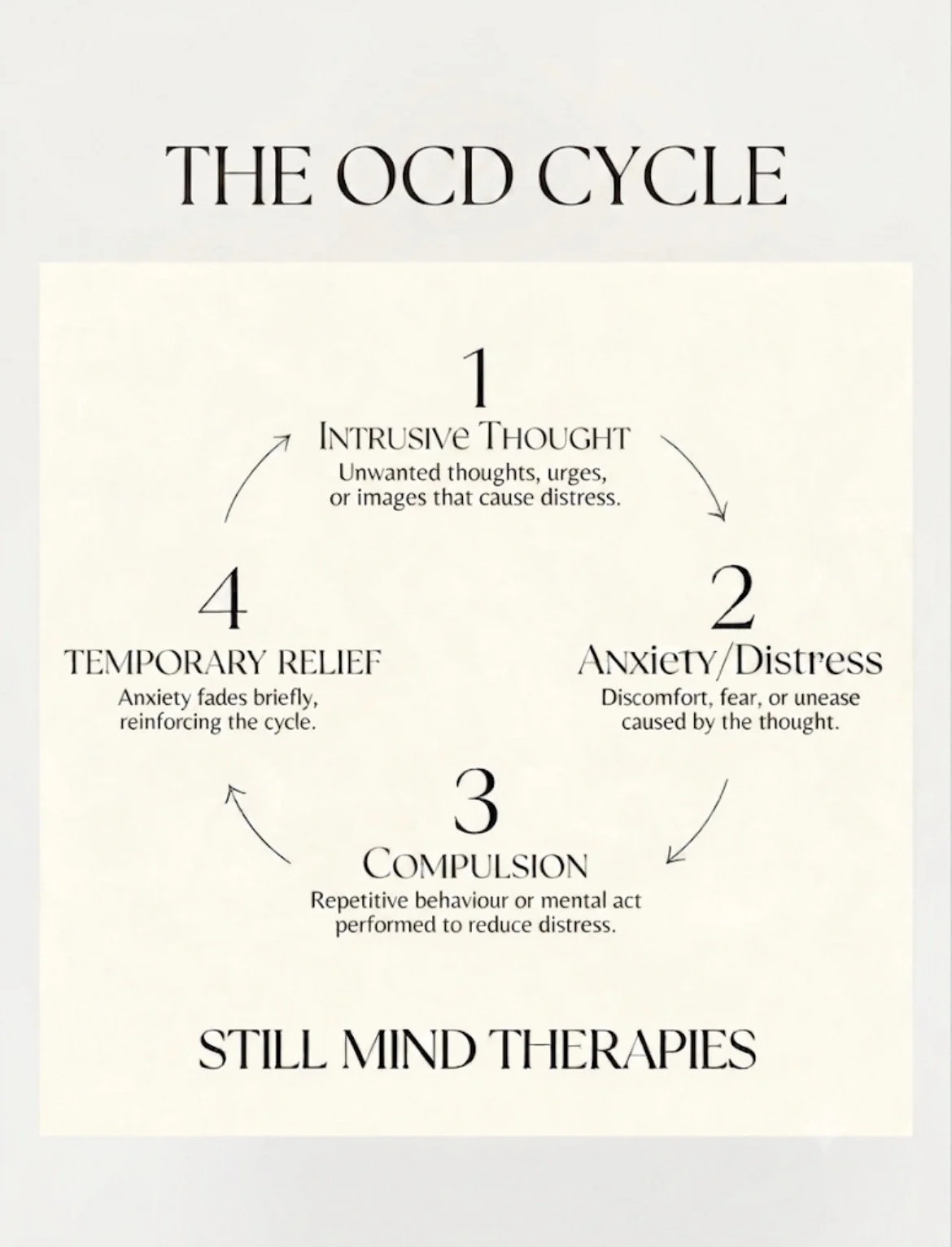
OCD often follows a familiar pattern:
Intrusive thought → Anxiety and uncertainty → Compulsion or reassurance → Temporary relief → Stronger OCD cycle
A thought appears.
Your brain interprets it as important or threatening.
Anxiety rises.
You feel driven to do something to reduce that discomfort → checking, avoiding, researching, asking for reassurance or mentally reviewing.
The anxiety reduces temporarily.
However, the brain can learn:
"That response helped me feel safe, so the threat must have been real."
This reinforces the cycle.
The goal is not to control every thought or eliminate uncertainty completely.
It is to help you feel less controlled by the thoughts and the emotional response attached to them.
OCD can take many different forms
OCD does not look the same for everyone.
It often attaches itself to the things that matter most to you; your health, your relationships, your safety, your values or your sense of being a good person.
You may experience:
Contamination OCD
Fear of germs, illness or contamination, leading to washing, cleaning, avoiding situations or repeatedly checking for safety.
Harm OCD
Distressing thoughts, images or fears about harming yourself or others. These thoughts can feel deeply upsetting, especially because they often go against your values and the person you know yourself to be.
Relationship OCD (ROCD)
Persistent doubts, uncertainty or fears about your relationship, your feelings or whether you have made the “right” choice. This can lead to repeatedly analysing your feelings or seeking reassurance.
Health OCD & Health Anxiety
A fear that something may be seriously wrong with your health, leading to checking your body, researching symptoms, seeking reassurance or struggling to trust that you are okay.
Sexual Intrusive Thoughts
Unwanted sexual thoughts, images or fears that feel disturbing, frightening or completely out of character. Many people experiencing this type of OCD become distressed by what the thoughts might “mean” about them, leading to rumination, checking, avoidance or seeking reassurance.
Having an intrusive thought does not mean you want it, believe it or that it reflects who you are.
Intrusive Thoughts & Pure OCD
Unwanted thoughts, images or doubts that become stuck because the mind feels driven to analyse them, understand them or find complete certainty.
Although OCD can appear in many different ways, the underlying pattern is often similar:
A thought creates fear or uncertainty → the brain searches for safety → relief is found temporarily → the cycle becomes stronger.

Working With The Emotional Patterns Behind OCD
OCD isn’t just about the thoughts themselves, it’s about the fear, uncertainty and emotional response that can become attached to those thoughts.
My approach focuses on understanding these patterns and the emotional responses that keep you feeling stuck.
IEMT works with the emotional intensity connected to memories, experiences and triggers. For some people, there may be past experiences, fears or learned emotional patterns that contribute to feeling stuck in an ongoing threat response. By working with these emotional responses, IEMT can help reduce the intensity attached to certain triggers and experiences.
Hypnotherapy can support the emotional side of OCD by helping you develop a greater sense of calm, reduce the intensity of anxious responses and build a different relationship with your thoughts.
Is this for you?
You may benefit from support if you:
Experience intrusive thoughts, images or urges that feel frightening, upsetting or difficult to let go of.
Feel driven to perform rituals or compulsions to reduce anxiety or feel certain.
Spend a lot of time checking, washing, researching, seeking reassurance or repeating actions until things feel “right”.
Find yourself caught in mental rituals such as analysing, replaying conversations, reviewing memories or trying to prove that a thought is not true.
Feel trapped by “what if?” thoughts or a need for certainty.
Avoid situations, places or experiences because of fear or uncertainty.
Feel overwhelmed by responsibility, making mistakes or needing things to be perfect.
Understand logically that your fears may not make sense, but the emotional response still feels very real.
Feel exhausted by the amount of time and energy spent trying to get relief from anxiety.
Getting Started is Simple.
Book a free consultation. Just fill out the form below and I’ll contact you within 24 hours to arrange a day and time that works for you.
In our consultation, we’ll chat about what you need support with, answer any questions and see how we can work together.
When you’re ready, we’ll book your first session and get started on making real, lasting changes.