

Why Your Brain Hates Uncertainty (And What Actually Helps)

You know that feeling when you send a slightly vulnerable text and then stare at your phone like it's a bomb that might or might not explode?
Or when you're waiting for test results and suddenly you're on WebMD at 3am, three clicks away from diagnosing yourself with a rare tropical disease you definitely don't have?
Or when someone says "we need to talk" and your brain immediately starts writing your resignation letter, divorce papers, and eulogy, all before they've even opened their mouth?
That's uncertainty. And your brain hates it.
The Overs Take Over
Here's what happens when your brain hits uncertainty:
It flips a switch. Suddenly you're in emergency mode. And in emergency mode, your brain doesn't do moderation. It does overs.
Overthinking — analysing every angle, every possibility, every tiny detail
Over-researching — seventeen tabs open, furiously Googling things you can't control
Over-planning — creating backup plans for your backup plans
Over-checking — refreshing your email for the fourteenth time in six minutes
Over-explaining — rambling to anyone who'll listen, trying to make sense of it all
Overworking — staying busy so you don't have to feel the uncertainty
It's not random. It's not weakness. It's your brain desperately trying to create certainty where none exists.
Why Your Brain Does This (The Neuroscience Bit)
Your brain is essentially a prediction machine. It's constantly scanning the environment, trying to predict what's coming next so it can keep you safe.
When it can't predict? When there's a gap in the data? That's when the alarm bells go off.
Because to your ancient nervous system, uncertainty = potential threat.
Back when we were dodging sabre-toothed tigers, not knowing what was in the bushes could literally get you killed. So your brain evolved to treat uncertainty as dangerous.
Fast-forward to now, and your brain still can't tell the difference between:
Waiting for test results
Waiting for a tiger to leap out
To your nervous system, they're both unknowns. And unknowns must be resolved immediately.
So it kicks into overdrive — thinking, planning, researching, checking — trying to manufacture the certainty it craves.
The problem? Most modern uncertainty can't be resolved by thinking harder. It can only be resolved by time.
And your brain? It's not great at waiting.
The Real Cost of Fighting Uncertainty
All that overthinking and over-planning comes at a price:
Mental exhaustion — your brain is running a marathon while sitting still
Physical tension — jaw clenching, shallow breathing, tight shoulders
Sleep disruption — 3am worry spirals, anyone?
Decision paralysis — too afraid to choose in case you choose wrong
Relationship strain — over-explaining, seeking constant reassurance
Missing the present — too busy catastrophising the future to notice what's actually happening now
And here's the cruel irony: all that worrying doesn't actually prepare you for anything. It just exhausts you before the thing you're worried about even happens (if it happens at all).
Practical Tools for Living With Uncertainty
So what do you do when your brain's in full overs mode and you're stuck in the not-knowing?
1. Name What You Actually Know
Your brain is catastrophising the gaps. So fill in what's actually true right now.
Instead of: "They haven't replied. They hate me. I've ruined everything."
Try: "They haven't repliedyet*. That's the only fact I have right now."*
This interrupts the spiral and brings you back to reality, which is usually far less dramatic than your brain's version.
2. Give Your Brain a Job (That Isn't Worrying)
Your brain is trying to "solve" uncertainty by thinking. Give it something else to focus on instead.
Tactical tasks work best:
Organise something physical (a drawer, your phone photos, anything tangible)
Do something with your hands (baking, gardening, Lego — genuinely)
Move your body (even just a 10-minute walk shifts the nervous system)
This isn't distraction. It's redirecting your brain's problem-solving energy towards something you can actually control.
3. The "Not Yet" Reframe
Every time your brain says "I don't know what's going to happen!", add two words: not yet.
"I don't know if I got the job" → "I don't know if I got the jobyet."
"I don't know how this will turn out" → "I don't know how this will turn outyet."
This tiny shift reminds your brain that uncertainty is temporary. The gap will close. Just not right this second.
4. Set "Worry Windows"
Trying to stop worrying rarely works. But containing it can.
Set a 15-minute "worry window" each day. During that time, worry as much as you want. Write it down. Catastrophise freely.
Outside that window? When worry pops up, acknowledge it: "I'll get to you at 7pm."
This trains your brain that worry doesn't need to hijack your entire day. It has its time slot.
5. Reality-Test Your Worst-Case Scenario
Your brain is probably catastrophising. So let's poke holes in it.
Ask yourself:
What's the actual worst that could happen? (Not the dramatic version — the realistic one)
Could I handle that? (Probably yes, even if it would be hard)
What's more likely to happen? (Usually something far more boring)
This isn't toxic positivity. It's realistic recalibration. Your brain is writing horror stories. You're just fact-checking the plot.
6. Anchor in the Present
When your brain's spinning out about the future, drop into your body right now.
Notice:
Five things you can see
Four things you can touch
Three things you can hear
Two things you can smell
One thing you can taste
Sounds simple (and slightly annoying when you're in panic mode), but it works. It pulls your nervous system out of what if and into what is.
7. Just Sit With the Discomfort
This is the one nobody wants to hear, but it's probably the most important.
Stop trying to make the uncertainty go away.
All the overthinking, the over-planning, the compulsive checking — it's all avoidance. You're trying to fix the feeling of not knowing because it's uncomfortable.
But here's the truth: the discomfort won't kill you. It just feels awful.
So instead of fighting it, running from it, or trying to think your way out of it — just let it be there.
Notice it. Name it. "This is what uncertainty feels like in my body right now."
Sit with the tightness in your chest. The churning in your stomach. The restless energy in your limbs.
Don't try to fix it. Don't try to breathe it away or positive-think it into submission. Just let it exist.
Because the more you avoid discomfort, the more power it has over you. The more you practice tolerating it — not enjoying it, just tolerating it — the less it controls your life.
And eventually, your nervous system learns: "Oh. We can survive not knowing. We don't need to panic every time there's a gap."
That's when real change happens.
You've Handled Uncertainty Before (And You'll Handle It Again)
Think about the last time you were in the thick of uncertainty. Waiting for something big. Not knowing how it would turn out.
Maybe it went well. Maybe it didn't. But either way — you handled it.
You didn't have all the answers then either. You were probably terrified. But you got through it.
And you'll get through this one too.
Not because you're strong or brave or special. But because you always have. That's just what humans do. We adapt. We cope. We figure it out as we go.
Your track record for getting through hard things is currently 100%. That's not luck. That's evidence.
So when your brain spirals into "What if I can't handle this?" — you can gently remind it: "I've handled everything so far. This won't be any different."
When You Need More Than Tools
Here's the thing: if you've been practising these tools and you're still spiralling every time uncertainty hits, it's not because you're doing it wrong.
It's because the pattern runs deeper than this moment.
Maybe you grew up in a household where unpredictability was dangerous. Where you never knew which version of a parent you'd get. Where financial security disappeared overnight. Where love felt conditional and you had to stay hypervigilant just to feel safe.
Your nervous system learnt: "If I can see it coming, I can protect myself. If I can't predict it, I'm in danger."
And that made sense. Back then, it kept you safe.
But now? That same pattern is running on autopilot, treating not knowing like you're back in that unpredictable childhood home.
The tools help you manage the symptoms. But they don't update the original programming.
That's where IEMT (Integral Eye Movement Therapy) and Hypnotherapy come in.
IEMT helps your brain reprocess those old memories, the ones that taught you uncertainty equals danger. It clears the emotional charge so your nervous system stops reacting to then when you're living in now.
Hypnotherapy works directly with your subconscious , the part of you that's still running those outdated survival patterns. It updates the belief system at the root: "I'm safe now. I don't need to control everything to survive."
Together, they don't just help you cope with uncertainty. They help you stop fearing it.
So your brain finally learns: not knowing isn't a crisis. It's just… not knowing yet.
And you can breathe in the space between what you know and what you'll find out.
The Truth About Uncertainty
Uncertainty isn't something to fix or overcome. It's just part of being human.
You'll never have all the answers. Life will always throw you curveballs. There will always be waiting rooms, unanswered texts, and situations where you just don't know yet.
But you don't need certainty to be okay.
You just need to trust that you can handle it. Whatever it is.
Because you can. You always have. And you always will.
Craving More Calm?
The Still Mind Toolkit for Instant Calm
Download a free toolkit with five simple techniques you can use immediately to restore a sense of calm when life feels overwhelming.
If any of this resonated, you don’t have to keep doing this alone.

Why Anxious Parents Raise Anxious Children (And How to Break the Cycle)

You’re doing everything right.
You read the parenting books. You validate their feelings. You don’t shout (well, not often). You create a calm, supportive home environment. You’re present, attuned, trying so hard to be the parent you wish you’d had. And yet. Your child is anxious.
They worry about things that seem, objectively, fine. They have meltdowns over minor changes. They ask “what if” questions you can’t answer. They struggle with separation, with sleep, with trying new things.
And you look at them and think: Where did this come from? Except, and here’s the uncomfortable part, you already know where it came from. Because you see yourself in their wide eyes when they’re spiraling. You recognise the way they catastrophise, the way they need reassurance, the way their body goes rigid when things feel uncertain. You see it because you are it. And the guilt? The guilt is crushing. I gave them this. I passed on my anxiety like some cursed heirloom. I’m the reason they’re struggling.
So let me say this before we go any further: Your child’s anxiety is not your fault. But it is connected to yours. And understanding how that works, really understanding it, is the first step to breaking the cycle. Not through better parenting strategies. Not through managing your anxiety harder or hiding it better. Through actually addressing what’s happening in your nervous system. And theirs.
The Thing Nobody Tells You About Anxiety and Parenting
Here’s what they don’t tell you in the parenting books: Anxiety isn’t just passed down through genetics or modelling behaviour. It’s transmitted nervous system to nervous system. Your child isn’t anxious because they learned it from watching you worry , though that can be part of it. They’re anxious because their nervous system is responding to yours.
How Nervous Systems Communicate
Human nervous systems are designed to read each other.
It’s called neuroception, a term coined by Dr Stephen Porges, the researcher who developed Polyvagal Theory. It’s your nervous system’s ability to detect safety or danger in your environment, often without conscious awareness. And children? Children are masters at this. They’re constantly scanning their caregivers for cues: Am I safe? Is everything okay? Can I relax? And here’s the thing: they’re not reading your words. They’re reading your nervous system. So when you say, “Everything’s fine, sweetheart!” while your heart is racing, your jaw is clenched, and your breath is shallow? Your child’s nervous system picks up on the mismatch. Your words say “safe.” Your body says “danger.” And guess which one their nervous system believes? The body. Every time.
Why “Stay Calm for the Children” Doesn’t Actually Work
You’ve probably heard the advice: “Stay calm for your kids. Don’t let them see you stressed.” And listen, I get the intention. But this advice is fundamentally misunderstanding how anxiety works. Because you can’t fake calm to a nervous system. You can control your face. You can modulate your tone. You can say the right words. But if your internal state is anxious, if your body is in fight-or-flight, if your nervous system is dysregulated, your child will feel it. Not because they’re psychic. But because their nervous system is designed to co-regulate with yours.
Think about it; when you hold a crying baby and genuinely feel calm, they settle. When you hold a crying baby whilst internally panicking about whether you’re doing it right, they stay dysregulated. Your child isn’t responding to what you’re doing. They’re responding to what you’re being.
And if you’re chronically anxious, if your baseline state is low-level hypervigilance, tension, worry, your child’s nervous system is absorbing that as: The world is not safe. I need to stay alert. Even when you’re trying your absolute hardest to protect them from your anxiety.
The Anxious Parent-Anxious Child Feedback Loop
Here’s where it gets even more complicated and why this is so hard to break. When your child is anxious, your anxiety spikes. You see them struggling, and your nervous system goes into overdrive trying to fix it, soothe it, prevent it. You become hypervigilant to their distress. Which means your nervous system gets more dysregulated. Which means their nervous system picks up on your heightened state. Which makes them more anxious. Which makes you more anxious.And round and round you go.
It’s not your fault. It’s not their fault. It’s just two nervous systems stuck in a dysregulated dance, each responding to the other’s distress. And no amount of “calm down” or “don’t worry” will interrupt it because the communication is happening below the level of conscious thought.
Why Your Childhood Is Showing Up in Your Child’s Anxiety
Okay, here’s where we need to talk about your nervous system. Because chances are, your anxiety didn’t start with you. It started with your own childhood.
Maybe you grew up in a home where:
Love felt conditional on being “good” or “easy”
Emotions weren’t allowed or were met with dismissal or anger
One or both parents were anxious, depressed, or emotionally unavailable
There was unpredictability: financial stress, conflict, instability
You learnt early on that the world wasn’t safe, and you had to stay vigilant
And so your nervous system adapted. It learnt to be on alert. To scan for danger. To stay small and good and careful. That wasn’t a choice. That was survival. But here’s the problem: that same survival wiring is still running today. And your child’s nervous system? It’s picking up on that. They’re not just absorbing your present day stress. They’re absorbing the unresolved activation from your childhood. The hypervigilance you learnt at age 6? Your child is learning it now. The belief that the world isn’t safe unless you’re in control? They’re internalising it. The chronic tension in your body, the inability to fully relax, the constant low level hum of “something could go wrong”? They feel it. And so the cycle continues. Not because you’re a bad parent. But because unhealed patterns don’t skip a generation.
What Breaking the Cycle Actually Looks Like
So what do you do? How do you stop your anxiety from becoming your child’s anxiety?
Here’s what doesn’t work:
Trying harder to hide your anxiety from them
Forcing yourself to “stay calm” when you’re not
Overcompensating by being overly permissive or controlling
Feeling guilty and spiralling into shame
Reading more parenting books hoping for the magic strategy
None of that addresses the actual problem. The problem is: your nervous system is still running on outdated survival programming. And until you address that, until you help your nervous system understand that the danger is over, that you’re safe now, your child’s nervous system will keep responding to yours.
What Actually Helps: Regulating YOUR Nervous System
Breaking the cycle doesn’t mean becoming a perfectly calm, zen parent who never feels anxious.
(Spoiler: that parent doesn’t exist. And if they did, they’d be insufferable.)
Breaking the cycle means:
1. Helping your nervous system come out of chronic hypervigilance
This is the foundational work. Your body needs to learn that it’s safe to relax. That you don’t have to scan for danger 24/7. That rest is not dangerous. This isn’t something you can think your way into. It requires nervous system level work, which is where therapies like IEMT (Integral Eye Movement Therapy) and Hypnotherapy become incredibly valuable. These approaches work directly with the part of your brain that’s holding the hypervigilance, the unresolved stress, the childhood patterns that are still running the show.
2. Processing the unresolved activation from your own childhood
Your childhood experiences didn’t just shape your beliefs. They shaped your nervous system’s baseline state. If you grew up in a state of chronic stress, unpredictability, or emotional neglect, your nervous system adapted to that. It learnt to stay activated, to never fully settle. And that activation is still there, stored in your body, influencing how you respond to your own children.Processing that, actually discharging the stored stress and rewiring the patterns, frees you from unconsciously passing it on.
3. Learning to co-regulate from regulation, not into regulation
Co-regulation is beautiful when you’re regulated. When you’re genuinely calm, your child can borrow your calm. Your nervous system becomes a resource for theirs. But when you’re dysregulated, you can’t co-regulate your child into calm. You just end up in a dysregulated feedback loop. So the work is: becoming someone whose nervous system is a safe place for your child to land.Not by faking it. But by actually doing the internal work to get there.
4. Giving yourself permission to heal, not just for your kids, but for you.
You don’t have to fix your anxiety just so your children don’t inherit it. You deserve to heal for you. You deserve to not live in a constant state of hypervigilance. You deserve to feel safe in your own body. You deserve to experience rest that actually feels restful. And yes, your healing will absolutely benefit your children. But it’s not only for them. It’s for you. For the child you were, who never got to feel safe. For the adult you are now, who’s been carrying this for far too long.
What This Looks Like in Real Life
So what does this actually look like in practice? Let’s say your child comes to you, spiralling about something: school, a social situation, an upcoming event.
Old pattern (dysregulated response):
Your own anxiety spikes immediately. Your chest tightens. You feel responsible for fixing this, for making them feel better right now. You either: Over reassure them (“It’s going to be fine! Don’t worry!”) whilst internally panicking Get frustrated (“We’ve talked about this a hundred times!”) Try to logic them out of their feelings (“But there’s nothing to worry about!”)Your child doesn’t settle. They might stop talking, but the anxiety is still there. They’ve just learnt not to come to you with it.
New pattern (regulated response):
You notice your own nervous system activating, but you have the capacity to pause. You take a breath. You check in with your body. You remind yourself: I am safe. They are safe. This feeling will pass. Then you respond from that place of regulation: You acknowledge their feelings without trying to fix them immediately (“I can see this feels really big right now.”) You offer your calm presence, not frantic reassurance. You stay with them in the discomfort, modelling that feelings are safe to feel. Your child might not calm down immediately. But over time, they learn: My parent can handle my big feelings. I don’t have to regulate myself alone. It’s safe to feel what I feel. That’s the difference. Not perfect parenting. But regulated parenting. The Work Isn’t “Parenting Better”, It’s Healing Yourself. I know this might feel like a lot. You’re already exhausted. You’re already trying so hard. And now I’m telling you the answer isn’t a better parenting strategy, it’s therapy for you? Yes. And I’m sorry if that feels overwhelming. But here’s the truth: You cannot give your child a regulated nervous system by reading parenting books. You cannot think your way out of patterns that are stored in your body. You cannot “stay calm for the kids” when your own nervous system is in a chronic state of activation. The most powerful thing you can do for your anxious child is heal your own nervous system. Not because their anxiety is your fault. But because your healing gives them permission to heal too. When you stop living in a state of hypervigilance, they don’t have to either. When you process the unresolved stress from your own childhood, they don’t inherit it. When your nervous system learns it’s safe to rest, theirs learns the same.
Why Traditional Talk Therapy Often Isn’t Enough
If you’ve tried talk therapy for your anxiety and felt like you understood everything intellectually but nothing actually changed, this is why. Anxiety isn’t just a thought problem. It’s a nervous system problem. You can understand why you’re anxious. You can recognise the patterns. You can even have insight into how your childhood shaped you. But if your nervous system is still running on the same survival programming, the anxiety doesn’t go away. This is where approaches like IEMT and hypnotherapy are so effective, because they work directly with the nervous system, not just the conscious mind. IEMT helps process the stored emotional charge and rewire the patterns that keep you stuck in hypervigilance. Hypnotherapy accesses the subconscious beliefs and nervous system states that are running the show, allowing you to update them at the root level. These aren’t just “nice to have” therapies. For nervous system-level healing, they’re often essential.
What Healing Actually Feels Like
So what does it look like when you start to heal your nervous system? It doesn’t mean you never feel anxious. You’re human. Anxiety is part of being human. But it means: Your baseline state shifts from hypervigilance to relative calm. You can feel anxiety without being consumed by it. You don’t automatically catastrophise every situation. Your body knows how to return to rest after stress. You can be present with your child’s emotions without immediately needing to fix them. You stop passing on the unresolved patterns from your own childhood. And your child? They start to relax too. Not because you’re doing anything differently on the surface. But because the internal landscape they’re navigating, you, has changed. Your nervous system becomes a place of safety. And from that safety, they can learn to regulate their own.
The Truth About Breaking the Cycle
Here’s what I want you to know: Your child’s anxiety is not your fault. But your healing can be their greatest gift. Not because you owe it to them. But because when you heal, everyone benefits. You get to live in a body that feels safe. Your child gets to grow up in a nervous system environment that’s regulated. And the patterns that have been passed down for generations? They stop with you. That’s not just parenting work. That’s generational healing. And it’s some of the most important work you’ll ever do.
So What Now?
If you’re reading this and recognising yourself, if you can see the ways your anxiety is showing up in your child, and you’re ready to do something about it, here’s the thing. This isn’t about becoming a “better” parent. It’s about becoming a regulated one. And that work? It’s not something you can do alone through willpower or self-help books. It requires support. It requires nervous system level intervention. It requires someone who understands how trauma and anxiety live in the body, not just the mind.
That’s the work I do.
Craving More Calm?
The Still Mind Toolkit for Instant Calm
Download a free toolkit with five simple techniques you can use immediately to restore a sense of calm when life feels overwhelming.
If any of this resonated, you don’t have to keep doing this alone.

Why Success Makes Imposter Syndrome Worse (And How to Actually Heal It)

You landed the client. You finished the degree. You hit the milestone. You did the thing you've been working toward for months, maybe years.
And instead of feeling proud, accomplished, or relieved... you feel like you've somehow fooled everyone into thinking you're competent.
Surely they'll realise soon. Surely someone will notice I don't actually know what I'm doing. Surely this is all about to come crashing down.
Welcome to the imposter syndrome paradox: the more you achieve, the more fraudulent you feel.
And here's the part that nobody warns you about, success doesn't cure it. Success often makes it worse.
Let me explain why. And then, more importantly, what actually helps.
The Achievement Paradox
Most people assume that imposter syndrome is just a confidence issue. That once you achieve enough, prove yourself enough, or get enough external validation, the feeling will go away.
It doesn't.
In fact, for many people, the opposite happens. Each new achievement raises the stakes, increases the visibility, and deepens the certainty that you're one mistake away from being "found out."
Here's what actually happens with each success:
Success = Higher Expectations
You get promoted. Great! Now you're expected to perform at an even higher level. And if you felt like you were barely keeping up before, now the bar is even higher.
Your brain:"I barely managed at the last level. How am I supposed to do THIS?"
Success = More Visibility
The better you do, the more people notice you. And when more people are watching, there are more opportunities to "mess up" and reveal that you're not as capable as they think.
Your brain:"The more visible I am, the more likely someone will realize I don't belong here."
Success = The Stakes Get Higher
When you were starting out, mistakes felt survivable. But now? Now you have a reputation. Responsibilities. People depending on you. The fall from here would be so much worse.
Your brain:"I can't afford to fail now. There's too much to lose."
Success = Proof That You're "Getting Away With It"
Every achievement becomes evidence that you've somehow managed to trick people into thinking you're competent. Which means the inevitable exposure is coming.
Your brain:"I've fooled them this long. But it can't last forever."
See the trap?
The very thing you thought would fix the imposter feeling, achievement, actually reinforces it.
Why External Validation Never Works
You think: "If I just get this one thing—this job, this award, this milestone—then I'll finally feel like I deserve to be here."
But when you get it, the feeling doesn't arrive. Instead, you immediately move the goalposts.
"Well, anyone could have done that. The real test is the NEXT thing."
Because here's what imposter syndrome actually is: it's not a lack of evidence that you're capable. It's a refusal to believe the evidence that already exists.
You could have:
A wall full of qualifications
A decade of experience
Glowing testimonials
Objective proof of competence
And your brain will still find a way to dismiss it all.
"I just got lucky."
"They're just being nice."
"Anyone could do what I do."
"I'm not REALLY an expert."
This is why chasing achievements to cure imposter syndrome is like trying to fill a bucket with a hole in the bottom. No amount of external validation will ever be enough if you fundamentally don't believe you're allowed to claim your own competence.
The Real Root: It's Not About What You've Achieved
So if success doesn't cure imposter syndrome, what does?
First, you need to understand what's actually creating the feeling.
Imposter syndrome isn't about lacking confidence or needing more proof of your abilities.
It's about a core belief, usually formed in childhood, that your worth is conditional.
Let me explain.
The Childhood Pattern Underneath
Most people with imposter syndrome grew up in environments where love, approval, or safety felt conditional on performance.
Maybe:
Praise only came when you achieved something
Your worth was tied to grades, accomplishments, or being "good"
Mistakes were met with criticism, disappointment, or withdrawal
You learned that being valuable meant being useful, competent, or achieving
So you internalised a belief:"I'm only worthy when I'm performing at a high level. If I stop achieving, I stop mattering."
And here's the kicker: no amount of achievement will ever feel like enough, because the system was designed to keep you performing.
You're not trying to prove you're capable. You're trying to prove you're allowed to exist.
And that's a battle you can never win through achievement alone.
Why High Achievers Struggle Most
If you're wondering why imposter syndrome seems to hit successful people the hardest, this is why.
High achievers aren't high achievers despite imposter syndrome. They're often high achievers because of it.
The belief that you're only valuable when you're performing? That creates:
Relentless work ethic (because stopping feels dangerous)
Perfectionism (because mistakes = exposure)
Overdelivering (because doing the minimum feels fraudulent)
Constant self-improvement (because you're never "enough" as you are)
So you achieve. A lot.
But every achievement just confirms the belief: "See? I HAVE to keep performing. The moment I stop, I'll be found out."
This is why therapists, doctors, lawyers, entrepreneurs, creatives, and high level professionals are drowning in imposter syndrome despite objective evidence of competence.
Because imposter syndrome isn't about competence. It's about worthiness.
And you can't achieve your way into feeling inherently worthy.
The Perfectionism Connection
If you're reading this and thinking, "Wait, this sounds like my perfectionism," you're right.
Imposter syndrome and perfectionism are deeply intertwined.
Perfectionism says: "I must be flawless to be acceptable."
Imposter syndrome says: "I'm not actually competent, so I need to be perfect to hide that fact."
Both are rooted in the same belief: conditional worth.
And both create the same exhausting cycle:
Set impossibly high standards
Work yourself into the ground trying to meet them
Achieve the thing (or come close)
Dismiss the achievement as "not good enough" or "anyone could do that"
Move the goalposts
Repeat
No wonder you're exhausted.
You're not just trying to do well. You're trying to earn the right to exist without being exposed as unworthy.
What Actually Helps
So if success doesn't cure imposter syndrome, what does?
Here's the uncomfortable truth: you have to address the belief system underneath.
Not the symptoms (self-doubt, overworking, perfectionism). The root.
And the root is this: the belief that your worth is conditional.
1. You Have to Separate "Being Good" from "Being Worthy"
This is the hardest one, because your brain has been conflating these for decades.
Being good at something = being worthy of existing.
You don't have to earn your right to take up space. You don't have to justify your existence through achievement. You're not only valuable when you're performing.
But here's the thing: you can't just think your way into believing this. Because the belief isn't held in your conscious mind.
It's encoded in your nervous system. In your identity. In your subconscious patterns.
Which is why traditional "just be more confident!" advice doesn't work.
2. You Have to Process the Emotional Charge
Your imposter feelings aren't just thoughts. They're nervous system responses.
When you're about to speak up in a meeting, or share your work, or step into visibility, your body goes into a stress response.
Because to your nervous system, visibility = danger.
(Remember: you learned early on that being "too much" or making mistakes could result in criticism, rejection, or loss of approval.)
So your body tries to keep you small. Quiet. Invisible. Safe.
You can't logic your way out of a nervous system response.
You have to help your body understand that visibility is no longer dangerous. That making mistakes won't result in abandonment. That you're allowed to be seen, even when you're imperfect.
And this is where therapies like IEMT (Integral Eye Movement Therapy) become incredibly valuable because they work directly with the emotional charge and nervous system activation that keeps the imposter pattern stuck.
3. You Have to Reconstruct Your Identity
This is the deepest level of work, and the most transformative.
Imposter syndrome is an identity issue.
Your identity is: "I'm not really [insert role/title]. I'm just pretending."
And as long as that's your identity, no amount of evidence will convince you otherwise.
So the work is: building an identity that isn't conditional on performance.
An identity that says: "I'm allowed to be here. I'm allowed to make mistakes. I'm allowed to still be learning. I'm enough, even when I'm not perfect."
This doesn't mean you stop achieving. It means you stop needing achievement to feel like you exist.
And that shift? That's what actually cures imposter syndrome.
Not more success. Not more validation. Not more proof.
Permission to be imperfect and still worthy.
Why The Right Kind Of Therapy Matters
Here's where I need to be honest: this isn't work you can do through affirmations or self-help books alone.
Because the beliefs driving imposter syndrome are:
Subconscious (you can't access them through logic)
Nervous-system encoded (they're stored in your body, not just your mind)
Identity-level (they're about who you are, not just what you do)
You need approaches that work at those levels.
That's why I work with Integral Eye Movement Therapy (IEMT) and Hypnotherapy
Hypnotherapy helps you:
Access the subconscious beliefs that are running the show
Reprogram identity-level patterns ("I'm a fraud" → "I'm allowed to claim my competence")
Create new neural pathways that support genuine self-belief
IEMT helps you:
Process the emotional charge around being "found out"
Clear the nervous system activation that makes visibility feel dangerous
Resolve the childhood patterns that created conditional worth
When you work at these levels, change stops being a battle. It becomes an unfolding.
What Healing Actually Looks Like
So what does it look like when you start to heal imposter syndrome?
It doesn't mean you suddenly feel supremely confident. (That's not the goal, and honestly, that's exhausting too.)
It means:
You can receive a compliment without immediately deflecting it
You can make a mistake without it confirming you're a fraud
You can share your work without spiraling into "everyone will think I'm incompetent"
You can own your expertise without feeling like you're lying
You can rest without feeling like you're "falling behind"
You can be visible without your nervous system panicking
It means your worth stops being conditional on achievement.
And when that happens? You still achieve probably even more, actually but it's no longer driven by fear. It's driven by genuine interest, creativity, and desire.
That's the difference between performing to survive and creating because you want to.
The Truth About "Enough"
You will never achieve enough to feel like you're enough.
Not because you're broken. But because the system was never designed for you to reach "enough."
It was designed to keep you performing, striving, proving.
So the only way out is to realise: you were always enough.
Not because of what you've achieved. But because worthiness isn't something you earn.
It's something you are. Even when you're imperfect. Even when you're still learning. Even when you make mistakes.
Especially then.
So What Now?
If you're reading this and recognizing yourself in every paragraph, here's what I want you to know:
You're carrying a belief system that was never yours to carry.
And the work isn't to achieve more, prove more, or perform more.
The work is to give yourself permission to stop.
To stop performing for approval. To stop earning your right to exist. To stop trying to be perfect enough that nobody realizes you're human.
And to start building a version of yourself that doesn't need external validation to feel whole.
That's not the easy path. But it's the only one that actually works.
Craving More Calm?
The Still Mind Toolkit for Instant Calm
Download a free toolkit with five simple techniques you can use immediately to restore a sense of calm when life feels overwhelming.
If any of this resonated, you don’t have to keep doing this alone.

The People Pleaser's Paradox: Why Everyone Loves You and Nobody Knows You
When you're constantly shape shifting to meet everyone else's needs, nobody actually knows who you are.

You know that thing you do where someone asks you for something and before your brain has even processed the request, your mouth is already saying "Of course! No problem! Happy to help!"
And then 30 seconds later you're standing there thinking, "Wait... why did I just agree to that? I don't even WANT to do that. I'm already exhausted. Why can't I just say no?"
However, it's not about being "too nice." It's not about having poor boundaries, though that's a symptom. And it's definitely not about lacking assertiveness skills. People pleasing is a trauma response. Specifically, it's called the fawn response and your nervous system has been running this programme in the background for years, possibly decades, without you even knowing it had a name.
Fight, Flight, Freeze... and Fawn
You've probably heard of fight, flight, or freeze. These are your nervous system's survival responses when it detects danger.
Fight: Get angry, defend yourself, push back
Flight: Run away, avoid, escape
Freeze: Shut down, go numb, play dead
But there's a fourth response that doesn't get talked about nearly enough:
Fawn: Appease, please, become whatever the other person needs you to be so they don't hurt you.
If you grew up in an environment where fighting back wasn't safe, running away wasn't an option, and freezing got you in more trouble... your nervous system learned a fourth survival strategy:
Make yourself useful. Make yourself pleasant. Make yourself indispensable. Become so helpful, so agreeable, so easy to deal with that you're not a threat.
Because if you're not a threat, maybe you're safe.
When Being "Good" Becomes Your Survival Strategy
Think about it. If you were a child in a home where:
A parent's mood could turn on a whim
Conflict meant emotional or physical danger
Your needs were ignored or punished
Love felt conditional on your behaviour
You had to manage other people's emotions to keep the peace
...you learned very quickly that your safety depended on keeping other people happy.
You became the good child. The helpful one. The one who didn't cause problems. The one who could read a room and adjust accordingly.
And it worked! It kept you safe, enough. It got you approval, sometimes. It made you valuable, conditionally.
But that survival strategy is still running... even though you're not a child anymore and you're not in danger.
The Exhaustion of People Pleasing
Here's what people pleasing actually looks like in adulthood:
Saying yes when you mean no
Over explaining, over apologising, over-functioning
Feeling responsible for other people's feelings
Anticipating what others need before they ask
Struggling to make decisions (What if I pick wrong and disappoint someone?)
Feeling guilty when you prioritize yourself
Anxiety when someone is upset with you (even if you did nothing wrong)
Resentment building up because you're constantly giving but rarely receiving
Losing yourself in relationships because you become whoever they need
Attracting people who take, take, take (because you give, give, give)
Why "Just Set Boundaries" Doesn't Work
If you've ever googled "how to stop people pleasing," you've probably been told to:
"Just say no"
"Set clear boundaries"
"Put yourself first"
"Stop caring what people think"
"Be more assertive"
Great advice! Except when you try it, your nervous system freaks out.
Because to your nervous system, saying no = danger.
Disappointing someone = threat.
Putting yourself first = selfish = bad = unsafe.
You're not lacking skills or willpower. You're stuck in a nervous system loop that equates your safety with other people's approval.
So when you try to set a boundary, your body floods with anxiety. Your brain screams, "Abort! Abort! This is scary!"
And you cave. Again.
Then you beat yourself up for it.
The Hidden Cost
Here's the really painful part about people pleasing that doesn't get said enough:
When you're constantly shape shifting to meet everyone else's needs, nobody actually knows who you are.
Including you.
You've spent so long being what others need that you've lost touch with:
What you actually want
What you actually feel
What you actually need
Who you actually are
Relationships feel hollow because you're not really IN them. You're performing. Managing. Anticipating. Adapting.
But you're not showing up as yourself because showing up as yourself has never felt safe.
The Pattern Didn't Start With You
People pleasing doesn't develop in a vacuum. It develops in response to relational environments where:
Your needs were consistently dismissed
Your boundaries were violated
Your emotions were too much or not allowed
Love was conditional on your compliance
Conflict was dangerous
Your job was to manage other people's emotions
Maybe it was:
A parent who needed you to be their emotional support
A chaotic household where you became the peacekeeper
A critical environment where nothing you did was good enough
An unpredictable caregiver whose moods you had to navigate
Emotional neglect disguised as "I'm fine" and "Don't cause problems"
You learned to fawn because it kept you safe. It made you valuable. It earned you scraps of love and approval.
But no it's keeping you stuck, exhausted, and disconnected from yourself.
What Healing Actually Looks Like
It's about helping your nervous system understand that you're not in danger anymore.
That means:
1. Recognising the fawn response when it's happening
Notice when you're auto agreeing, over explaining, or anxiety scanning the room for approval. That's your cue that the fawn response is activated.
2. Understanding it's not your fault
This isn't a character flaw. It's an adaptation. Your nervous system did what it had to do to keep you safe. Honour that. Then gently teach it that you don't need that strategy anymore.
3. Creating safety in your body
Before you can set boundaries in the world, you need to feel safe inside yourself. That's where approaches like IEMT, hypnotherapy and nervous system regulation becomes crucial.
4. Practicing tiny micro-boundaries
Not "tell your boss off" boundaries. Start with:
"Let me think about it and get back to you"
"That doesn't work for me"
Not immediately texting back
Ordering what YOU want at a restaurant
Let your nervous system learn: I can express a preference and I'm still safe.
5. Grieving what you didn't get
You shouldn't have had to earn love by being convenient. You shouldn't have had to manage other people's emotions. You deserved to be seen, valued, and safe just as you were.
That grief is real. Let yourself feel it.
The Relationship Test
Want to know if people pleasing is running your relationships?
Ask yourself:
Do the people in your life know the real you?
Or do they know the version of you that:
Never complains
Always accommodates
Rarely asks for anything
Makes everything easy
Do they know you're struggling? Or do you hide it because you don't want to be a burden?
Do they know what you need? Or do you wait for them to guess (and then resent them when they don't)?
Would they still want you if you were messy, difficult, needy, honest?
If the answer is "I don't know", that's your sign.
What People Pleasing Is Really Costing You
Let's be brutally honest about what this pattern is stealing from you:
Authentic relationships (because nobody knows the real you)
Self-trust (you can't trust yourself when you don't know what you want)
Energy (constantly managing everyone else is exhausting)
Resentment (giving without receiving builds bitterness)
Your identity (you've become a collection of other people's preferences)
Peace (you're always on alert, scanning for disapproval)
And here's the kicker:
The people you're trying so hard to please? Most of them aren't even thinking about you as much as you think they are.
You're exhausting yourself over hypothetical disappointment that often never comes.
Permission Slip
You don't owe anyone:
An explanation for your no
Constant availability
Your mental/emotional labour
Compliance with their expectations
Performance of happiness when you're not happy
Silence about your needs
People who genuinely care about you don't want you to perform for them. They want to know you. The real, messy, honest, complicated you.
And the people who only want the easy, agreeable, accommodating version? They were never really loving YOU anyway. They were loving what you did for them.
That's not love. That's transaction.
Moving From Fawn to Authentic
Healing people-pleasing isn't about becoming selfish or difficult. It's about moving from automatic compliance to conscious choice.
It's learning to ask:
What do I actually want here?
What feels true for me?
Am I saying yes because I want to, or because I'm afraid to say no?
Is this my responsibility or am I taking on someone else's?
Therapies likeIEMTand hypnotherapy are particularly powerful here because they work directly with your nervous system and subconscious patterns, not just your conscious mind.
You can't think your way out of a nervous system response. You have to retrain your body to understand that safety doesn't require constant accommodation anymore.
Final Thought
People pleasing isn't kindness. It's self-abandonment disguised as generosity.
Real kindness? That includes yourself.
Real boundaries? Those keep everyone safe, not just other people.
Real relationships? Those can handle your honesty, your needs, your nos.
You spent years making yourself smaller to keep others comfortable.
What if you stopped?
What if you let people experience their own discomfort without rushing to fix it?
What if you trusted that the people worth keeping will stay even when you're not performing?
What if you finally, finally let yourself be known?
That's the work. And it's worth it.
Craving More Calm?
The Still Mind Toolkit for Instant Calm
Download a free toolkit with five simple techniques you can use immediately to restore a sense of calm when life feels overwhelming.
If any of this resonated, you don’t have to keep doing this alone.

Deconstructing Attachment Styles: The Childhood Blueprint Running Your Relationships

"I know my attachment style is anxious. I've read all the books. So why do I still keep doing the same thing in relationships?"
If you've spent any time on social media or in therapy circles lately, you've probably encountered attachment theory. You might even know your attachment style: anxious, avoidant, secure, or disorganised.
However, knowing your attachment style isn't the same as changing it. Understanding that you're anxiously attached doesn't stop you from spiralling when your partner doesn't text back. Knowing you're avoidant doesn't magically make intimacy feel safe.
That's because your attachment style isn't a personality type or a thinking pattern. It's an emotional survival strategy your nervous system learned before you could even speak.
The Blueprint You Didn't Choose
Your attachment style was formed in the first few years of your life, based on how your earliest caregivers responded to your needs.
When you cried as an infant, what happened? Did someone come quickly and comfort you? Did they come sometimes but not others? Did they seem overwhelmed or irritated by your distress? Or did no one come at all?
Your developing brain was asking a fundamental question: "Can I trust others to be there for me when I need them?"
And based on the answer you received, not in words, but in repeated emotional experiences, your nervous system created a blueprint for relationships.
Secure attachmentdeveloped when caregivers were consistently responsive. Your brain learned: "When I'm in distress, help comes. People are reliable. I'm worthy of care."
Anxious attachmentformed when caregivers were inconsistent. Sometimes they responded beautifully, other times they didn't. Your brain learned: "I need to amplify my distress to get attention. Connection is unreliable. I must work hard to keep people close."
Avoidant attachment developed when emotional needs were repeatedly dismissed or met with rejection. Your brain learned: "Showing vulnerability isn't safe. I must handle everything alone. Needing others leads to pain."
Disorganised attachment emerged when caregivers were the source of both comfort and fear. Your brain learned: "The person I need for safety is also dangerous. There is no safe strategy."
Here's the crucial part: these weren't conscious decisions. They were adaptations. Your nervous system did exactly what it was designed to do—it created the best possible strategy for getting your needs met in the environment you were in.
Why Knowing Doesn't Equal Changing
So you've read the books. You recognize your patterns. You understand intellectually that your anxious need for reassurance or your avoidant tendency to withdraw isn't serving you.
But the moment you're triggered in a relationship, when your partner seems distant, or when someone wants more closeness than feels comfortable, all that intellectual understanding vanishes. You're right back in that old pattern, feeling the same overwhelming emotions, doing the same protective behaviours.
Why?
Because your attachment style lives in your emotional brain, not your thinking brain. It was encoded before you had language, before you could think logically about relationships. It exists as felt sense, as automatic nervous system responses, as patterns of activation and shutdown.
When you're triggered, you're not operating from the present moment with your adult understanding. You're operating from that early blueprint, that original answer your nervous system formed about whether people are trustworthy and whether you're worthy of connection.
Knowing your attachment style is like having a map of a city you've never visited. It gives you information, but it doesn't change where you actually live.
The Hidden Cost of Attachment Wounds
Attachment patterns don't just affect romantic relationships, they shape how you move through the entire world.
If you're anxiously attached, you might find yourself:
Constantly monitoring others' moods and adjusting yourself accordingly
Feeling responsible for other people's emotions
Struggling to trust that relationships will last, even when they're going well
Losing yourself in relationships as you prioritize connection above your own needs
Experiencing your self-worth as dependent on others' approval
If you're avoidantly attached, you might notice:
Feeling suffocated when people want emotional closeness
Priding yourself on independence while feeling secretly lonely
Minimizing your own needs and emotions
Ending relationships when they start to feel too intimate
Struggling to ask for help or show vulnerability
If you're disorganised, you might experience:
Intense push-pull dynamics in close relationships
Wanting connection desperately while simultaneously fearing it
Difficulty regulating emotions when triggered
A sense of chaos in your internal world when relationships activate you
Feeling like you can never quite get relationships "right"
You're often doing all of this while consciously wanting something different. You want to feel secure, to trust, to relax into connection but your nervous system has other ideas.
What Most Attachment Content Misses
Here's what the Instagram infographics and self-help books rarely tell you: your attachment style isn't just a behavioural pattern you can think your way out of.
It's encoded in your nervous system as:
Physical sensations (the tightness in your chest when someone pulls away)
Automatic responses (the impulse to text repeatedly or to ghost someone)
Emotional flashbacks (suddenly feeling like that abandoned child again)
Survival strategies (the behaviours that once kept you emotionally safe)
You can't talk your way out of an emotional memory that was formed before you could talk. You can't affirmation your way to a secure attachment when your nervous system still believes that closeness equals danger or that people will inevitably leave.
This isn't a failure of willpower or understanding. It's a matter of working at the wrong level.
The Original Emotional Memories
Every attachment pattern has origin moments, specific experiences where your nervous system learned its rules about relationships.
Maybe it was repeatedly being left to cry in your cot. Or watching your parent's face shut down when you expressed big emotions. Perhaps it was the unpredictability of an alcoholic parent, sometimes warm and engaged, other times checked out or frightening.
These moments created emotional snapshots, just like phobias do. Your brain took a picture: "This is what happens when I need someone." And that snapshot became your template.
You often don't consciously remember these moments. They happened too early, or they were too subtle, or there were simply too many of them to isolate. But your nervous system remembers. It's still responding as if those original conditions are current reality.
This is why you can be in a relationship with someone who is genuinely reliable, yet still panic when they're away. Your thinking brain knows they'll come back. But your emotional brain is responding to all those times in childhood when someone didn't.
Working at the Foundation Level
Real change in attachment patterns requires working with those original emotional memories, the experiences that taught your nervous system its relationship rules.
This is where approaches like Integral Eye Movement Therapy (IEMT) and Hypnotherapy become essential. Rather than just understanding your attachment style or trying to change your behaviours,IEMT helps your brain reprocess those foundational emotional experiences. We're working with the actual moments that created the attachment wound, helping your nervous system update its threat assessment.
When someone with anxious attachment processes the early experiences of inconsistent care, their brain can finally learn: "That was then. This is now. I don't need to panic every time someone is briefly unavailable."
When someone with avoidant attachment reprocesses the original rejections of their emotional needs, their system can begin to recognise: "Vulnerability wasn't safe then. But it doesn't have to mean danger now."
Hypnotherapy works alongside this by helping install new subconscious patterns. While your conscious mind might want to trust and feel secure, your subconscious is still running those old protective programs. In hypnosis, we can help create new associations, teaching your deeper mind that connection can be safe, that you can need people without losing yourself, that closeness doesn't have to lead to abandonment or suffocation.
Both approaches recognize that attachment healing isn't about getting better at managing your anxiety or suppressing your avoidance. It's about updating the emotional foundation that created those strategies in the first place.
What Secure Attachment Actually Feels Like
When attachment wounds heal at the foundation level, the changes are profound but often subtle.
You stop constantly monitoring your partner's emotional state. You can miss someone without panicking about whether they still care. When conflict happens, you don't immediately assume the relationship is ending.
If you were avoidant, intimacy starts to feel less threatening. You can let people in without feeling like you're losing yourself. You discover that showing vulnerability doesn't always lead to rejection.
You're not performing security or following attachment theory rules. You're simply responding from a nervous system that has genuinely learned: "I'm safe in connection. People can be trustworthy. I'm worthy of care exactly as I am."
This doesn't mean you'll never feel insecure or need space. It means those responses become appropriate to the present moment rather than echoes of childhood wounds.
The Permission to Heal
Perhaps the most important thing to understand about attachment patterns is this: they weren't your fault and they're not your identity.
You developed an insecure attachment style because you were a child trying to survive in an environment where your emotional needs weren't consistently met. Your nervous system created the best possible strategy with the resources it had.
That was adaptive then. It kept you emotionally safe, or as safe as possible, in circumstances you couldn't control.
But you're not in those circumstances anymore. And that childhood survival strategy might now be preventing you from having the very thing you most want, genuine, secure connection.
You don't have to stay in the attachment pattern you inherited. Your nervous system is capable of remarkable healing and updating when given the right conditions and approaches.
The anxious part of you that needs constant reassurance? It's still that child who never knew when care would come. The avoidant part that pushes people away? It's still protecting you from the rejection you once experienced.
These parts deserve compassion, not judgment. And they deserve the opportunity to learn that the world has changed, that you have more resources now, that connection can be different.
Beyond the Labels
Ultimately, knowing your attachment style is just the beginning. It gives you a framework for understanding your patterns. But real healing requires going deeper to those original emotional experiences that created the blueprint.
When you work at that level, attachment security stops being something you're striving for and becomes something you're embodying. Not because you've memorised the "secure attachment script," but because your nervous system has genuinely updated its understanding of relationships.
You don't have to perform security. You get to feel it.
Craving More Calm?
The Still Mind Toolkit for Instant Calm
Download a free toolkit with five simple techniques you can use immediately to restore a sense of calm when life feels overwhelming.
If any of this resonated, you don’t have to keep doing this alone.

Deconstructing Phobias: Why Avoidance Makes Your Fear Stronger

"It's just a spider. I know it can't hurt me. So why does my body react like I'm in mortal danger?"
If you've ever felt the crushing weight of a phobia, you know how isolating it can be. People tell you it's irrational. You already know that. But knowing doesn't stop the panic that floods your system when you encounter your trigger or even think about encountering it.
Here's the thing about phobias, they're not about logic. They're about your brain trying to protect you from a threat it learned to fear, often in a split second, sometimes decades ago.
And here's the cruel irony, the more you try to protect yourself from that fear by avoiding it, the smaller and more restricted your world becomes.
The Moment Everything Changed
Phobias rarely develop gradually. They're usually born in a single moment.
Maybe you were a child when a dog lunged at you unexpectedly. Or you got stuck in a lift for twenty minutes. Perhaps you choked on food, or had a panic attack on a plane, or watched someone have a severe reaction to a bee sting.
In that moment, your brain did exactly what it's designed to do, it created a powerful “emotional snap shot” to keep you safe. It essentially said, "This is dangerous. Remember this. Avoid this at all costs!"
The problem is, that your brain doesn't distinguish between actual life threatening danger and perceived danger. Your amygdala (threat detection system) operates on a "better safe than sorry" principle. It doesn't care that statistically, you're safer in a plane than in a car. It doesn't matter that the spider can't actually hurt you. Your emotional brain experienced a threat, and it filed that information away as critical survival data.
From that point on, even thinking about the trigger can activate the same fear response you had in that original moment. Your brain isn't being dramatic, it genuinely believes it's saving your life.
How One Fear Becomes Many
Here's where phobias get particularly cunning.
At first, you might just fear the specific thing; dogs, heights, enclosed spaces, needles. But over time, the fear often spreads. It's like watching ink bleed across paper.
If you have a phobia of dogs, you might start avoiding parks where people walk their dogs. Then certain areas. Then you might not visit friends who have dogs. Eventually, you're choosing restaurants based on whether they have outdoor seating where dogs might appear.
If you fear flying, you might start avoiding not just planes, but airports. Then you might avoid making plans that would require flying. Then you stop considering job opportunities or relationships that might involve travel.
This is called generalisation and it's your brain's way of being extra cautious. If dogs are dangerous, then places with dogs are dangerous. If flying is terrifying, then anything connected to flying becomes threatening.
Your world doesn't shrink all at once. It happens so gradually that you might not even notice until one day you realise how many decisions you're making based on fear.
The Avoidance Trap
Avoidance feels like the solution. And in the short term, it works.
When you avoid the thing you fear, you feel relief. Your nervous system calms down. The panic subsides. Your brain registers: "Good job. We avoided the threat. We're safe."
But here's what's actually happening: every time you avoid your fear, you're teaching your brain that the fear was justified. You're reinforcing the neural pathway that says, "This is dangerous and we must stay away."
Avoidance doesn't weaken the phobia. It feeds it.
Think of it like this, if you had a smoke alarm that went off every time you made toast, you wouldn't solve the problem by never making toast again. You'd just end up hungry, living in a house where you're afraid to use the toaster. The alarm hasn't learned anything. It still thinks toast is a five alarm fire.
Your phobia works the same way. By avoiding the trigger, you never give your brain the chance to learn that it's safe. The alarm keeps blaring, and your world keeps shrinking.
The Panic Cycle That Keeps You Stuck
When you have a phobia, it's not just the trigger itself you fear. You start fearing the fear.
You remember how terrible the panic felt; the racing heart, the sweating, the feeling that you couldn't breathe, the overwhelming certainty that something catastrophic was about to happen. So you become hypervigilant, constantly scanning your environment for potential triggers.
This creates a exhausting cycle:
Anticipation — You worry about encountering your trigger. Your anxiety rises just thinking about it.
Hypervigilance— You're constantly on alert, which keeps your nervous system in a state of tension.
Panic — When you encounter (or think you've encountered) your trigger, your body launches into full fight-or-flight mode.
Avoidance — You escape or avoid the situation, which brings temporary relief but strengthens the fear.
Shame — You feel frustrated with yourself for being "irrational," which adds another layer of distress.
Then the cycle starts again, often with the fear even stronger than before.
The exhausting part? This can all happen without you ever actually encountering the thing you fear. Just the thought of it can trigger the entire response.
How Your World Gets Smaller
The real tragedy of phobias isn't the fear itself, it's what you give up to avoid it.
You stop traveling because of your fear of flying. You turn down a promotion because it would mean taking a lift to the 15th floor every day. You don't go to your friend's wedding because you'd have to cross a bridge to get there. You avoid medical care because of your needle phobia.
Each accommodation feels small in the moment. "I'll just take the stairs." "I'll just drive instead." "I'll say I'm busy."
But these small accommodations add up to a life that feels increasingly constrained. You're not just avoiding the trigger anymore, you're avoiding opportunities, experiences, relationships, and parts of yourself.
The saddest part? Most people with phobias are incredibly capable, strong individuals who have organised their entire lives around this one area of perceived weakness. They've built elaborate systems to avoid their fear, which actually demonstrates remarkable intelligence and adaptability.
Imagine what would be possible if that same energy could be redirected toward expansion instead of contraction.
Why "Just Face Your Fear" Doesn't Work
People love to offer this advice. "Just expose yourself to it gradually and you'll get over it."
And yes, exposure is part of the solution but not the way most people think.
Traditional exposure therapy asks you to face your fear while your nervous system is still convinced it's dangerous. It's like asking someone to calmly pet a dog while their brain is screaming, "THREAT! THREAT! RUN!"
For some people, this can work over time. But for many, it just reinforces the trauma and makes the phobia worse. You're essentially re-traumatising yourself while trying to prove you can handle it.
The missing piece is this: your brain needs to reprocess the original emotional memory before exposure can be truly effective.
This is where approaches like IEMT and Hypnotherapy become powerful.
IEMT works with the actual memory—the moment your brain learned to fear this thing and helps it process that experience differently. We're not trying to convince your brain that dogs are safe while it's still holding onto the emotional imprint of that childhood attack. We're helping it update that original emotional file.
Hypnotherapy works with your subconscious responses. While your conscious mind knows the fear is irrational, your subconscious is still running that old protective program. In the focused state of hypnosis, we can access those automatic fear responses and help install new, calmer associations. Instead of "dog = danger," your subconscious learns "dog = neutral" or even "dog = safe."
Once your brain has reprocessed that foundational fear memory and your subconscious has updated its automatic responses, exposure doesn't feel traumatic anymore. It feels like gathering new data. Your nervous system can actually learn, "Oh, this isn't the threat I thought it was."
What Changes Look Like
When phobia work is done at the right level, addressing the emotional memory, not just the behaviour, the shifts can be remarkable.
People describe it as the fear simply... lifting. Not because they've become braver or more logical, but because their brain has genuinely updated its threat assessment.
The hypervigilance fades. You're not constantly scanning for danger. You can be in a room with your trigger and feel curious about your calm response instead of bracing for panic.
Your world starts to expand again, often in ways you didn't even realize it had shrunk. You make plans without the mental calculation of "will I encounter my trigger there?" You say yes to opportunities you've been unconsciously avoiding for years.
This doesn't mean you'll suddenly love the thing you once feared. You might never be a dog person. You might not choose to go skydiving. But the fear no longer has veto power over your life.
The difference between discomfort and terror is the difference between freedom and prison.
Reclaiming Your World
If you've been living with a phobia, you've probably become accustomed to working around it. The accommodations feel normal now. You might have even forgotten that life could be different.
Butyou don't have to accept a smaller world.
That moment when your brain learned to fear something, it wasn't your fault. Your brain was doing its job. And the way the fear has generalised and grown over time is not weakness. That's your nervous system's survival mechanism working exactly as designed.
But you're not stuck there.
When you work with the actual emotional memory that created the phobia, rather than just trying to manage the symptoms or force yourself through exposure, change becomes not just possible but often surprisingly swift.
Your brain is incredibly capable of updating old threat assessments when given the right tools. It wants to help you feel safe in the world, it's just been working with outdated information.
The question isn't whether you're brave enough to face your fear. The question is: are you ready to help your brain learn that it's safe to stop running?
Craving More Calm?
The Still Mind Toolkit for Instant Calm
Download a free toolkit with five simple techniques you can use immediately to restore a sense of calm when life feels overwhelming.
If any of this resonated, you don’t have to keep doing this alone.

Renovating Your Identity: Why Surface Changes Don't Stick

I've tried everything to change, but I keep falling back into the same patterns."
If you've ever said this to yourself, you're not alone. In my therapy room, I meet people every day who've read the self-help books, tried the affirmations, and made countless attempts to "think differently" about themselves. Yet somehow, they find themselves right back where they started, feeling stuck in the same old story about who they are.
Here's what I've learned after years of helping people transform their deepest patterns: trying to change your identity from the surface is like painting over a crack in the wall. It looks good for a while, but the foundation issue remains.
The House You've Been Living In
Think about renovating a house for a moment.
You could spend thousands on beautiful new paint, trendy furniture, and gorgeous fixtures. Your home might look completely different on the surface. But if the foundation is cracked, the plumbing is faulty, or the electrical system is outdated, those surface improvements won't hold.
The same is true for identity change.
You can paint over limiting beliefs with positive affirmations, but if the underlying emotional foundation hasn't been addressed, those old patterns will keep seeping through. Most people approach personal change like they're redecorating, focusing on what's visible and accessible.
But lasting identity transformation? That requires renovation at the structural level.
The Stories We Never Chose
From our earliest years, we absorb messages about who we are and what we're capable of. These aren't just casual comments, they become the blueprint for our sense of self.
"You're too sensitive."
"You're not athletic."
"Our family doesn't take risks."
"You're the responsible one."
But here's what's crucial to understand: most of these identity blueprints weren't designed by us, for us. They're hand me downs from parents, teachers, siblings, and society. We've been living in houses built by other people's expectations, fears, and limitations.
You might consciously know that these inherited beliefs aren't accurate. But they're still running the show at a deeper level. That's why surface level changes don't stick, you're trying to redecorate a house whose foundation was poured by someone else, decades ago.
Your Brain's Secret Loyalty
Here's something that might surprise you: your brain isn't actually designed to help you grow. It's designed to keep you safe and alive, which often means keeping you exactly where you are.
Your nervous system treats familiar patterns, even painful ones, as safe. That identity you've carried for years? Even if it's limiting and outdated, your brain recognises it. It knows how to navigate the world from that place.
When you try to make surface changes, your subconscious often pulls you back to what it knows. It's not sabotage, it's protection. Your brain is saying, "Hey, I know this old identity is uncomfortable, but at least we've survived with it this far."
This is why willpower and positive thinking often fail. You're trying to convince the most primitive part of your brain to abandon its survival strategy using logic. That's like trying to renovate your electrical system with a paintbrush.
What Foundation Work Actually Looks Like
Real identity renovation starts with addressing the structural issues; the emotional memories, trauma responses, and subconscious programming that keep the old patterns in place.
This is where approaches like IEMT and hypnotherapy become essential. They're not surface treatments. They're foundation repair.
IEMT is like rewiring the electrical system. Those identity shaping moments from your past; the criticism that convinced you you weren't smart enough, the rejection that taught you you weren't lovable, the failure that proved you couldn't succeed, they're still sending emotional signals through your system. IEMT uses guided eye movements to help your brain process these memories differently, essentially updating the wiring so old experiences stop triggering present day identity beliefs.
Hypnotherapy is like updating the blueprints.While your conscious mind might understand you're capable and worthy, your subconscious is still operating from those old inherited plans. In the relaxed, focused state of hypnosis, we can access these deeper blueprints and help install new ones. Instead of the subconscious belief "I'm not enough," we can help establish "I am inherently valuable" at the foundational level.
Both approaches work with your brain's natural renovation abilities. Just like a house can be structurally updated while keeping its essential character, your identity can transform while preserving what's authentically you. The goal isn't to become someone completely different, it's to remove the limiting structures that have been constraining your true self.
Signs You Need to Go Deeper
How do you know when you need to go beyond surface changes? Here are some tells:
You intellectually understand that old beliefs aren't true, but you still feel them in your body. You might know logically that you're not "broken" or "not good enough," but these beliefs still feel absolutely real emotionally.
You find yourself repeating the same patterns despite your best efforts. You keep attracting similar relationships, facing the same career obstacles, or falling into familiar emotional reactions.
Positive affirmations feel fake or triggering. When you try to tell yourself "I am confident," it creates internal resistance or feels like you're lying to yourself.
You have moments of breakthrough followed by sliding back. You make progress, feel hopeful, then find yourself right back in old patterns as if nothing had changed.
These aren't signs of failure. They're signs that you're trying to solve a foundation problem with surface tools.
The Renovation Process
Real identity renovation isn't a quick weekend project. It unfolds in stages:
Assessment— Understanding which inherited beliefs are actually yours and which ones you've been carrying for other people. This means getting curious about the origins of your self-concept.
Foundation repair— Working with the emotional memories and subconscious patterns that keep old identities in place. This is where approaches like IEMT and hypnotherapy become invaluable.
Structural updates — Installing new neural pathways that support your authentic self rather than your inherited programming.
Integration — Learning to live from this updated sense of self, which often means navigating relationships and situations differently than before.
Maintenance — Developing practices that support your new identity structure rather than reverting to old patterns.
What It Feels Like to Live in Your Renovated Self
When you've done the foundation work, change feels different.
Instead of forcing yourself to be someone new, you feel like you're finally being who you've always been underneath the inherited limitations.
You stop needing to convince yourself you're worthy, you simply know it. You don't have to fight against old patterns because they no longer have the same emotional charge. The changes feel organic, sustainable and deeply authentic.
This isn't about becoming perfect or eliminating all challenges from your life. It's about having a strong, flexible foundation that can weather life's storms without cracking.
Your authentic identity, the one that emerges when you clear away other people's programming, is remarkably resilient. It doesn't need constant maintenance or positive reinforcement because it's built on truth rather than wishful thinking.
The Permission to Renovate
Perhaps the most radical act of self-love is giving yourself permission to examine the identity structures you've inherited and decide which ones actually serve you.
You don't have to keep living in a house built by other people's fears and limitations. You have the right to renovate your sense of self from the foundation up.
This doesn't mean disrespecting where you came from or rejecting everything about your past. It means honoring your growth enough to create an identity that actually fits who you're becoming.
The person you were meant to be is still there, underneath all the inherited programming. Sometimes they just need the right conditions and tools to emerge.
Craving More Calm?
The Still Mind Toolkit for Instant Calm
Download a free toolkit with five simple techniques you can use immediately to restore a sense of calm when life feels overwhelming.
If any of this resonated, you don’t have to keep doing this alone.
A Holiday Survival Guide: 5 Tips for Staying (Mostly) Sane
Ah, the holiday season.
That magical time of year when Mariah has defrosted and everyone is suddenly saying "I can't believe it's Christmas already!" and "this year has absolutely flown by. It’s getting quicker every year!"
And if your family is... let's call it "emotionally textured," the holidays can feel less like Home Alone and more like The Shining. Except the scary bit isn't Jack Nicholson, it's Auntie Elizabeth asking if you're "thinking about Ozempic."
And there you are, pretending you're absolutely fine even though your nervous system is doing the equivalent of Macaulay Culkin's face scream from Home Alone on a loop.
So let's talk survival. The kind that helps you get through December with your sanity (mostly) intact and minimal regrets about what you said after the third glass of wine.
1. Pick Two Boundaries (and Actually Defend Them)
Kevin McCallister defeated the Wet Bandits by being strategic, setting traps and protecting his territory.
You need to do the same, minus the paint cans.
Pick two topics that are OFF LIMITS this year. Not up for debate. Not up for "just asking." OFF LIMITS.
Maybe it's:
Your love life
Your body (yes, Auntie Elizabeth, Ozempic commentary included)
Your life choices
Your career
Why you're not more like your cousin who "just seems to get on with it"
You're not 15 anymore. You're Adult Kevin, with a mortgage, car keys and the right to leave whenever you want.
Practice your line now: "I'm not discussing that this year." Then change the subject or walk away. You don't owe anyone a debate.
2. You Don't Have to Be Relentlessly Cheerful
Buddy the Elf is lovely, but that level of enthusiasm is exhausting.
You don't have to smile through everything like you're being held at candy cane-point. You don't have to be all sweetness and cheer. Sometimes what you actually need is Bailey’s, boundaries and a quiet corner.
You're allowed to feel complicated things. Joy AND dread. Gratitude AND resentment. Love AND the overwhelming urge to hide in your car. You don't need to explain yourself or perform enthusiasm you don't feel.
When someone asks why you're being quiet, smile mysteriously and say you're "taking it all in."
3. You're Not Here to Save Christmas
John McClane didn't want to be at that Christmas party in Die Hard. He didn't want to save everyone. But he had to survive, so he got tactical.
(And yes, Die Hard IS a Christmas movie)
You are not here to save Christmas. You are not the emotional support human for the entire family. So find your metaphorical air vent; a quiet room, a walk around the block, the bathroom with your phone for seven uninterrupted minutes.
Internal mantras that help:
"Yippee-ki-yay" when someone asks you THE question, the one you've been dreading
"Not my circus, not my monkeys" when the family drama starts
Remember John McClane was barefoot, exhausted and surrounded by people who made everything worse.
He still made it out.
So will you.
4. Plan Your Escape Before You Arrive
Kate Winslet and Cameron Diaz literally swapped countries to escape their problems in The Holiday.
You don't have to relocate to rural Surrey but the principle stands, create distance when you need it.
Set your leaving time BEFORE you arrive. Tell people: "I'm heading off at 9pm." Not negotiable. Not "we'll see how it goes." 9pm.
When 9pm comes, stand up and leave. Don't wait for permission. Don't get pulled into "just one more drink" or "but we haven't done presents yet."
You are not abandoning ship. You are honouring the commitment you made to yourself. That's called self respect.
5. Perfection Was Never The Point
Clark Griswold wanted a perfect holiday in National Lampoon's Christmas Vacation.
Instead he got exploding trees, electrocuted cats, a SWAT team and Cousin Eddie living in an RV on the front lawn.
Perfection is not on the menu. Real life is.
Every family has a Cousin Eddie. Every holiday has a moment where someone asks, "Why would you say that out loud?"
Many people are just trying to get through December without a full emotional breakdown or saying the one sentence that blows up the entire family.
So when things get uncomfortable (and they will), pause. Take a deep breath. Pour something nice and look around at the beautiful, ridiculous mess of it all. The burnt roast. The passive-aggressive comments. Cousin Eddie in his metaphorical RV. The fact that you're still here, still standing, still (mostly) intact.
This is it. This is the holiday. Imperfect, chaotic, human.
So raise your glass and say:
"Merry Christmas, ya filthy animals."
You made it.
Craving More Calm In Your Life?
Download The Still Mind Toolkit for Instant Calm — a free guide with five simple techniques you can use immediately to restore a sense of calm, even when life feels overwhelming.
👉 Download here:
https://www.stillmindtherapies.com/free-toolkit
If you feel ready to go a little deeper, you’re warmly invited to book a consultation call and explore how we might work together.
👉 Book a consultation:
https://www.stillmindtherapies.com/consultationform
Why Highly Sensitive People Carry Trauma Differently (And What That Means for Healing)
You know that feeling when someone says "just let it go" and you think, if only it were that simple?
If you're highly sensitive, trauma doesn't work the same way it does for other people. It goes deeper. Stays longer. Leaves marks that others can't see but you feel every single day.
And here's what makes it harder: most trauma therapy wasn't designed with you in mind.
Let me explain what I mean.
The HSP Nervous System Isn't Wired Like Everyone Else's
Being a highly sensitive person isn't about having thin skin or being "too emotional." It's about having a nervous system that processes everything more deeply.
Dr. Elaine Aron's research shows that roughly 15-20% of people are born with this trait. Your brain literally processes sensory information more thoroughly. You notice subtleties others miss. You feel emotions, yours and other people's, with an intensity that can be overwhelming.
This isn't a disorder. It's a different operating system.
But here's what happens when that sensitive nervous system encounters trauma.
When Trauma Meets High Sensitivity
Imagine two people experience the same stressful childhood.
Person A has an average sensitivity threshold. Their nervous system processes the experience, files it away and moves on. They might carry some residual stress, but it doesn't dominate their life.
Person B (you) has a highly sensitive nervous system. The same experience gets processed at a deeper level. Every facial expression, every tone of voice, every emotional undercurrent gets absorbed and stored. Not because you're weak or doing something wrong, but because that's how your system is designed.
Years later, Person A might think, "Yeah, my childhood was a bit rough."
You're still carrying the weight of every moment. Not because you're stuck, but because your nervous system encoded those experiences with far more detail, more emotion and more sensory information than most people's would.
That's why "just let it go" doesn't work.
Your nervous system isn't holding onto trauma because it's being difficult. It's holding on because the imprint was deeper to begin with.
The HSP Trauma Experience
If you're highly sensitive and carrying trauma, you might recognise this:
You feel other people's emotions as if they're your own. Walking into a tense room feels like being hit with a wave you can't escape. You absorb everyone's anxiety, anger, sadness, even when they're not directed at you.
Small things trigger big reactions. A critical tone. An unexpected change of plans. Someone walking away mid conversation. Things other people brush off send your nervous system into alarm mode.
You can't "toughen up" no matter how hard you try. People tell you you're too sensitive, and you've tried to be less affected. But it doesn't work that way. It's like asking someone with blue eyes to try harder to have brown ones.
You replay interactions for days. That conversation from three weeks ago? Still analysing it. That look someone gave you? Still wondering what it meant. Your brain processes so deeply that letting go feels impossible.
Rest never quite happens. Your nervous system is constantly monitoring for threats, scanning for emotional danger, preparing for the next overwhelming experience. Even when you're physically still, internally you're vigilant.
Boundaries feel selfish. You sense what others need before they do. You feel their disappointment viscerally when you say no. So you say yes, even when yes costs you everything.
If this is you, I need you to know something.
This isn't your fault. And it's not a character flaw.
Why Standard Trauma Therapy Often Misses the Mark for HSPs
Most trauma protocols were developed for average sensitivity levels.
Exposure therapy? For many HSPs, it's retraumatising. Your nervous system doesn't habituate the same way.
"Just challenge your thoughts"? You've already analysed every angle. Logic isn't the problem.
"Build resilience through repeated exposure"? Your system doesn't need more input. It needs help processing what's already there.
And here's what almost no one talks about: if you're highly sensitive, you might have trauma from experiences that others wouldn't even classify as traumatic.
Being chronically misunderstood as a child. Growing up in a loud, chaotic household when you needed quiet. Having emotions dismissed as "overreactions." Being told you're too much or not enough, over and over.
These are real wounds. But they're invisible on standard trauma assessments.
The assessment asks: "Did you experience abuse, neglect, violence?"
And you say no, because your trauma was subtler than that. So you're told you don't have trauma. But your nervous system knows differently.
What Actually Happened
Your trauma isn't always about what happened. It's often about what didn't happen.
The attunement you needed but didn't receive. The understanding that never came. The safety to be yourself that was never there. The space to feel deeply without being shamed for it.
For non-HSPs, these absences might register as mild disappointments.
For you, they register as danger. Your nervous system learned: The world isn't safe for someone like me. I have to hide who I am to survive. Being this sensitive isn't acceptable.
And that becomes the trauma. Not a single event, but a chronic state of having to suppress your essential nature.
The Hidden Cost of Being Sensitive in an Insensitive World
You probably learned early to:
Downplay your reactions. Apologise for your tears. Pretend things don't affect you as much as they do. Act like criticism rolls off your back. Make yourself smaller so others feel more comfortable.
And the exhausting part? You got good at it.
People describe you as calm. Together. Resilient. They have no idea how much energy it takes to appear unaffected when everything affects you.
That performance takes a toll. You're not just managing your own nervous system, you're managing everyone else's perception of you.
And underneath it all, there's a quiet voice asking: What's wrong with me? Why can't I just be normal?
Nothing is wrong with you.
Your sensitivity isn't the problem. The problem is living in a world that doesn't understand it and carrying unprocessed experiences that your nervous system absorbed more deeply than most people's would.
A Different Approach to Healing
This is why I work the way I do.
Traditional talk therapy assumes that understanding your trauma will resolve it. But for highly sensitive people, you already understand. You've probably analysed it from seventeen different angles. Understanding isn't the issue.
The trauma lives in your nervous system. In the implicit memories formed before you had language. In the emotional imprints that get triggered before conscious thought kicks in.
That's where we need to work.
I use Integral Eye Movement Therapy (IEMT) and Hypnotherapy precisely because they work at this deeper level, with your emotional brain and nervous system, not just your thinking mind.
IEMT helps process traumatic memories without you having to relive them. For highly sensitive people who already feel everything so intensely, this matters.We're not adding more overwhelm. We're helping your system release what it's been holding without retraumatising you in the process.
Hypnotherapy works with your unconscious mind, the part that learned to be hypervigilant, to hide your sensitivity, to constantly monitor for danger.We're not trying to convince you logically that you're safe. We're helping your nervous system actually feel safe.
Together, these approaches create space for something different to emerge.
What Healing Actually Looks Like for HSPs
Healing doesn't mean becoming less sensitive. You'll never stop noticing subtleties or feeling deeply. That's not the goal.
Healing means your sensitivity stops feeling like a burden and starts feeling like the gift it actually is.
It means:
Walking into a room and sensing the emotional atmosphere without absorbing it as your own. Feeling other people's emotions without taking responsibility for fixing them. Setting boundaries without the crushing guilt that used to follow. Experiencing intensity without fearing you'll be overwhelmed by it. Being yourself without constantly monitoring how others are responding.
And perhaps most importantly, trusting your perceptions instead of questioning them.
When you've been told your whole life that you're "too sensitive," you learn to doubt yourself. Was that interaction actually uncomfortable, or am I overreacting? Is this person trustworthy, or is my anxiety lying to me?
Healing means reclaiming trust in your own nervous system. Your sensitivity picks up real information. You're not making it up. You're not overreacting. You're responding to signals that are actually there, that others simply don't notice.
The Strength in Sensitivity
Here's something that gets missed in all the discussions about highly sensitive people and trauma.
Your sensitivity, the very thing that makes you more vulnerable to trauma, is also what makes you capable of profound healing.
You feel deeply? That means when you process trauma, you process it thoroughly. You notice subtleties? That means you'll recognise shifts in your nervous system that others might miss. You're attuned to emotional nuance? That makes you an active participant in your own healing, not a passive recipient of treatment.
The same nervous system that absorbed trauma so deeply can also release it deeply, when given the right support.
If This Is You
You've probably spent years trying to be less sensitive. Less affected. More resilient. Tougher.
And it hasn't worked. Because you can't change your fundamental wiring, and honestly, why would you want to?
Your sensitivity allows you to experience beauty more vividly, connect more deeply, create more richly, understand more intuitively than most people ever will.
The goal isn't to dull that. It's to clear the trauma that's hijacked your nervous system so your sensitivity can do what it's meant to do: enrich your life instead of overwhelming it.
If you're exhausted from trying to function in a world that wasn't built for your nervous system, and ready for an approach that actually understands how sensitivity and trauma interact, I'd love to talk.
I work specifically with highly sensitive people navigating anxiety, trauma and overwhelm. Not to make you less sensitive, but to help your nervous system finally feel safe enough to just be.
That's what becomes possible when someone actually understands how your system works.
You don't need to change who you are. You just need support that's designed for the way you're wired.
Craving More Calm?
The Still Mind Toolkit for Instant Calm
Download a free toolkit with five simple techniques you can use immediately to restore a sense of calm when life feels overwhelming.
If any of this resonated, you don’t have to keep doing this alone.

5 Signs Your Anxiety Needs Professional Support

We all get anxious. It's human. That flutter before a job interview, the slight panic when your phone battery hits 1%, the worry when your partner says "we need to talk", that's just your brain doing its job.
But sometimes anxiety stops being your helpful alarm system and becomes the annoying flatmate who won't leave you alone. It follows you everywhere and commentates on everything you do.
So how do you know when anxiety has crossed the line from "normal human experience" to "okay, this needs addressing"?
Here are five signs it might be time to get some professional support.
1. Your World Is Getting Smaller
Remember when you used to do things? Go places? See people?
Maybe you're turning down social events you'd actually enjoy. Perhaps you've started avoiding certain roads, shops, or situations "just in case." You might find yourself creating elaborate excuses to stay in your comfort zone which, ironically, is getting smaller by the week.
When your decisions are being made by anxiety rather than you, it's time to reclaim the driver's seat.
2. Your Body Has Joined the Anxiety Party
Anxiety isn't just mental gymnastics, it's a full-body experience. And not the fun kind.
Constant muscle tension . Racing heart for no apparent reason. Digestive issues your doctor can't quite pin down. Exhaustion that sleep doesn't fix. Headaches that have taken up permanent residence.
If your body feels like it's permanently braced for impact, your nervous system is stuck in survival mode. It's trying to protect you from threats that aren't actually there, which is both exhausting and unsustainable.
3. "What If" Has Become Your Full-Time Job
Sure, everyone worries sometimes. But anxiety turns worry into a 24/7 occupation which means you never clock off.
That text your mate hasn't replied to? They're definitely angry. That slight chest pain? Definitely serious. Your boss wants a quick chat? You're getting fired.
You replay conversations on loop, analysing every word, every facial expression. You rehearse future scenarios obsessively, trying to control outcomes that haven't even happened yet. Your brain is essentially running 47 tabs at once, all playing worst-case scenarios.
If catastrophising has become your brain's default setting, that's anxiety working overtime.
4. Nothing You Try Actually Helps
You've done the research. Downloaded the meditation apps. Tried the breathing exercises. Maybe you've even done some therapy and gained plenty of insights about where your anxiety comes from.
You get it. You understand the triggers. You recognise the patterns.
But when anxiety actually hits? All that knowledge vanishes like your phone charger when you need it most. The techniques don't work. The understanding doesn't stop the panic. You're still stuck in the same exhausting loop.
Here's the thing, this isn't your fault. Anxiety often rises from your emotional brain, the part that reacts and feels but doesn't speak the language of logic . While your thinking brain is busy analysing and understanding, your emotional brain is still running old protective software that's well past its expiry date.
Sometimes we need approaches that work directly with where these responses are actually stored like IEMT, Hypnotherapy and other subconscious focused approaches.
5. Your Relationships Are Taking the Hit
Anxiety has a sneaky way of seeping into the spaces between you and the people you care about.
Maybe you're snapping at your partner over small things. Perhaps you're withdrawing from friends because socializing feels too exhausting. You might be constantly seeking reassurance, which is starting to wear thin. Or you're so preoccupied with worry that you can't be fully present with anyone.
When anxiety starts affecting how you connect with the people who matter most, it's taking too much from you.
So… What Now?
If you're reading this thinking "well, that's uncomfortably accurate", you're not alone. And more importantly, you don't have to stay stuck.
Anxiety isn't a character flaw or a sign that you're weak. It's your nervous system stuck in a protective pattern that once served you but no longer does. These patterns can be changed. Not just understood but actually resolved.
You don't need to wait until you're at breaking point. You don't need to prove how bad it is. If anxiety is making your life harder than it needs to be, that's reason enough.
Because you deserve to feel calm in your own mind. You deserve to move through life without constant fear. You deserve to feel free.
Modern therapy isn't about spending years analysing your childhood . It's about rapid, effective techniques that work with your subconscious to create lasting change.
If you're ready to stop managing anxiety and actually resolve it, I'd love to help you get there.
Craving More Calm In Your Life?
Download The Still Mind Toolkit for Instant Calm — a free guide with five simple techniques you can use immediately to restore a sense of calm, even when life feels overwhelming.
👉 Download here:
https://www.stillmindtherapies.com/free-toolkit
If you feel ready to go a little deeper, you’re warmly invited to book a consultation call and explore how we might work together.
👉 Book a consultation:
https://www.stillmindtherapies.com/consultationform

Why Hypnosis Works for Anxiety (and How It Helps You Feel Calm Again)

The meeting invitation appears in your inbox and your chest tightens before you even finish reading it. Your partner asks if you're okay and you smile automatically, but inside there's that familiar static, that low grade hum that never quite goes quiet. These micro moments all add up. By the end of the day, you're exhausted from a thousand tiny battles no one else saw you fight.
You know exactly what your problem is. You've analysed it, understood where it came from. You can explain your anxiety patterns to others. You’ve read the books, tried meditation, maybe even therapy for anxiety, but still, your body won’t switch off. And yet your heart still races. The dread still comes. The thoughts still spiral. Here’s the thing, knowing about your anxiety and actually resolving it are two completely different things.
My Background and Why This Shifted Everything
I spent years working in neuropsychology and trained in traditional talk therapies. Talk therapy definitely has its place; it’s valuable for exploring the bigger picture, developing coping strategies and understanding patterns. But in my experience, there was something it wasn’t quite reaching. Something that needed more than insight to shift. That’s when I discovered clinical hypnosis and it finally made sense why so many people struggle to think their way out of anxiety.
The Thinking Brain vs The Feeling Brain
Anxiety doesn’t live in your thoughts. It lives in the part of your brain that reacts before you can think, the instinctive, emotional part that controls your body’s survival responses. Your logical brain knows your anxiety is irrational. But your feeling brain hasn’t gotten that message. It still believes you’re in danger. That’s why everything you’ve tried might have helped partway but not fully. Until you reach the part of your brain where anxiety actually lives, you’re managing symptoms instead of shifting the pattern.
Why Hypnosis Works When Other Things Haven’t
1. It Speaks the Language of Your Nervous System
Anxiety isn’t a thinking problem; it’s a feeling problem. Your body reacts before your mind catches up: racing heart, tight chest, sweaty palms, and then your mind scrambles to figure out why. Hypnosis works with your body and your feeling brain together. It doesn't try to convince you logically. Instead, it creates an actual experience of safety that your nervous system can recognise and respond to. Your body learns, "Oh, I can relax now." Not because someone told it to, but because it feels it.
2. It Bypasses Your Inner Critic
That harsh internal voice that says, "this won’t work" or "you’re not doing it right"? During hypnosis, it quiets down. You’re able to absorb positive suggestions without that critical filter getting in the way. You don’t have to believe it will work; your subconscious just receives the information and begins integrating it.
3. It Works With Your Protective Parts Instead of Against Them
That anxious part of you isn’t the enemy. It’s been working overtime trying to keep you safe. Hypnosis for anxiety helps this protective part understand that you appreciate what it’s been doing for you, there are calmer ways to stay safe, it can ease up without leaving you vulnerable, and that working with your calm part is actually more effective. When these parts finally cooperate instead of conflict, you stop feeling at war with yourself. That’s when real, lasting change happens. One client once described her anxiety as a guard dog that never stopped barking. Through hypnosis, that part finally learned when it was safe to rest.
4. It’s Rapid and Cost Effective
Unlike years of weekly therapy, many clients notice results in just a few hypnosis sessions for anxiety. Some feel calmer after the first session. You can also learn self-hypnosis techniques to use anytime, anywhere, no prescription or equipment required.
5. It Addresses the Root, Not Just the Symptoms
Other approaches help you manage anxiety when it shows up. Hypnosis can actually change how your feeling brain responds in the first place. Think of anxiety like an old alarm that keeps going off. Traditional therapy teaches you coping skills, ways to calm down when the alarm sounds. Hypnosis goes to the alarm itself and helps your brain update it: "This isn’t an emergency anymore." That’s when calm becomes your new normal. And this isn’t just theory, the research backs it up.
The Science Behind Hypnosis for Anxiety
A 2019 meta-analysis by Valentine, Milling, Clark, and Moriarty (International Journal of Clinical and Experimental Hypnosis) analysed 15 studies of hypnosis for anxiety. People receiving hypnosis reduced anxiety more than 79 percent of control participants, and at follow-up, 84 percent. The effects didn’t just last; they got stronger over time.
Recent 2024 research (Frontiers in Psychology) found hypnosis effective for performance anxiety (athletes, performers, test-takers), medical and dental anxiety, generalised anxiety disorder, and competitive stress. Studies showed athletes experiencing significantly reduced anxiety and cancer patients reporting sustained relief over two years.
And it’s safe. A 2018 analysis of 429 participants found zero serious adverse events, and a 2023 overview covering 20 years of research confirmed this consistently.
What to Expect in a Hypnosis Session
No stage shows. No losing control. Nothing weird, I promise. You’ll get comfortable, usually in a chair, eyes closed or softly focused. Your therapist guides you into deep relaxation, that peaceful, dreamy state just before sleep where you’re still aware but deeply, wonderfully calm. Through gentle suggestions and imagery, you’ll enter focused relaxation. Your conscious, critical mind quiets down, and your subconscious becomes more receptive. This is where the real work happens. Your therapist might guide you through imagery that creates new neural pathways for calm, help different parts of yourself communicate and cooperate, or help you rehearse new, calmer responses to situations that usually trigger you. Then you’re gently brought back to full alertness, usually feeling refreshed and clearer than when you arrived. Sessions typically last 45 to 60 minutes, and about two thirds of people respond very well to hypnosis. Research shows those with higher hypnotisability tend to have increased connectivity in brain regions associated with attention and emotional processing. Many notice meaningful shifts in just a few sessions.
It’s Sustainable and Empowering
There are no side effects, no withdrawal symptoms, and no concerns about long-term use or dependency. The side effects are usually things like improved sleep, greater confidence, better focus, and a general sense of well-being.
What Could Change When Anxiety Isn’t Running the Show
You accept an invitation without spending three days dreading it beforehand. You lie down at night and actually fall asleep easily. You face challenges and feel capable instead of terrified. That’s what happens when your nervous system finally understands it’s safe.
If You’re Thinking About Trying One More Thing
I know you’ve probably tried so much already. But most approaches try to fix anxiety by working with your thinking brain. Hypnosis goes deeper to the part of your brain where anxiety actually lives. Your calm, confident self is still there underneath it all, waiting to be reached. Hypnosis is simply the bridge that helps you get there.
References for Further Reading
Valentine, K.E., Milling, L.S., Clark, L.J., & Moriarty, C.L. (2019). The Efficacy of Hypnosis as a Treatment for Anxiety: A Meta-Analysis. International Journal of Clinical and Experimental Hypnosis, 67(3), 336-363. https://doi.org/10.1080/00207144.2019.1613863
Rosendahl, J., Alldredge, C.T., Burlingame, G.M., & Strauss, B. (2023). Meta-analytic evidence on the efficacy of hypnosis for mental and somatic health issues: A 20-year perspective. Frontiers in Psychology. https://doi.org/10.3389/fpsyg.2023.1330238
Hoffmann, L., Pellegrini, M., & La Torre, A. (2024). "Close your eyes and relax": The role of hypnosis in reducing anxiety, and its implications for the prevention of cardiovascular diseases. Frontiers in Psychology. https://doi.org/10.3389/fpsyg.2024.1411835
Bollinger, A. (2018). Adverse events of hypnosis: A compilation of registered cases from clinical trials. Clinical Hypnosis Research Database.
Brugnoli, M.P., et al. (2018). The role of clinical hypnosis and self-hypnosis to relieve pain and anxiety in severe chronic diseases in palliative care: A 2-year long-term follow-up of treatment in a nonrandomized clinical trial. Annals of Palliative Medicine, 7(1), 17-31.
Craving More Calm?
The Still Mind Toolkit for Instant Calm
Download a free toolkit with five simple techniques you can use immediately to restore a sense of calm when life feels overwhelming.
If any of this resonated, you don’t have to keep doing this alone.

Isn't High-Functioning Anxiety Just... Anxiety?
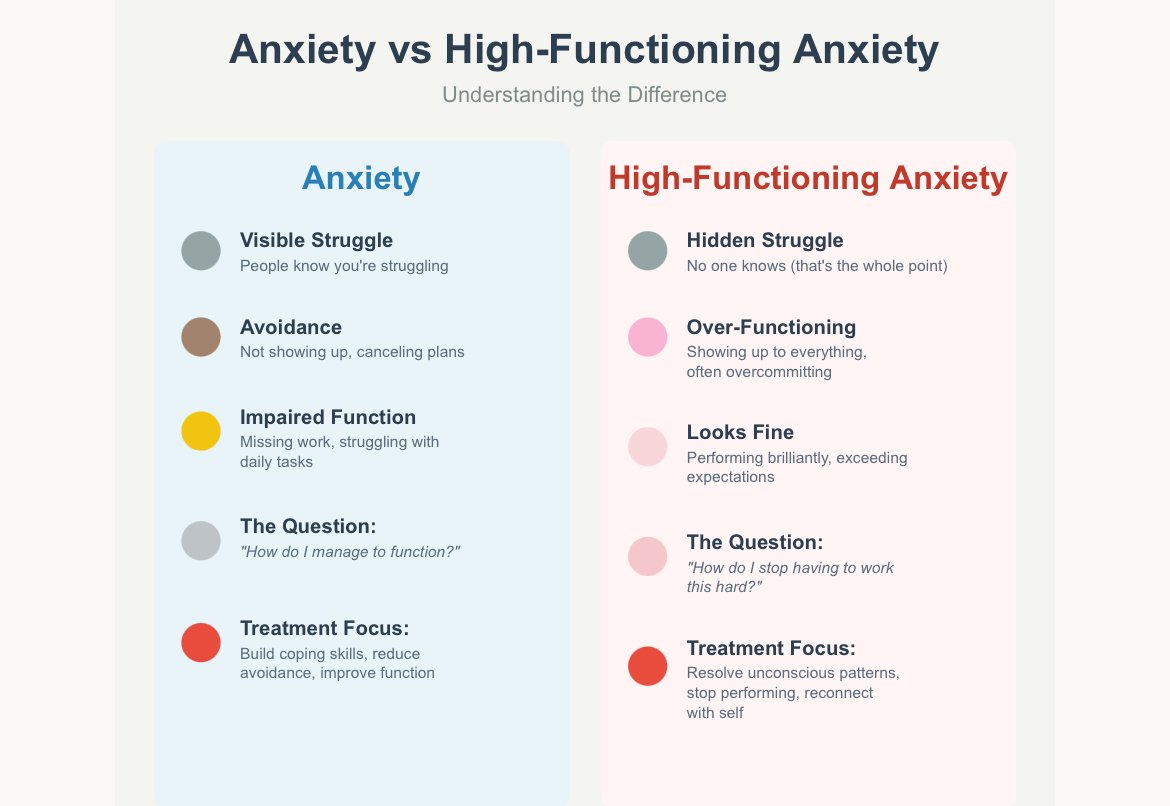
Someone asked me this last week and I had to pause.
Because honestly? It's a really fair question.
The answer is yes. High-functioning anxiety IS anxiety.
But also... no. It's not the same as what most people think of when they hear "anxiety."
Let me explain why this matters and why so many capable, intelligent people are struggling in silence because their anxiety doesn't "look" like anxiety.
The Picture We Have of Anxiety
When most people think "anxiety," they picture:
Panic attacks that stop you in your tracks
Avoiding situations, cancelling plans
Visible struggle that others can see
That's real, valid anxiety. No question.
But high-functioning anxiety? It looks completely different.
What High-Functioning Anxiety Actually Looks Like
From the outside, you look successful. Calm. Together. The person everyone describes as "so capable."
From the inside? Overthinking and racing thoughts that never stop. Constant anxiety and tension. Perfectionism. Exhausted from appearing “fine”.
Traditional anxiety often shows up as struggle with functioning.
High-functioning anxiety drives you to over-function at massive cost to yourself.
That's the key difference.
The Signs Everyone Misses
You might have high-functioning anxiety if:
You're always the "strong one" people lean on
Look capable on the outside but feel chaotic on the inside
Perfection isn't optional, it's how you prove you're okay
You look confident but replay interactions for hours afterward
Rest feels wrong, like you're being irresponsible
You're constantly preparing for disasters that haven't happened
Asking for help feels impossible
If you just thought "that's me," you're not alone.
Why Standard Anxiety Approaches Often Miss the Mark
Here's the frustrating part.
Standard anxiety assessments ask: "Are you avoiding things? Missing work? Having panic attacks?"
Your answers are all "no." So according to the screening, you're fine.
But you're not fine. You're just really good at hiding it.
And here's what most anxiety treatment offers: breathing techniques, thought challenging, stress management, mindfulness.
Those things help. But they don't resolve high-functioning anxiety.
Because you don't lack coping skills, you're already stuck in constant coping mode.
Adding more things to manage just gives you more to manage. It's like telling someone who's drowning to swim more efficiently.
You don't need to swim better. You need to get out of the water.
What's Really Happening
High-functioning anxiety isn't just anxiety you're "managing well."
It's a pattern that lives in your unconscious mind.
You learned early that:
Showing vulnerability wasn't safe
Your worth was tied to how well you functioned
Struggling wasn't acceptable
You had to perform calm even when feeling terrible
So you built a performing self to survive. And it worked, you became capable, successful, high-functioning. Now you're stuck in performance mode and can't get out
And somewhere along the way, you lost connection with who you actually are.
The anxiety is a signal. The gap between who you're performing as and who you actually are is exhausting and unsustainable.
A Different Approach
This is why I work the way I do.
Traditional therapy works at the conscious level; your thoughts, behaviours, coping strategies. That's helpful for understanding.
But high-functioning anxiety lives deeper in your emotional brain. These patterns are encoded in the limbic system and implicit memories formed when you first learned that struggling or showing vulnerability wasn't safe. Your emotional brain doesn't respond to logical reasoning or conscious effort. That's why you can understand your anxiety perfectly and still feel stuck.
Is This You?
If you can relate , you may be interested in support for high functioning anxiety.
You've Been The Capable One Long Enough
What if you could actually be okay, not just look okay.
Craving More Calm?
The Still Mind Toolkit for Instant Calm
Download a free toolkit with five simple techniques you can use immediately to restore a sense of calm when life feels overwhelming.
If any of this resonated, you don’t have to keep doing this alone.

Why Sensitive People Struggle with Anxiety (and How to Stop Fighting Yourself)

"I'm so sensitive. Is that why I'm this anxious?"
I hear this question all the time. Usually whispered, often with a mix of frustration and shame.
If you've ever cursed your sensitivity and wondered if you'd be less anxious if you could just toughen up , I want you to know that your sensitivity isn't the problem. But I understand why you think it is.
When Being Sensitive Feels Like a Curse
From the time you were young, you probably heard some version of:
"You're too sensitive"
"Don't be so emotional"
"You need thicker skin"
"Why do you take everything so personally?"
So you learned that your sensitivity was something to hide. Something to manage. Something to apologise for.
And if you're anything like the people I work with, you got really, really good at hiding it.
You became the capable one. The strong one. The person everyone could rely on. You learned to push through, to not make a fuss, to keep it together even when you were dying inside.
You built armour.
And for a while, it worked. You functioned. You achieved. You looked fine on the outside.
But inside? You were exhausted. Anxious. Running on empty.
Why Sensitive People Feel MORE
Being highly sensitive doesn’t mean you’re weak or dramatic. It means your nervous system is wired differently, like the volume is turned up on everything.
You process information more deeply. Where someone else might notice a conversation, you're picking up on tone, body language, what wasn't said, the tension in the room, the shift in someone's energy.
You feel emotions intensely - yours AND other people's. You don't just notice that your colleague is stressed. You feel it in your body. You absorb it. You carry it home with you.
You're more affected by your environment. Loud noises aren't just annoying , they're overwhelming. Bright lights drain you. Chaotic spaces make it hard to think. You need quiet to recover.
You notice subtleties others miss. The slight change in someone's voice. The thing that feels "off" but you can't quite name. The emotional undercurrent in a room.
Imagine walking through life with the sensitivity setting turned to maximum. Everything is louder, brighter, more intense. Every interaction requires more processing. Every emotion - yours and everyone else's - lands harder.
Now imagine trying to function in a world designed for people who DON'T experience life this way.
That's exhausting. And that exhaustion? It's fertile ground for anxiety.
The Real Problem: Suppression and Stress
It’s not your sensitivity alone that causes anxiety. It’s what happens when sensitivity collides with stress, trauma and the pressure to suppress what you feel.
Think of your sensitivity as a finely tuned smoke detector. It picks things up quickly; changes in tone, atmosphere, energy. That’s not faulty, that’s awareness.
But add in years of stress, painful life events, or unresolved trauma and suddenly that smoke detector is going off constantly. Layer on top the belief that you’re “too much” or need to hide your feelings and you end up with a nervous system that never truly switches off.
That’s the perfect recipe for anxiety.
There’s nothing wrong with you. It’s that your nervous system has been carrying both your natural sensitivity and the weight of everything you’ve been through, while also being told to keep quiet about it.
No wonder it feels overwhelming.
The High Functioning Trap
Many sensitive people often fall into what I call, the high-functioning trap:
On the outside, you look fine: capable, strong, reliable.
On the inside, you’re overwhelmed, exhausted, drowning.
Because somewhere along the way you learned that:
Showing feelings = too much
Having needs = difficult
Being affected = weak
So you became an expert at coping: saying yes when you wanted to say no, suppressing your emotions, appearing calm while your nervous system screamed.
The world rewards this. Promotions, praise, trust. But your nervous system pays the price.
No wonder you’re anxious.
What Actually Fuels the Anxiety
The anxiety doesn’t come from the fact that you feel things deeply. Feeling deeply is simply how your nervous system works.
Anxiety comes from what happens around that sensitivity, the layers you’ve carried on top of it. The stress, the difficult life events, the unresolved experiences that never really had space to be processed.
And then, on top of that, the strategies you learned to survive in a world that didn’t understand your sensitivity.
The anxiety doesn’t come from your sensitivity. It comes from:
Trying not to feel things deeply (suppression)
Taking on too much because you can’t say no (no boundaries)
Absorbing everyone else’s emotions without realising it (no protection)
Carrying unresolved stress, trauma, or painful life events (unprocessed experiences)
Never resting because rest feels “weak” (no recovery)
Comparing yourself to less sensitive people and feeling broken (shame)
Appearing fine while falling apart inside (the performance)
So it isn’t sensitivity that breaks you down. It’s sensitivity combined with life’s inevitable challenges and the years you’ve spent trying to manage those challenges by shutting yourself off from what you actually feel.
What Actually Helps
You don’t need to toughen up. You need to stop fighting your sensitivity.
Anxiety isn’t about feeling too much. It’s about being overloaded by unprocessed experiences and forced to hide what you feel.
When you stop waging war on your sensitivity and when you create a life that fits your nervous system instead of forcing yourself into one that doesn’t, things shift.
If you’ve spent years wishing you were different, I get it.
But your sensitivity isn’t a flaw. It’s simply how you’re wired.
The anxiety? That’s the byproduct of trying to live as someone you’re not. Of carrying stress and trauma while performing strength on the outside.
There’s another way.
It begins with ending the war against yourself. With allowing your sensitivity, not apologising for it.
You’ve been strong for so long. What if it’s time to be real instead?
Craving More Calm?
The Still Mind Toolkit for Instant Calm
Download a free toolkit with five simple techniques you can use immediately to restore a sense of calm when life feels overwhelming.
If any of this resonated, you don’t have to keep doing this alone.

The Art of Restoration: What Upholstery Taught Me About Therapy

Did I ever tell you how much I love traditional crafts like sewing and upholstery? Love might even be an understatement. I loved them so much that, in my spare time, I went to college just to learn how to do them properly. There's something about threading a needle, feeling fabric under your fingertips, coaxing it into place; it's meditative, grounding and really satisfying.
And then there was this chair.
A battered 1960s Parker Knoll I stumbled across on Facebook Marketplace, listed under "free to good home" with the kind of photos that made you wonder if anyone would actually want it. The fabric was faded beyond recognition, springs poking through like arthritic fingers, and one arm was more duct tape than upholstery. The seller's description was brutally honest: "Seen better days. Probably only good for parts."
But I could see past all that.
I could see the beautiful oak frame underneath. The solid construction that had weathered decades. The elegant lines that just needed restoring.
Looking Beyond the Surface
There’s something about working with your hands that teaches you to see potential where others see problems. When you are stripping back layers of old fabric, you’re not just removing material, you’re uncovering a story.
Sometimes you find surprises. Newspaper stuffing from 1962. A child’s lost toy wedged in the springs. Evidence of repairs done with love, even if they weren’t quite professional. Each layer tells you something about the life this piece has lived.
And it’s not so different from what happens in therapy.
The Assessment
When someone sits in my therapy room for the first time, they often arrive a bit like that Parker Knoll chair. Worn down. Carrying the weight of years. Maybe held together by coping mechanisms that worked once but aren’t quite fit for purpose anymore.
"I'm probably beyond help," they'll say. Or "I don't even know where to start."
But I'm looking at the structure underneath. The resilience that got them through everything that brought them here. The strength that's still there, even if it's buried under layers of anxiety, trauma or old beliefs that stopped serving them years ago.
Just like with furniture restoration, the first step isn't diving in with tools blazing. It's assessment.
What are we working with here? What's solid? What needs support? What can be saved and what needs to be completely rebuilt?
Stripping Back the Layers
In upholstery, you work backwards. Carefully removing each layer, photographing as you go so you remember how it all fits together. You're not destroying, you're revealing.
Therapy works the same way.
We don't bulldoze through someone's coping mechanisms or dismiss the patterns that have kept them functioning. Even if those patterns are causing problems now, they were probably brilliant solutions at some point.
That hypervigilance? It kept you safe when safety wasn't guaranteed.
That people pleasing? It secured attachment when love felt conditional.
That perfectionism? It protected you from criticism when criticism felt dangerous.
These aren't character flaws to be ashamed of. They're evidence of a mind that learned to adapt, to survive, to find ways through. But just like old upholstery, sometimes what protected us in the past starts to restrict us in the present.
The Delicate Work
Here's what they don't tell you about furniture restoration, you can't rush the process. Try to rip off old fabric too quickly and you might damage the frame underneath. Skip steps and the whole thing falls apart.
Each layer has to be respected, understood and gently removed.
Some days you make visible progress. Other days you're dealing with stubborn staples that just won't budge or discovering damage that's worse than you initially thought. And some days, honestly, you wonder if you should have just bought a new chair from IKEA instead.
Therapy has the same rhythm.
Carrie and the Stubborn Staples
Carrie came to see me after years of what she called "failed therapy attempts." She'd tried talking therapies, counselling, self-help books; all the standard approaches.
"I must be one of those people who can't be fixed," she told me. "I understand my problems. I know where they come from. But nothing changes."
She was like a chair where previous restorers had used industrial strength staples instead of the gentle tacking that belonged there. All that force, all that trying to make change happen through will and logic alone, had actually made the original fabric harder to remove.
We had to work differently. More gently.
Using IEMT and Hypnotherapy, we weren't trying to rip out old patterns. We were carefully, softly helping her nervous system release what it had been holding onto for decades. The change didn't look dramatic from the outside. But inside? She was finally free to become who she'd always been underneath all those protective layers.
The Hidden Structure
One of my favourite moments in any restoration project is when you finally see the frame clearly. No padding, no fabric, no distractions. Just the essential structure that's been supporting everything else.
And almost always, it's more beautiful than you expected.
That solid oak. Those elegant joints. The craftsmanship that's lasted decades precisely because it was built to endure.
In therapy, we have these moments too.
When someone stops apologising for taking up space and you see their natural confidence. When the anxiety lifts and their curiosity emerges. When they stop trying to be who they think they should be and remember who they actually are.
That essential self was always there. It just got covered up along the way.
The Rebuilding
When you're rebuilding a piece, you don't just copy what was there before. You use better materials. More supportive padding. Fabric that's suited to how the piece will actually be used.
Not restored to what it was. Restored to what it was always capable of being.
The Finishing Touches
The final stage of any restoration is the most satisfying.
Choosing fabric that honours the original design while making it work for modern life. Standing back and seeing not just a restored piece of furniture, but something that's ready for the next chapter of its life.
In therapy, this looks like someone walking into a social situation without rehearsing their exit strategy. Applying for the job they actually want. Setting a boundary without three days of emotional preparation.
Living like someone who knows they belong here.
Both Are Acts of Faith
Whether it's a chair or a person, restoration is fundamentally an act of faith.
Faith that what looks broken can be beautiful again. Faith that with the right tools, enough patience and genuine care, almost anything can be brought back to life.
Nobody looks at a beautiful oak frame and calls it broken. They know it needs the right hands.
Craving More Calm?
The Still Mind Toolkit for Instant Calm
Download a free toolkit with five simple techniques you can use immediately to restore a sense of calm when life feels overwhelming.
If any of this resonated, you don’t have to keep doing this alone.

Why People with ADHD Are Actually Perfect for Hypnotherapy

"But I can't even sit still for five minutes - how could I possibly be hypnotised?"
I hear this from almost every ADHD client who walks through my door. They've been told their whole lives that they're "too distractible," "too restless," or "too all-over-the-place" for anything that requires focus or stillness.
Here's what might surprise you: People with ADHD are actually some of the best candidates for hypnotherapy.
I know it sounds counterintuitive but I've witnessed this truth play out in my therapy room countless times. Let me share why your ADHD brain might be exactly what makes hypnotherapy so powerful for you.
The Beautiful ADHD Brain: Built for Deep States
Remember the last time you got completely absorbed in something you loved? Maybe you were researching a new interest and suddenly realized three hours had passed without you noticing. Or you were so engrossed in a conversation that the world around you seemed to disappear.
That's hyperfocus and it's actually a form of natural trance state.
People with ADHD are naturally prone to slipping into these deep, imaginative states. Your brain already knows how to do this. We're just learning to direct it intentionally.
What Your ADHD Brain Does During Hypnosis
Recent brain imaging research has shown us exactly what happens when someone with ADHD enters hypnosis:
Enhanced connectivity between brain regions that control attention
Increased activation in areas responsible for emotional regulation
Strengthened networks that support cognitive control
In simpler terms? Hypnosis helps your ADHD brain do what it's been trying to do all along - focus, regulate and feel in control.
"But I've Tried Everything..."
I get it. By the time clients find me, they've often tried medication, traditional therapy, mindfulness apps, organizational systems, and countless self-help strategies. Some worked for a while, others didn't work at all.
Here's what makes hypnotherapy different for ADHD:
It Works With YOUR Brain
Traditional approaches often try to force your ADHD brain into neurotypical boxes. Hypnotherapy embraces how your mind naturally works - through imagination, storytelling and those deep dive states you already experience.
It Targets the Root, Not Just Symptoms
While other treatments might help you manage ADHD symptoms, hypnotherapy actually rewires the underlying patterns by updating your brain's automatic responses.
Beyond Focus: The Emotional Game-Changer
Here's what the research doesn't fully capture but I see every day: hypnotherapy doesn't just help with ADHD symptoms like focus and attention. It transforms the emotional experience of having ADHD.
Many of my ADHD clients carry decades of shame, frustration, and feeling "not good enough." These emotional patterns often drive the symptoms more than the ADHD itself.
During hypnotherapy, we can access and gently update these deep-seated beliefs:
"I'm lazy and unmotivated" becomes "I work differently and that's my strength"
"I always mess things up" becomes "I'm learning and growing"
"Something's wrong with me" becomes "My brain is unique and valuable"
The Science That Changes Everything
The research backing hypnotherapy for ADHD is becoming impossible to ignore. Recent neuroscience shows us that the same brain networks involved in hypnosis are the ones that regulate attention and emotion - exactly what ADHD affects.
But perhaps most compelling is the Hiltunen study (2014) - the first controlled trial specifically comparing hypnotherapy to CBT for ADHD. What they found challenges everything we thought we knew about ADHD treatment:
While both treatments helped initially, only hypnotherapy created lasting change. Six months after treatment ended, the hypnotherapy group maintained significantly better outcomes in psychological wellbeing, anxiety, depression, and ADHD symptoms compared to those who received CBT.
This isn't just statistical noise - this is your brain showing us the pathway to sustainable healing. When we work with these networks through hypnotherapy, we're not just managing ADHD - we're creating the neurological foundation for long-term wellbeing.
Your ADHD Brain
If you're reading this and thinking "this sounds too good to be true," I understand. You've probably been disappointed before. But here's what I want you to know:
Your ADHD brain isn't a problem to be fixed. It's a different operating system that needs the right approach to thrive.
Those traits that have caused you struggle, your vivid imagination, your ability to hyperfocus, your sensitivity to your environment, these same traits make you an ideal candidate for hypnotherapy.
Taking the Next Step
If you're curious whether hypnotherapy might be right for your ADHD, here are some signs it could be a perfect fit:
You can get lost for hours in activities you enjoy
You have a vivid imagination
You've tried traditional approaches but still feel stuck
You're tired of just "managing" your ADHD and want to actually transform your experience
You're open to working WITH your brain rather than against it
Ready to Discover What Your ADHD Brain Can Really Do?
Your ADHD brain has been preparing for hypnotherapy your whole life - through every daydream, every deep dive into special interests, every moment you've gotten beautifully lost in something you love.
What if instead of seeing these as distractions, we saw them as your superpower?
What if your "scattered" attention is actually incredibly flexible and adaptable?
What if your ADHD brain isn't the problem - but the solution you've been looking for?
Craving More Calm?
The Still Mind Toolkit for Instant Calm
Download a free toolkit with five simple techniques you can use immediately to restore a sense of calm when life feels overwhelming.
If any of this resonated, you don’t have to keep doing this alone.

The Science of Rapid Therapeutic Change: Why Your Brain Can Transform Faster Than You've Been Told

What if the right approach could help you make meaningful change in weeks rather than years?
Rethinking the Timeline of Change
For decades, we've been told that real psychological change takes years. That healing is slow. That you need to "process" everything inch by painful inch, session after session, month after month.
But here's what I learned during my training in Psychology and Neurological Rehabilitation: your brain is designed to change rapidly.
Think about it. If you touched a hot cooker, would your brain take months to learn "don't touch hot things"? Of course not. You'd learn instantly, completely and the lesson would stick forever.
So why do we accept that emotional healing must be different?
How Your Brain Actually Changes
Every experience you have creates neural pathways. When something traumatic or significant happens, your brain doesn't file it away like a document. Instead, it creates a whole network of connections: sensory memories, emotional responses, physical reactions and behavioural patterns.
Your brain is remarkably adaptable. It can form new neural pathways relatively quickly and under the right conditions, update automatic responses faster than traditional therapy timelines suggest.
The question isn't whether change can be rapid, but whether we're using approaches that allow for it.
How These Approaches Work Differently
While traditional talking therapies certainly have their place, approaches like Hypnotherapy and IEMT work more directly with the brain's natural processing systems:
Integral Eye Movement Therapy Your eyes aren’t just cameras recording the world, they’re active participants in how you access and process memory. Notice how your eyes naturally move to certain positions when you recall emotional experiences. IEMT works with these natural movement patterns, helping the brain access and update stuck emotional material.
Hypnotherapy bypasses conscious resistance by accessing the subconscious where emotional patterns live. Clinical studies demonstrate its effectiveness for anxiety, pain relief, phobias and habit change.
Identity level work addresses the deeper almost invisible, beliefs we hold about ourselves, which often drive our emotional responses and behaviours.
This is why these approaches can often create meaningful shifts more quickly, as they access the brain's subconscious processing systems rather than working primarily through conscious analysis.
Why Some Changes Happen Faster
Here's what I've observed in my practice, certain types of issues seem to respond particularly well to these approaches:
Trauma responses tied to particular memories
Negative beliefs that feel "stuck" despite logical understanding
Habit patterns that feel automatic and hard to control
Specific phobias
A Different Kind of Therapeutic Approach
When clients come to see me, they're often surprised by what doesn't happen. We don't spend months talking about your childhood (though we might address specific memories if needed). We don't slowly build up to change over many sessions.
Instead, we work directly with the neurological patterns that are creating your experience. We use techniques that help your brain process information in new ways. We create conditions where lasting change becomes not just possible, but natural.
Meet Andrew, a client of mine that struggled with stress blinking for 40 years and we resolved it one session using Integral Eye Movement Therapy (see Google review for more details)
Your brain's particular wiring, your specific experiences, your readiness for change and the nature of what you're dealing with all influence how quickly shifts can happen.
This doesn't mean therapy becomes easy, breakthrough work is still work. But it does mean you don't have to carry the burden of believing that healing must take forever.
Your Brain Is Already Ready
The most beautiful part of this work is realizing that your brain isn't defective.
Your brain created the patterns that are causing you difficulty to protect you. And the same incredible capacity that created those patterns can create new ones that serve the person you're becoming rather than the person you used to need to be.
The same is true for you.
Moving Forward
If you've been told that real change takes years, I invite you to question that belief. Not because I'm promising magic but because neuroscience suggests something far more hopeful: your brain is designed to adapt, heal, and transform more quickly than you've been led to believe.
The question isn't whether you can change rapidly. The question is whether you're ready to try approaches that work with your brain's natural capacity for transformation rather than against it.
Your brain has been ready for rapid change all along.
Craving More Calm?
The Still Mind Toolkit for Instant Calm
Download a free toolkit with five simple techniques you can use immediately to restore a sense of calm when life feels overwhelming.
If any of this resonated, you don’t have to keep doing this alone.

Integral Eye Movement Therapy vs Traditional Therapy: Why Eye Movements Work When Talking Doesn’t

If you’ve ever sat in a therapy session feeling frustrated because you know exactly what your problems are but still can’t seem to resolve them, you’re not alone. Maybe you’ve spent months or even years discussing your childhood, analysing your patterns and developing coping strategies, yet that knot in your stomach still appears when certain situations arise. That familiar anxiety still washes over you, despite all your hard work and insight.
Here’s what many people don’t realise: it’s not that you’re not trying hard enough, and it’s certainly not that therapy “doesn’t work.” It’s that traditional talk therapy, while incredibly valuable, sometimes can’t reach the deeper places where our emotional wounds live.
Think of it like trying to convince your heart to stop racing during a panic attack by having a logical conversation with it. Your heart simply doesn’t speak the language of logic.
The Hidden World of Non Verbal Trauma
Imagine your brain as having two different operating systems.
The first is your thinking brain - articulate, rational, and great at forming insights. This is the part that engages beautifully with traditional therapy.
But running underneath is your feeling brain- more like an ancient, instinctive alarm system: fast, emotional and non-verbal. It doesn’t think in words or reason through situations. Instead, it reacts instantly to perceived danger based on past emotional experiences, aiming to protect you before your thinking brain even has time to catch up.
When something traumatic happens, whether it’s a single overwhelming event or years of subtle emotional wounds, your feeling brain creates a kind of emotional imprint. These imprints don’t respond well to reasoning or analysis because they weren’t created through thinking in the first place. They’re stored as sensations, images and instant emotional reactions that can hijack your entire system before your thinking brain even knows what’s happening.
This is why you might find yourself having the same emotional reactions over and over, despite understanding them intellectually. Your thinking brain gets it, but your feeling brain is still operating from old programming.
Anxiety gets encoded at a pre-verbal, emotional level. It’s not a thought process, it’s a protective reflex that bypasses your thinking mind entirely.
IEMT: Speaking the Language of Emotions
Integral Eye Movement Therapy works differently because it communicates directly with the feeling brain. Instead of trying to think your way through trauma, IEMT uses the natural connection between your eyes and your emotional processing system to reach those old imprints at their source.
You might wonder, “How can moving my eyes possibly help with emotional pain?”
Your eyes aren’t just cameras recording the world, they’re active participants in how you access and process memory. Notice how your eyes naturally move to certain positions when you recall emotional experiences. IEMT works with these natural movement patterns, helping the brain access and update stuck emotional material.
Rather than focusing on the memory itself, IEMT targets the kinaesthetic imprint - the emotional response encoded in the brain’s emotional system and reflected throughout the nervous system.
The Science That Makes It Work
When you engage in guided eye movements while holding a particular memory; you create optimal conditions for your brain to do what it already knows how to do,process and integrate difficult experiences.
These structured eye movements can support neurological pattern interruption, reduce overactivation of emotional responses and help the brain register that an old threat is no longer present.
IEMT helps your brain and nervous system register safety, allowing it to release emotional charges that no longer serve you. In other words, your system shifts out of protection mode and finally lets go.
Think of it as giving your brain’s natural healing systems a gentle, focused nudge in the right direction.
Why Insight Alone Isn’t Always Enough
To be clear, traditional therapy isn’t wrong or ineffective. For many, it provides essential insights, coping strategies and a safe space to be heard and understood.
But if you’ve ever felt like you’re doing all the “right” therapeutic work and still feel stuck, it’s likely because you’re trying to solve anemotionalproblem with cognitivetools.
It’s like trying to fix a broken bone by talking to it. You can have all the insight in the world about how the break happened, but actual healing requires intervention at the level where the injury exists.
The Relief of Rapid Resolution
One of the most striking things about IEMT is how quickly it can produce change. While traditional therapy often measures progress in months or years, IEMT can create significant shifts in just a few sessions, often even in one.
This isn’t because it’s a “quick fix”, it’s because it works at the level where the emotional problem actually lives.
When your emotional system finally gets the message that an old threat is no longer relevant, the shift can feel immediate and profound. Clients often describe it as a weight being lifted or tension switching off. The memory doesn’t disappear; it just loses its emotional charge and becomes something the brain can finally file away.
The Beautiful Partnership: Integration and Wholeness
The most exciting developments intrauma treatmentshow us that we don’t have to choose between approaches. We can integrate them.
IEMT excels at clearing emotional blocks and calming the nervous system, creating space for the insight and self-reflection that traditional therapy offers to take root and flourish.
When your feeling brain isn’t constantly hijacking you into survival mode, you can explore your patterns with curiosity instead of fear. You’re not working against your system anymore; you’re working with it.
A New Chapter in Healing
Rather than trying to override your emotional system with logic or willpower, we’re learning how to work with your brain’s built-in mechanisms for healing and integration.
If you’ve been feeling stuck despite your best efforts in therapy, please know that it doesn’t mean you’re broken. It might just mean that your emotional system needs a different kind of attention. One that speaks the language of safety and emotion.
Your brain already knows how to heal. Sometimes it just needs the right conditions and the right kind of support.
IEMT offers one powerful way to create those conditions by opening doors to healing that words alone cannot reach.
Because sometimes, the breakthrough you’ve been seeking really is just a few eye movements away.
Craving More Calm?
The Still Mind Toolkit for Instant Calm
Download a free toolkit with five simple techniques you can use immediately to restore a sense of calm when life feels overwhelming.
If any of this resonated, you don’t have to keep doing this alone.

When Chronic Anxiety Feels Normal (And Why It Doesn’t Have to)

"I thought that was normal."
I hear this phrase often, usually spoken with a half-smile or nervous laugh, just after someone has described what it’s like inside their world.
The constant feeling of waiting for the other shoe to drop.
Replaying conversations, scanning for mistakes or hidden meanings.
The worry about how others see them and whether they’ve said or done the “wrong” thing.
The second-guessing of even the smallest choices, what to eat for dinner, which route to take, whether that message sounded okay.
The way it feels impossible to fully exhale and just be.
And then, with genuine surprise, they’ll say:
“I thought everyone lived like this.”
It can be such a powerful moment. Almost like living underwater and believing that’s how the world works, until you find out there’s air above the surface.
The Fish Doesn't Know It's Wet
Here's what interesting about chronic anxiety: it's invisible to the person living with it. When your baseline is hypervigilance, hypervigilance feels normal. When your nervous system has been in overdrive since childhood, overdrive feels like... Tuesday.
I had another client who, after her second IEMT session, called me almost panicked: "Something's wrong. I'm not thinking about anything."
"What do you mean?" I asked.
"I'm just... sitting here. My mind isn't racing. I'm not worrying or replaying conversations. Is this... is this how other people feel?" she asked genuinely curious.
She'd lived forty three years believing that mental chaos was the human condition.
It can feel unsettling, seeing how much of your energy has been spent just keeping things together. And yet, that same realisation can be freeing, because suddenly you can begin to imagine living differently.
The Underwater Life
Imagine you’ve been underwater your entire conscious life. You’ve developed incredible skills down there; you’re efficient, you can hold your breath for ages, you’ve learned to navigate in low visibility and you’re always alert for danger.
From down below, you can see the surface, it shimmers above you. But you assume everyone lives in the depths, just like you. The pressure in your chest? Normal. The muffled, distant feeling of the world around you? That’s just how life sounds.
Then one day, for reasons you can’t quite explain, your head breaks the surface.
And suddenly, you realise: you’ve been holding your breath for far too long.
How Adaptive Anxiety Develops
Early Learning: Your nervous system is incredibly smart, it learns what keeps you safe. If you grew up in an environment where:
Conflict felt dangerous (parents arguing, walking on eggshells)
Love felt conditional (only got attention when you were "good")
Unpredictability was the norm (chaotic household, inconsistent caregivers)
Your emotions weren't welcome (told to stop crying, be strong)
Your brain develops anxiety as a survival strategy. It starts scanning constantly for signs of danger, rejection, or abandonment. This hypervigilance actually worked - it helped you navigate those early challenges.
How It Gets Sustained
The Reinforcement Loop:
Anxiety warns you of potential social threats
You adapt your behaviour (people-please, avoid conflict, over-prepare)
Bad thing doesn't happen (because you prevented it through anxiety-driven behaviour)
Brain thinks: "See! The anxiety worked! Keep doing this!"
Example: You spend ages crafting the perfect text so you don't sound rude → Person responds positively → Your brain credits the anxiety/over-thinking for the good outcome → Pattern reinforced
Neuroplasticity Factor: The neural pathways for hypervigilance get stronger with use (like a path through grass that becomes a motorway). Your brain becomes efficient at anxiety - it can spot potential problems from miles away.
Why It Feels Like Personality
After decades, these responses become automatic and unconscious:
You don't choose to scan rooms for threats - it just happens
People-pleasing feels natural, not effortful
The mental rehearsing happens without you deciding to do it
The chest tightness becomes background noise
Your identity forms around these adaptive strategies:
"I'm just very detail oriented" (I catastrophise every possible outcome)
"I'm naturally empathetic" (I absorb everyone's emotions as my responsibility)
"I'm a planner" (I can't exist without controlling every variable)
"I care about people" (I shape shift to avoid any hint of conflict)
You just think you're naturally cautious. Naturally considerate. A natural worrier.
Your nervous system learned to hold its breath, metaphorically speaking, to keep you safe. The problem is, it never learned when to exhale.
The Breakthrough
This is exactly why IEMT is so effective for this type of deep rooted anxiety. We're not just treating symptoms; we’re updating your nervous system's threat assessment.
It's like showing your brain new information: "The danger you're protecting against isn't here anymore. The strategies that kept you safe when you were seven don't need to run your life when you're thirty seven."
The Before and After That No One Talks About
What's remarkable isn't just what changes, it's what stays the same. People worry they'll become lazy or careless or somehow "less than" if they're not constantly vigilant.
Instead, they discover they can be thoughtful without being obsessive. They can be responsible without being rigid. They can care about outcomes without being paralysed by them.
One client put it beautifully: "I'm still me, just... at a manageable volume."
What Awaits Above the Surface
If any of this feels familiar and if you’ve started to wonder whether your “normal” might just be your nervous system stuck in survival mode, here’s something important to know:
There’s air up here.
There’s a version of you who doesn’t spend every moment preparing for what could go wrong. A you who can make mistakes without it feeling like the end of the world. A you who can walk into a room and simply be, without performing. A you who can have needs without apology, who doesn’t have to keep proving your right to exist.
You don’t have to become someone new. You only have to reconnect with the parts of you that already know how to breathe.
Craving More Calm?
The Still Mind Toolkit for Instant Calm
Download a free toolkit with five simple techniques you can use immediately to restore a sense of calm when life feels overwhelming.
If any of this resonated, you don’t have to keep doing this alone.
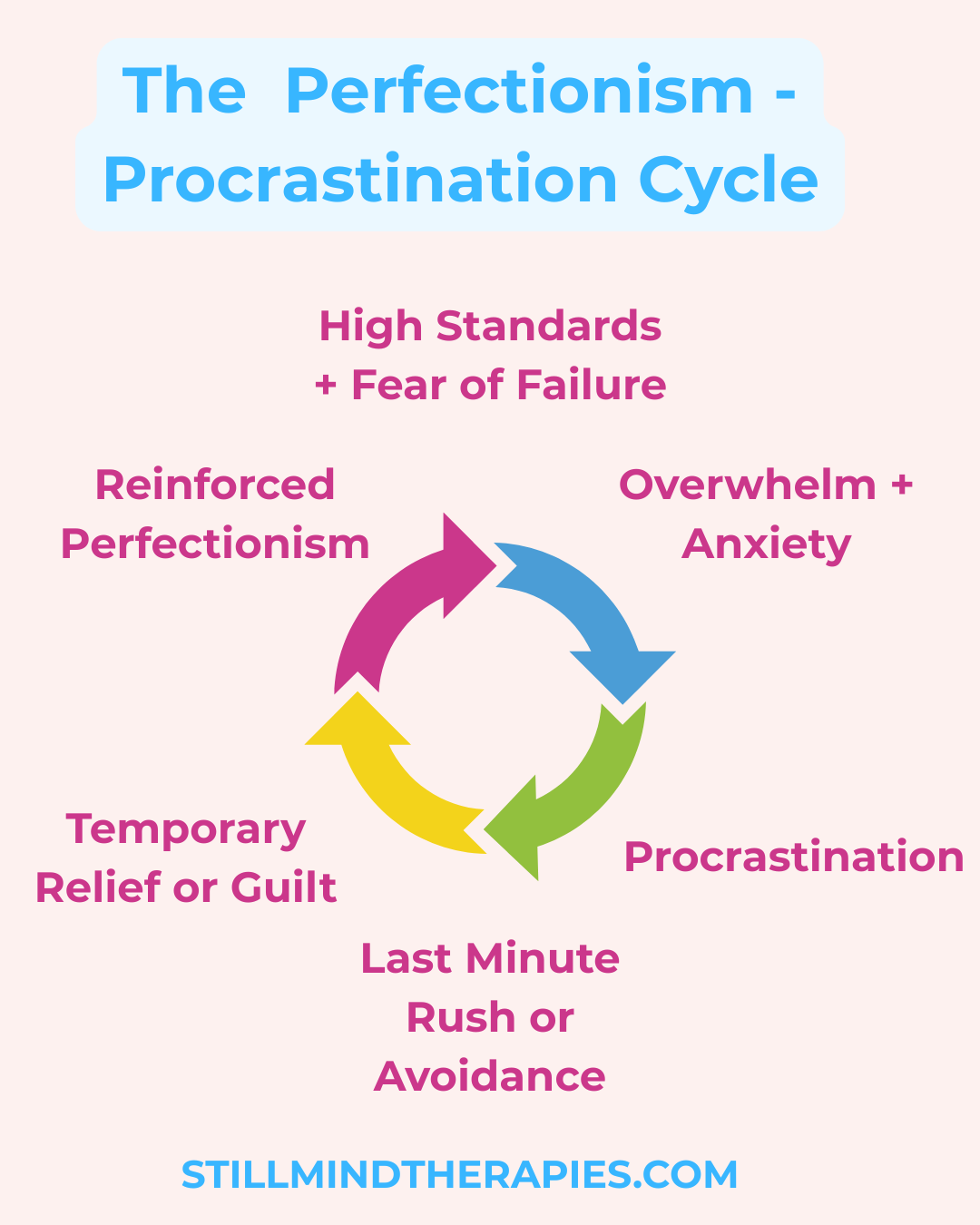
The Perfectionism-Procrastination Cycle (And How To Break It)

You know that feeling when you're staring at a blank screen; frozen, overwhelmed and quietly panicking because whatever you're about to create needs to be brilliant? So instead… you open Instagram. Or deep clean your kitchen. Or convince yourself you need just a bit more research before you start.
Hours pass. The project remains untouched. The deadline gets closer. The anxiety builds. And you're left wondering: "Why do I keep doing this to myself?"
This, my friend, is the perfectionism-procrastination loop. And if you're caught in it, you're definitely not alone.
The Truth About Perfectionism
Perfectionism gets mistaken for ambition. High standards. Drive. But it's rarely about wanting things to be excellent. It's usually about needing to feel safe.
Where It All Begins
For many, this pattern began in childhood. Maybe you grew up in a home where standards were high and tongues were sharp. Maybe praise was rare, but criticism came easily. You learned early that love was earned, not given. That approval came with conditions.
So your brilliant, adaptive brain came up with a strategy: Be perfect. Stay accepted. Don't give them a reason to find fault. Stay small, or stay impressive, just don't be vulnerable.
And slowly but surely, that strategy didn't just shape how you behaved, it shaped who you believed you had to be.
When Perfectionism Becomes Your Identity
Over time, perfectionism stops being "something I do" and becomes "who I am." You might not say these things out loud, but you probably feel them in your bones:
"I'm the one who gets it right."
"If I don't do it perfectly, I've failed."
"My worth is measured by what I produce."
"If I make a mistake, I'll lose people's respect."
"I have to control every detail, or it will all fall apart."
"If I'm not achieving, I'm falling behind."
These are identity level beliefs. They're not just passing thoughts. They're survival strategies stored in your nervous system. They formed through experience and repetition and they don't shift just because you now know better.
The Perfectionism - Procrastination Cycle
Perfectionism and procrastination aren't opposites, they are dance partners. The loop looks like this:
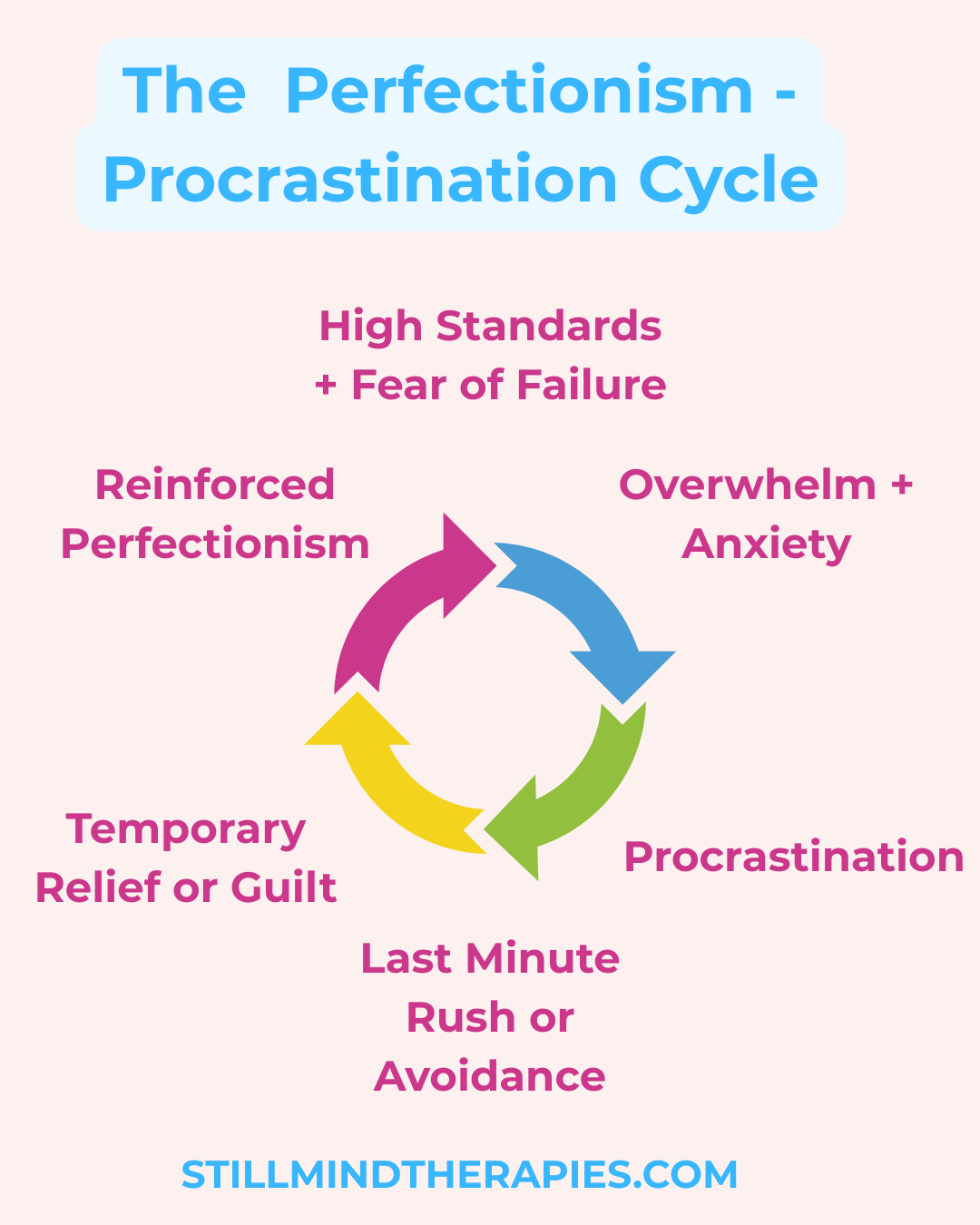
Here's how the perfectionism-procrastination cycle actually plays out:
High Standards + Fear of Failure: You set unrealistic expectations and fear making mistakes
Overwhelm + Anxiety: The pressure feels too intense, leading to stress and avoidance
Procrastination: You delay starting because it feels too big or risky
Last Minute Rush or Avoidance: You either scramble to finish under pressure or avoid it completely
Temporary Relief or Guilt: If you finish, you feel exhausted. If you don't, you feel guilty
Reinforced Perfectionism: The cycle repeats as you vow to "do better" next time, raising standards even more
This cycle is exhausting because your brain never learns that "good enough" is actually... good enough.
The Hidden Costs
This loop doesn't just steal your productivity. It steals your peace. Your creativity. Your sense of self. It leads to chronic anxiety , constantly scanning for flaws, always on edge. Emotional burnout, your inner critic never sleeps. Stalled creativity, fear squeezes out spontaneity. Strained relationships, either from holding others to impossible standards or hiding your own struggles. And perhaps most painful of all: a lost identity. When your worth is wrapped around your output, rest feels like failure, and softness feels dangerous.
Why Logic Isn't Enough
You can't think your way out of this because this isn't a mindset problem , it's a pattern stored in your nervous system.
You might know that it's okay to make mistakes. But if your body still believes that imperfection = danger, your nervous system won't let you relax. That's why affirmations or pep talks only go so far. This isn't about logic. It's about safety.
A Different Way Forward
To really shift, you need to work at the level where the pattern lives. And that's where modalities like IEMT (Integral Eye Movement Therapy) and Hypnotherapy can be transformational.
How IEMT Works
With IEMT, we work directly with the emotional memory system, the part of your brain that stores the felt sense of those sharp words, the disappointed looks, the times you were shamed for not being "better." It helps to safely reduce the emotional charge around those memories, so your body no longer reacts as if you're still in danger. The old survival strategies lose their grip. You begin to feel something new: Maybe it's okay to get this wrong. Maybe I don't have to prove anything anymore.
How Hypnotherapy Helps
Hypnotherapy helps access the subconscious beliefs driving the pattern, the onesthat tell you you're only valuable when you're performing, achieving, or keeping it all together. In a relaxed, receptive state, we can gently rewrite those beliefs. We don't just tell you "you are enough." We help your system feel it, integrate it, live from it.
You begin to shed the identities that never really belonged to you: The one who always has it together. The one who doesn't make mistakes. The one who's only lovable when they're impressive.
And you start to embody new ones: I'm allowed to be human. My worth isn't up for debate. I can create from a place of freedom, not fear.
A Gentle Step Forward
If any of this resonates, here's a gentle reflection to try. Next time you notice yourself procrastinating, ask: "What am I afraid it would mean about me if this isn't perfect?" Then pause. Listen. Be curious, not critical. What you find there isn't proof that something's wrong with you, it's a clue. A doorway. A map toward healing.
What Freedom Looks Like
Freedom from perfectionism doesn't mean you stop caring. It means you stop cracking under the weight of caring too much. It looks like starting before you feel fully ready. Allowing room for imperfection. Trusting that who you are is enough, even when the outcome isn't polished or impressive.
The Journey Forward
If you've been living inside this loop for years, it makes sense that letting go of it might feel scary.
Perfectionism isn't your personality. It's a protection strategy you no longer need.
With the right support, you can unlearn the pressure. You can soften the inner critic. You can remember what it's like to simply be, not perform.
Because you don't need to be flawless to move forward. You just need to feel safe enough to begin.
Craving More Calm?
The Still Mind Toolkit for Instant Calm
Download a free toolkit with five simple techniques you can use immediately to restore a sense of calm when life feels overwhelming.
If any of this resonated, you don’t have to keep doing this alone.

When Being the 'Perfect Child' Becomes Your Prison: Understanding Golden Child Syndrome

Do you remember being the child who could do no wrong? The one everyone praised, the straightA student, the responsible one who never caused trouble? Perhaps you were told how lucky your parents were to have such a "good child," or maybe people would say, "I wish my child was more like you."
If this sounds familiar, you might be nodding along with a heavy feeling in your chest. Because while being the golden child might sound like a privilege, it often comes with a hidden cost that can follow you well into adulthood.
What Is Golden Child Syndrome?
Golden child syndrome is a widely recognised pattern in family dynamics where a child is consistently elevated above their siblings or peers, often becoming the family's source of pride and achievement. While not a formal clinical diagnosis, this dynamic is well-documented in family systems therapy and psychology research.
On the surface, this might seem positive. After all, who wouldn't want to be praised and celebrated?
But here's what happens beneath the surface: when love and approval become conditional on performance, the child learns that their worth is directly tied to meeting others' expectations. They can develop "approval addiction" which a deep, often unconscious belief that they must be perfect to be loved.
The golden child learns to suppress parts of themselves that might disappoint others. They become hypervigilant about others' needs and emotions, often at the expense of their own. They may struggle to identify what they actually want or need because they've spent so long focusing on what others want from them.
The Hidden Struggles of the Golden Child
Many people who were golden children describe feeling like they're living behind a mask. They've become so skilled at being what others need them to be that they've lost touch with who they really are.
This experience is incredibly common. You might recognize feeling completely burned out despite external success or having the sense that everyone thinks you have it all together while you feel like you're drowning inside. Perhaps you don't even know what you want anymore because you've spent so long doing what you thought you should do.
This is incredibly common. Golden children often experience:
Imposter syndrome — feeling like a fraud despite their achievements, always waiting to be "found out"
Perfectionism— setting impossibly high standards and feeling devastated by even minor mistakes
People-pleasing — struggling to say no or set boundaries because disappointing others feels unbearable
Identity confusion — not knowing who they are beyond their achievements and others' expectations
Relationship difficulties — either becoming controlling (trying to maintain the "perfect" image) or attracting partners who need "fixing"
Anxiety and depression — the constant pressure to maintain their elevated status becomes exhausting
The Identity Crisis
Perhaps the most devastating impact of golden child syndrome is what happens to your sense of identity. When your worth becomes so deeply intertwined with performance and others' approval, you can lose touch with who you actually are beneath all those expectations.
Many golden children develop what psychologists call a "false self" - a carefully constructed identity built around being what others need them to be. Meanwhile, their "true self" - their authentic thoughts, feelings, desires, and quirks - gets buried deeper and deeper.
This creates a profound identity confusion that can persist well into adulthood. You might find yourself asking:
Who would I be if I wasn't constantly achieving?
What do I actually enjoy, versus what I think I should enjoy?
What are my real values, separate from what I was taught to value?
How do I even access my own feelings when I've spent so long managing everyone else's?
What do I even want?
You might realise you don't even know what kind of music you like, or what activities bring you genuine joy, because you've been so busy being the person everyone expected you to be that you never stopped to ask yourself what you actually enjoyed.
This identity crisis often intensifies during major life transitions; career changes, relationships ending, children leaving home, when the external structures that defined you are no longer there to lean on.
Transforming Your Identity at the Core
This is where identity level work becomes crucial. Surface level changes like learning to say no or setting boundaries are important, but they often don't stick if we haven't addressed the deeper identity beliefs that drive our behaviour.
At the identity level, golden children often carry beliefs like:
"I am only valuable when I'm achieving"
"I am responsible for everyone else's emotions"
"I must be perfect to be loved"
"My needs don't matter"
"I am not allowed to disappoint others"
These aren't just thoughts, they become part of how you see yourself at the deepest level. They shape not just what you do, but who you believe you are.
True healing happens when we can identify these outdated identity beliefs and gently replace them with more empowering truths:
"I am inherently valuable, regardless of what I achieve"
"I am allowed to be imperfect and still be loved"
"My authentic self is worthy of love and acceptance"
"I can honour both my needs and others' needs"
"I belong, just as I am"
This identity transformation work goes beyond changing behaviours, it's about fundamentally shifting how you see yourself and your place in the world.
Why This Happens
Golden child syndrome often develops in families where parents, often unconsciously, use one child to meet their own emotional needs. Maybe the parent was struggling with their own self-worth and needed the child's success to feel good about themselves. Perhaps there was instability in the family, and the golden child became the source of stability and pride.
It's important to understand that parents who create golden children aren't necessarily malicious. They often believe they're being loving and supportive. But when praise becomes the primary way a child receives attention and affection, it creates a blueprint in their brain: "I am only valuable when I'm achieving, pleasing or being perfect."
The Ripple Effects in Adulthood
The patterns established in childhood don't just disappear when we grow up. Many golden children find themselves:
Taking on too much responsibility at work and in relationships
Struggling with decision making because they're so used to doing what others expect
Feeling guilty or selfish when they prioritise their own needs
Experiencing relationship conflicts because they either become controlling or attract people who take advantage of their giving nature
Feeling empty despite external success because achievements feel hollow
You might have the life everyone thinks they want, but it doesn't feel like your life. It can feel like you're playing a character that everyone loves, but you don't know who you are underneath.
The Path to Authentic Self
The good news is that it's absolutely possible to heal from golden child syndrome. The patterns that feel so automatic and ingrained can be changed when we work directly with how the brain stores and processes these emotional experiences.
Recovery often involves:
Recognising the pattern: Understanding how being the golden child shaped your beliefs about yourself and relationships. This isn't about blaming your parents, but about gaining awareness of how these dynamics affected you.
Identifying your authentic self: Learning to distinguish between what you genuinely want and what you think you should want. This often involves reconnecting with parts of yourself that you learned to suppress.
Healing the underlying beliefs: Addressing deep seated beliefs like "I'm only lovable when I'm perfect" or "My needs don't matter." These beliefs often operate below conscious awareness but drive much of our behaviour.
Learning to set boundaries: Developing the ability to say no, disappoint others, and prioritise your own needs without overwhelming guilt.
Rebuilding your identity:This is perhaps the most profound part of the healing journey. It involves questioning everything you thought you knew about yourself and slowly, gently, discovering who you really are beneath all those expectations. This might mean exploring interests you dismissed as "impractical," honouring emotions you learned to suppress, or simply giving yourself permission to not know who you are yet and being okay with that uncertainty.
Your Worth Isn't Conditional
If you recognise yourself in this description, I want you to know that your worth was never conditional on your achievements, your ability to please others, or your capacity to be perfect. You were worthy of love and belonging simply because you existed.
The child who learned to dim parts of themselves to maintain approval was doing the best they could with the tools they had. But as an adult, you have choices. You can learn to love and accept all parts of yourself, not just the achieving, pleasing parts.
Recovery from golden child syndrome isn't about becoming less successful or caring less about others. It's about learning to succeed and care from a place of authenticity rather than compulsion. It's about building a life that feels genuinely yours, not just one that looks good from the outside.
The mask you've been wearing so well served its purpose, it kept you safe and loved in the only way you knew how. But now you have the opportunity to gently remove it and discover the incredible person who's been underneath all along.
Craving More Calm?
The Still Mind Toolkit for Instant Calm
Download a free toolkit with five simple techniques you can use immediately to restore a sense of calm when life feels overwhelming.
If any of this resonated, you don’t have to keep doing this alone.