

Understanding the OCD Cycle
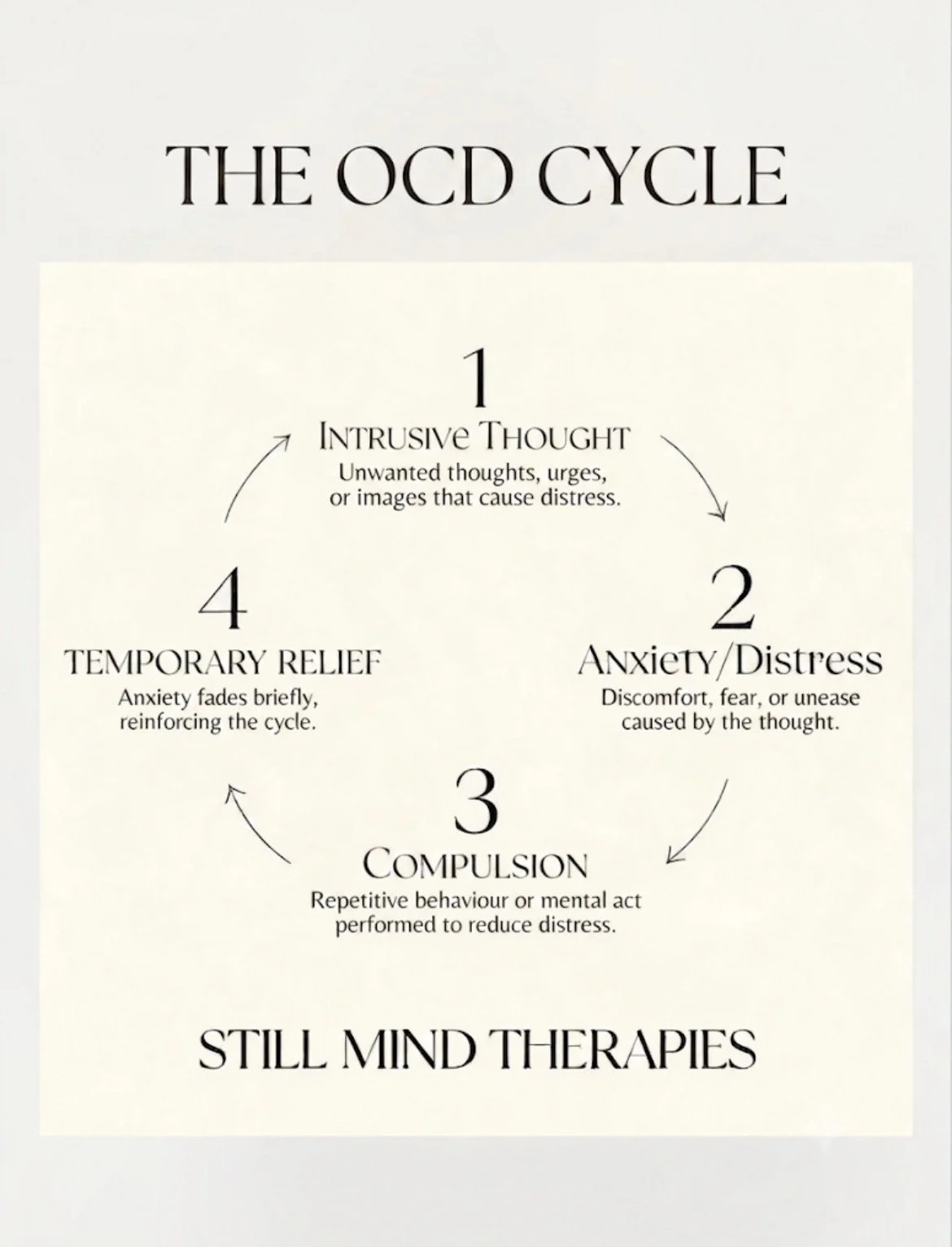
A thought arrives and it won't leave.
Maybe it's physical. That trolley, that door handle, that hand I just shook. What if it makes me ill?
Maybe it's quieter and entirely in your head. What if I meant that? What if I'm not who I think I am? What if I'm a bad person?
Most people would let a thought like that drift past. But if you live with OCD, it doesn't drift. It sticks.
Your anxiety climbs. Your mind starts hunting for certainty. So you do something to make it stop. You wash. You check. You replay it. You search, again, for reassurance.
The anxiety settles. You feel better.
For a little while.
Then the doubt returns. And the whole thing starts again.
If you live with OCD, you don't need me to describe this. You've lived it a thousand times. What you might not have been told is why it's so hard to stop, and why stopping has almost nothing to do with the thoughts themselves.
It's a loop and your brain is learning it
Think of OCD as a learning loop.
A thought appears. The thought triggers anxiety and uncertainty. To reduce the anxiety, you do something. A check. A wash. A search for reassurance. The anxiety drops and that drop feels like relief.
Here's the trap.
Your brain makes a connection. It decides the ritual was what kept you safe, even when there was never any real danger. So the next time a similar thought turns up, the urge to perform the ritual is stronger. And the time after that, stronger still.
Without realising it, you've been teaching your brain to fear the thought. Every ritual is another rep.
The content barely matters. Contamination, your health, your relationship, harming someone, intrusive sexual thoughts, whether you locked the door. The fear changes. The loop stays the same.
One pattern, many disguises
Take contamination as an example, because it's easy to picture.
You touch a shopping trolley. What if someone ill touched this? Your anxiety rises. You wash your hands and it settles. Your brain files it away: washing kept me safe. Next time, the anxiety comes faster and the urge to wash is stronger, even though there was never any real danger.
Now swap the trolley for a thought about whether you love your partner. Or whether you're a good person. Or whether you left the hob on. The trigger changes and the ritual changes, but the machinery is identical. Anxiety, ritual, relief, reinforcement.
Same loop. Different disguise.
It was never about the thought
The thoughts aren't the problem. Everyone has strange, random, unwanted thoughts. They drift in, they drift out, and most people barely notice. The difference with OCD is that your brain snags on them. The thought suddenly feels important. Dangerous. Urgent. Something you have to solve right now.
It's not the thought that keeps you stuck. It's the emotional response to it.
Compulsions you can't see
When people hear "compulsion", they picture hand washing or checking the door. Sometimes that's exactly it.
But a lot of OCD happens silently, inside your head.
Replaying a conversation to check you didn't say the wrong thing. Reviewing a memory for evidence. Analysing what a thought means about you. Reassuring yourself, again, that you're a good person.
Nobody sees these. But they work the same way. A moment of relief, and another lesson to your brain that the thought was dangerous.
If your OCD lives almost entirely in your head, this is where it hides. And it counts. It's every bit as real as the visible kind.
What you're actually fighting
One of the biggest shifts I see in therapy is the moment someone realises they're not fighting the thoughts at all.
They're fighting uncertainty.
OCD makes a promise. Check one more time, think it through a little longer, find one more piece of reassurance and then you'll feel certain. So you do. And the certainty never comes. It can't, because every ritual teaches your brain that not knowing is unbearable.
When people see this clearly, something changes. They stop blaming themselves. They realise they're not broken or obsessive or untrustworthy. They're caught in a pattern.
And patterns can be changed.
How I work
Most people I see already understand their OCD. They know the fear doesn't quite add up. And yet their body reacts as though the danger is real. That's the heart of it. Insight isn't enough, because the emotional response has become automatic.
The approach with the strongest evidence behind it is ERP, exposure and response prevention. You gradually face what triggers the anxiety, and you don’t perform the ritual. No washing. No checking. No silent replaying. The anxiety climbs. Then, because you haven’t fed it, it falls on its own. And your brain learns the lesson the compulsion kept blocking. The danger wasn’t real. You could sit with not knowing after all. It’s hard work, which is why so much of what I do is aimed at making it possible, turning down the fear enough that you can actually face it.
So that's what I work with directly. The fear attached to the thought, rather than the thought itself. Hypnotherapy helps turn down the intensity of that automatic anxiety, so there's room to respond differently. IEMT works with the emotional charge sitting under old memories and triggers, the imprints that keep your nervous system braced for danger that isn't there. As that charge softens, the thoughts tend to lose their grip.
And we work at the level of identity, because OCD has a way of rewriting how you see yourself. I'm obsessive. I'm an anxious person. I can't trust myself anymore. Over time it stops feeling like something you're going through and starts feeling like who you are.
It isn't. It's something you're experiencing. And that distinction is where change begins.
Where it starts
When you understand the cycle, you stop seeing OCD as the truth about who you are and start seeing it for what it is. A pattern. The thoughts may still turn up. They just don't get to run the show.
That understanding is where the loop begins to loosen. And it's where the work begins.
If any of this feels familiar, you don't have to work it out alone. I offer a free, no pressure conversation where we can talk through what you're experiencing and whether we'd be a good fit to work together. Get in touch whenever you're ready.