Why Consultants Are Recommending Hypnotherapy for IBS
A client contacted me recently after her gastroenterologist recommended hypnotherapy. She’d been through every test, had the all-clear on anything structural and was still living with symptoms that were running her life. Her consultant didn’t suggest it as a last resort. He told her it was genuinely one of the better evidenced options available to her.
She’s not alone in that, and her consultant isn’t alone in recommending it either. More and more, gastroenterologists are referring patients for hypnotherapy, not as a last resort, but because the evidence behind it is genuinely strong. So I wanted to explain why.
Before you leave the house, you've already worked out where the toilets are.
Not because you're paranoid. Because you've learned the hard way. So now it's automatic and the mental map runs in the background everywhere you go, whether you want it to or not.
You've turned down restaurant invitations you wanted to say yes to because you couldn't face explaining, again, why you might need to leave suddenly. Sometimes it's easier to just say you're busy.
Other times you go anyway and you eat half of what you actually want because you don't trust your gut to behave if you eat the whole thing.
Or you're in a meeting, doing a kind of internal triage. Is that cramping or is that nothing? Can I get through the next hour? Where's the nearest bathroom?
You check in with your stomach constantly. Automatically. It’s exhausting.
And here's the cruel bit, the more you brace for it, the more likely it is to happen. You feel a flicker of something in your gut, your brain immediately goes on alert, your body responds to that alert as if it's a genuine threat, and suddenly the very thing you were trying to avoid is happening. You weren't imagining it. You were anticipating it into existence. This is a real, recognised pattern and it's exactly why consultants and gastroenterologists are increasingly recommending hypnotherapy.
What's Actually Happening In Your Body
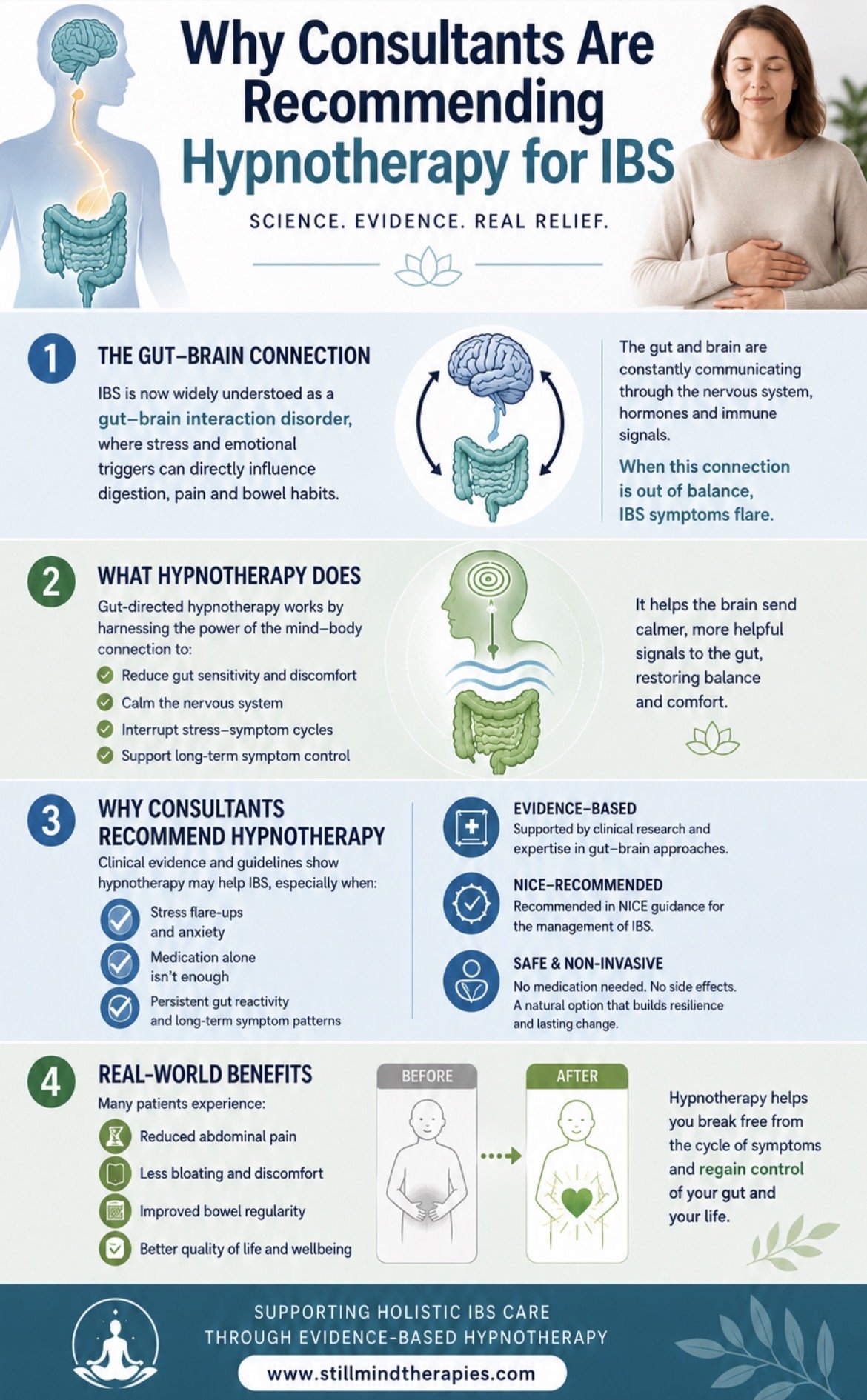
IBS is now understood as a disorder of gut-brain interaction. The gut isn't structurally broken, the communication between gut and brain has become dysregulated.
Your gut has its own extensive nervous system, sometimes called the second brain and in IBS this system becomes hypersensitive. Normal digestive sensations get amplified. Your brain interprets them as threats, which triggers the stress response, which makes the gut more reactive. That's the loop.
But here's the part that explains the constant checking, the planning around toilets, the quiet dread before you've even left the house — anticipatory anxiety. Once your nervous system has been caught out enough times, it stops waiting for symptoms to start. It starts predicting them. Scanning for them. Trying to get ahead of them.
That hypervigilance feels like protection. It feels like you're managing the risk. But it's actually maintaining the cycle because a nervous system that's constantly scanning for threat is a nervous system that stays in a heightened, reactive state, which keeps the gut sensitive, which gives you more to scan for. You end up fighting a fire you're also quietly feeding.
This is why treating the gut alone often doesn't give lasting relief if the nervous system underneath is still living in a state of threat.
Why Consultants Are Recommending Hypnotherapy
Hypnotherapy is being recommended because it works directly on this gut-brain pathway and specifically on the anxiety that keeps the whole cycle running.
In a gut-directed hypnotherapy session, the mind becomes calm and focused, which makes it possible to introduce suggestions that help the gut feel smoother, less reactive, less like something to be feared. Just as importantly, the work addresses the hypervigilance itself, gradually teaching your nervous system that it doesn't need to scan, predict, and brace the way it has been. That checking-in becomes less automatic. The background hum quietens.
The Research
The first controlled trial, published by Whorwell, Prior and Faragher in The Lancet in 1984, found dramatic improvement in patients with severe IBS who hadn't responded to anything else, improvement that held up at follow-up, with no relapses recorded. This work led to the development of the Manchester Protocol, now one of the most widely studied psychological approaches to IBS in the world. A later audit of over a thousand patients treated using this approach, published in Frontline Gastroenterology in 2020, reported a response rate of 76%, with benefits maintained long term. More recent research from the same group, published in 2024, found that people carrying both physical and psychological symptoms, including anxiety, were among those most likely to benefit. Which makes sense. If anxiety is driving the cycle, addressing it directly gets results.
Because this work treats the gut symptoms and the anxiety driving them at the same time, the results tend to be more durable than approaches that treat mind and body as separate problems.
What This Means For You
If you've been through every investigation, had the all-clear on anything structural, and are still living with IBS that isn't fully responding to diet changes or medication; especially if anticipation, checking, or anxiety are part of your picture , you're exactly who this work is for.
What actually shifts is the anxiety. The constant scanning quietens. You stop running the toilet-location check before you've even decided to go somewhere. A flicker of sensation in your gut stops being an automatic five-alarm event. It can just be a flicker, and pass, the way it does for everyone else. Your nervous system learns it doesn't need to stay on guard, so it stops sending the signals that kept the cycle going.
That's not the same as never having a bad day. It's your baseline changing, from braced to settled. And when that baseline changes, everything built on top of it changes too.
These are the changes people report after hypnotherapy sessions.
You order what you actually want, not what feels "safest." You say yes to the dinner, the trip, the last-minute plan, without running a risk assessment first. You sit in the meeting, the cinema, the long car journey, and realise twenty minutes have gone by without a single thought about your gut. You go back to the things IBS quietly took from you; the job, the gym, the sport, the hobby, the spontaneity, because your body finally feels like something you can trust again, not something you have to manage.
This is the part people don't expect: it's not just about the gut. It's about getting yourself back. The version of you who isn't constantly negotiating with your own body just to get through the day.
Book your free consultation and let's explore whether gut-directed hypnotherapy could be the missing piece for your IBS.